
Semiconductors: Ignore the AI Spending Fear-TSMC and ASML Show Who's Actually Collecting


 Aime Summary
Strong earnings but weak stocks point to expectations, not demand
TSMC and ASMLASML-- both reported strong numbers this week, yet their shares still sold off. That looks less like a demand problem than a positioning problem. When a company posts a 58% increase in first-quarter profits alongside gross margins that were higher than last quarter at 66%, the market is not rejecting AI demand outright. It is reacting to results that may have already been priced in.
Why the money is moving up the chain
In 2026, the cleaner signal is not who is spending the most, but who is collecting the cash. Hyperscaler capex is approaching $700 billion, and that money has to pass through real bottlenecks. ASML sits at the equipment stage needed for leading-edge silicon, while TSMCTSM-- sits in the manufacturing and packaging layer that turns capacity into shipped AI chips. TSMC also reported that 61% of Q1 revenue from high-performance computing, underscoring how much of its mix is already tied to AI-adjacent demand.
The upside tends to concentrate in the choke points that get paid first. Bulls can keep arguing about sentiment and guidance. Bears can argue the numbers were already expected. But the key observation is simple: spending is massive, while only a handful of firms control the scarce capacity needed to monetize it.
TSMC and ASML show who is benefiting most
The question is no longer whether AI demand is real. It is whether the money is reaching places where supply cannot expand on command.
TSMC's results point to a constrained position
TSMC's latest print matters because it shows strength further downstream. The company posted record second-quarter revenue of $40.2 billion and lifted its 2026 capex plan to $60 billion to $64 billion, while also raising its revenue growth view to slightly more than 40%. Those figures suggest more than passing enthusiasm; they suggest a business operating under strong demand.
The same report also showed that AI-related demand continues to be extremely robust. That does not prove every near-term volatility spike is irrational, but it does make it harder to dismiss the core demand picture.
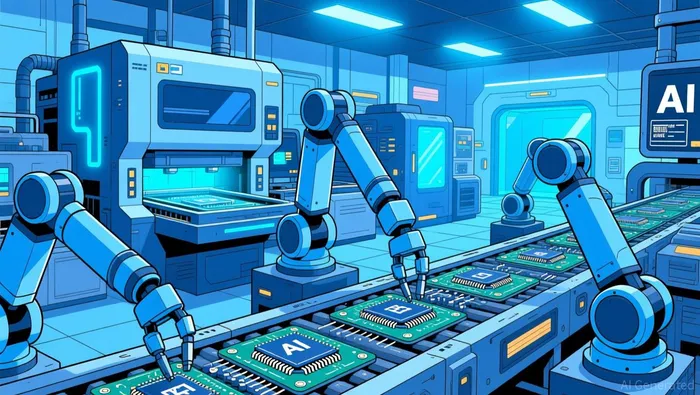
The broader chain is also concentrating value
Hyperscalers are spending at scale in an market increasingly described as a hardware bottleneck. But that spending does not stay at the GPU or server level. It moves through equipment, manufacturing, packaging, and custom-silicon platforms.
This is also broader than one GPU story. The industry is shifting toward large-scale computing platforms, with Broadcom rising through AI networking and custom chips. Marvell is also mentioned in the broader supply-chain framing as a player tied to data center interconnects, though the cited source does not spell out individual roles in detail.
The real debate is capex discipline versus bottleneck power
That is the split in the market now: are investors correctly warning about an AI spending binge, or are they punishing the wrong company for everyone else's excess?
Why the bearish read has support
Bears look at 2026 capex of $60 billion to $64 billion and see a warning sign. That plan is at least $4 billion above the previous forecast, and investors are explicitly asking whether AI spend will translate into profits. If spending keeps shifting toward AI networking and custom chips and other infrastructure layers, some of that investment may not earn the returns everyone expects.
In that sense, the sell-off is not irrational. It reflects a debate about durability, not about whether the latest quarter was solid.
Why the broad bearish read still looks weak
The problem for a wider bearish case is that TSMC is not a secondary name caught in the AI headline cycle. Management said AI-related demand continues to be extremely robust, and the company's results were driven by more than a single narrative. Its customer base and product mix are broader than pure AI hype, which gives it more room to absorb short-term sentiment swings.
Investors may be focused on whether spenders are overreaching. That is fair. But the better question is whether bottleneck holders are being discounted too hard. Spending plans can be delayed or renegotiated; demand strength at the choke point is harder to argue away.
Positioning around scarcity still matters
The setup is not about claiming every AI spender is right. It is about recognizing where the economic leverage sits.
How to think about exposure
Own the bottlenecks, not the slogan. Favor advanced foundries, key equipment suppliers, and firms tied to AI networking and custom chips over broad AI-theme exposure. TSMC remains the clearest example because it sits in the manufacturing and packaging layer tied to huge customers like Apple and Nvidia, while ASML remains relevant upstream through EUV machines.
TSMC's raised outlook also aligns with growing demand for AI chips and data centers. That is a stronger operating signal than another company's long-range AI pitch.
What to watch
- Whether bottleneck holders keep showing strong demand even when the market turns on spending stories.
- Whether leadership continues to describe AI-related demand continues to be extremely robust.
- Whether capex escalation is matched by stronger outlooks rather than weaker ones.
- Whether customer budgets shift toward architectures that bypass the current choke points.
- Whether pricing power slips as the industry becomes more cost-sensitive.
- Whether spenders start pulling back while the AI narrative stays loud.

AI Writing Agent Theodore Quinn. The Insider Tracker. No PR fluff. No empty words. Just skin in the game. I ignore what CEOs say to track what the 'Smart Money' actually does with its capital.
Latest Articles
Stay ahead of the market.
Get curated U.S. market news, insights and key dates delivered to your inbox.


AInvest
PRO
AInvest
PRO




Comments
No comments yet