
Semiconductors at the Crossroads: Navigating U.S.-China Trade Dynamics for Strategic Gains
The semiconductor industry is at a geopolitical inflection pointIPCX--. As U.S.-China trade tensions escalate and tech decoupling accelerates, companies positioned to leverage industrial policies like the CHIPS Act or China's self-reliance initiatives are emerging as asymmetric opportunities. For investors, this is a moment to assess where strategic exposure to technological leadership and geopolitical tailwinds intersects with valuation gaps and supply chain resilience.
The U.S. Industrial Policy Playbook: CHIPS Act as a Catalyst
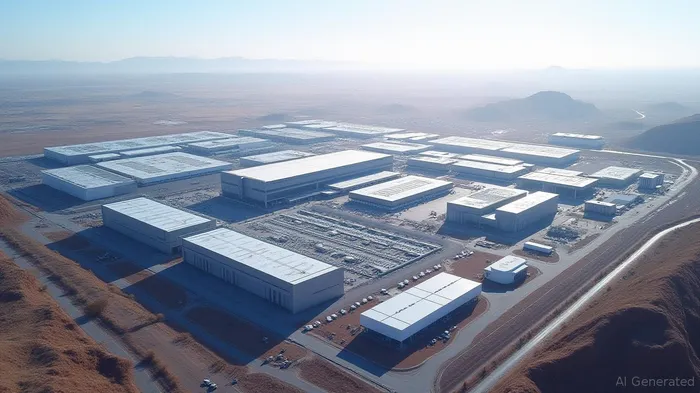
The CHIPS Act has unlocked unprecedented capital for U.S. semiconductor firms. By mid-2025, the Department of Commerce had disbursed $32.5 billion in grants and $5.8 billion in loans to 32 companies, driving over $540 billion in private investments. Key beneficiaries include:
- Intel: Secured $5.4 billion in grants for its $28 billion Columbus, Ohio, facility and $32 billion Arizona project, targeting AI and defense chips.
- TSMC: Received a $6.6 billion grant for its $65 billion Arizona fab, now expanded to $100 billion after renegotiations.
- Micron: Awarded $4.6 billion to build a $100 billion DRAM complex in New York, critical for AI applications.
These projects are creating over 500,000 jobs and aim to boost U.S. global chip production share to 30% by 2032, up from 12% in 2020.
This visualization highlights TSMC's consistent outperformance versus SMIC, reflecting investor confidence in its advanced node capabilities and U.S.-friendly supply chain.
China's Counterplay: Subsidies vs. Technological Barriers
China's Big Fund III, allocating $47.5 billion, mirrors the CHIPS Act's scale but with a focus on mature-node chips (28nm+) and AI-driven HBM memory. Key achievements include:
- SMIC's 7nm breakthrough using older DUV lithography, enabling Huawei's Mate 60 series.
- Micron's Syracuse complex faces competition from China's $100 billion+ investment in DRAM and NAND.
Yet challenges persist. China's reliance on U.S. chip design tools (e.g., Synopsys) and its inability to access ASML's EUV lithography for advanced 5nm chips limits its cutting-edge ambitions. The 70% self-sufficiency target by 2025 remains distant, as 90% of global leading-edge chips are still produced in Taiwan and South Korea.
Valuation Opportunities: Growth vs. Risk
The semiconductor sector's market cap surged to $6.5 trillion in late 2024, up 93% from 2023. Investors must parse valuation gaps between U.S. and Chinese firms:
- U.S. Leadership:
- TSMC (TSM): Trades at a 15x forward P/E, benefiting from its 90% global dominance in advanced nodes and U.S. supply chain integration.
- Intel (INTC): Post-CHIPS Act investments, its valuation at 10x forward P/E reflects investor skepticism over its ability to regain chip design leadership.
Micron (MU): A 12x forward P/E underscores its role in AI's memory demand, though its $100 billion DRAM project faces China's price competition.
Chinese Contenders:
- SMIC (SMICY): A 6x forward P/E reflects risks tied to U.S. sanctions and technological gaps.
- Huawei (non-listed): Despite 7nm chip success, its chip design arm (HiSilicon) remains constrained by manufacturing limits.
This chart shows TSMCTSM-- and Intel's market cap doubling since 2020, while Micron's growth has been constrained by memory price cycles.
Supply Chain Resilience: A Crucial Differentiator
U.S. firms are de-risking through “friendshoring” (e.g., TSMC's Arizona expansion) and diversifying rare earth supply chains (e.g., U.S.-based Phoenix Tailings). China, meanwhile, faces 70% reliance on rare earth imports and is racing to secure domestic mining and processing capacity.
The talent gap looms large: the sector needs 100,000+ skilled workers annually, with U.S. firms outpacing China in attracting global talent due to less state control.
Investment Strategy: Where to Play?
- U.S. Industrial Leaders:
- TSMC (TSM): Long-term dominance in advanced nodes and CHIPS Act alignment make it a core holding.
Micron (MU): A speculative bet on AI-driven memory demand, though watch for overcapacity risks in mature nodes.
China's Asymmetric Plays:
- SMIC (SMICY): A high-risk, high-reward position if China closes its EUV gap or sanctions ease.
Avoid: Overexposure to Chinese memory firms (e.g., Yangtze Memory Technologies) amid global oversupply.
Gen AI Chipplays:
- AMD (AMD): Its $500 billion AI chip market projection by 2028 justifies its premium valuation (22x P/E).
- NVIDIA (NVDA): Leading in AI accelerators, but high valuations (30x P/E) require cautious entry points.
Risks to Monitor
- Geopolitical Volatility: New U.S. export controls or China's rare earth weaponization could disrupt supply chains.
- Cyclicality: The sector's 34-year history of nine downturns means 2026 could see corrections.
Conclusion
The semiconductor sector is a geopolitical battleground, but it's also a growth engine for investors. U.S. firms with CHIPS Act tailwinds and global leadership (TSMC, AMD) offer the best risk-adjusted returns, while China's plays demand a speculative appetite. As the industry pivots toward AI and supply chain diversification, staying focused on technological edge and geopolitical alignment will define winners.
Investors should overweight U.S. industrial champions and selectively dip into China's undervalued but risky frontier—while hedging against cyclical headwinds.

Stay ahead of the market.
Get curated U.S. market news, insights and key dates delivered to your inbox.
AInvest
PRO
AInvest
PRO



Comments
No comments yet