
Semiconductors in the Crossfire: How U.S.-China Tensions Are Fueling a Manufacturing Revolution
The escalating U.S.-China trade war has reshaped global supply chains, but beneath the headlines lies a seismic shift in strategic priorities: self-sufficiency. As trade tensions and technological decoupling intensify, companies and nations are racing to insulate critical industries from geopolitical volatility. Nowhere is this clearer than in the semiconductor sector, where the CHIPS Act has positioned U.S. manufacturers to seize control of their destiny. Meanwhile, the Home Depot-GMS acquisition offers a masterclass in how vertical integration and supply chain resilience can turn trade friction into opportunity. Investors who heed this trend will find themselves on the right side of a structural realignment.
The CHIPS Act: A Blueprint for Semiconductor Sovereignty
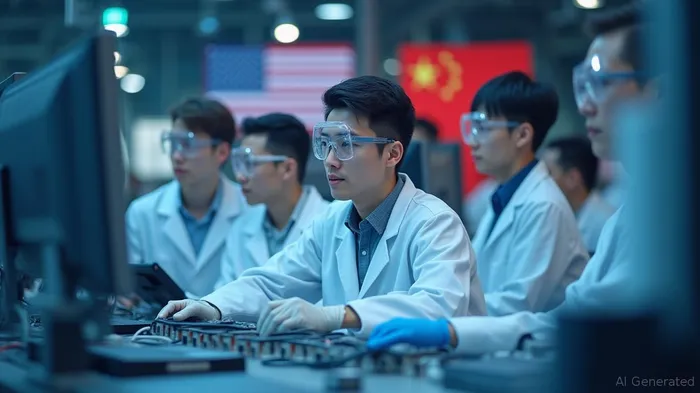
The CHIPS and Science Act of 2022 is not just a subsidy program—it's a national strategy to reclaim dominance in semiconductors, a $600 billion industry that underpins everything from smartphones to missile guidance systems. By allocating $52.7 billion in grants, tax credits, and loans, the Act incentivizes U.S. firms to build domestic fabrication plants (fabs), invest in cutting-edge R&D, and secure access to critical minerals like gallium and germanium, which China currently dominates.
Why it matters:
- Supply Chain Resilience: U.S. reliance on Taiwan and South Korea for 92% of advanced chips creates a chokepoint. The CHIPS Act aims to reduce this dependency by tripling U.S. manufacturing capacity by 2030.
- Technological Arms Race: China's $150 billion state-backed push to rival U.S. chipmakers is countered by the CHIPS Act's focus on R&D in AI, quantum computing, and 3nm node fabrication.
- Geopolitical Insurance: Export controls and the Act's “China exclusion clause” (banning subsidized firms from expanding in China for a decade) ensure U.S. facilities won't fund Beijing's tech ambitions.
The Home Depot-GMS Playbook: A Mirror for Semiconductor Strategy
When Home DepotHD-- acquired GMSGMS-- for $5.5 billion, it wasn't just buying distribution centers—it was vertically integrating its supply chain. By securing control over drywall, steel framing, and tool rentals, Home Depot insulated itself from China's tariffs and logistical disruptions. This move mirrors the CHIPS Act's goals: domestic control over critical inputs.
Investors should see this as a template:
1. Vertical Integration: Companies that own or partner with suppliers of critical components (e.g., semiconductor fabs, rare earth mineral miners) gain pricing power and avoid shortages.
2. Friend-Shoring: Relying on allies like Mexico, Canada, and Taiwan for supply chains reduces exposure to China's export bans (as seen with gallium in 2023).
3. Cost Efficiency: The CHIPS Act's tax credits (e.g., 25% for equipment costs) and state-level incentives (e.g., Ohio's $2B for Intel) offset the higher upfront costs of U.S. manufacturing.
The parallels are stark:
| CHIPS Act | Home Depot-GMS |
|---------------|--------------------|
| $52.7B to build U.S. fabs | $5.5B to control construction materials |
| Secures access to critical minerals | Secures access to critical building supplies |
| Mitigates China's tech dominance | Mitigates China's trade dominance |
Investment Implications: Where to Stake Your Chips
The semiconductor sector is now a high-beta play on U.S. industrial policy. Here's how to capitalize:
1. Direct Beneficiaries of CHIPS Act Funds
- Intel (INTC): Received $8.5B in grants for Ohio and Arizona fabs. Its “Secure Enclave” program targets national security chips, a high-margin niche.
- TSMC (TSM): Secured $6.6B for a Texas 2nm fab. Despite higher U.S. labor costs, its scale and R&D prowess make it a long-term winner.
- GlobalFoundries (GFS): Leveraged $1.5B for New York/Vermont fabs. Its focus on legacy nodes (critical for defense) offers steady demand.
2. Equipment & Materials Suppliers
- ASML (ASML): Sells the EUV lithography machines essential for advanced chips. U.S. export controls mean its tech is irreplaceable.
- Lam Research (LRCX): Chip equipment maker with 70% of its sales tied to U.S. customers. CHIPS Act subsidies will boost demand.
3. Mineral and Infrastructure Plays
- Freeport-McMoRan (FCX): Supplies copper, a semiconductor essential. Its U.S. mines reduce reliance on China's midstream processing.
- Clean Energy Metals (TSX: CLE): Invests in nickel and lithium for EV batteries—a complementary sector to semiconductors.
4. The Home Depot Model: Vertical Integration in Other Sectors
- Lowe's (LOW): Could follow Home Depot's lead by acquiring distributors or tool manufacturers.
- Caterpillar (CAT): Already integrates mining equipment and infrastructure projects—watch for moves into rare earth extraction.
Risks and Realities
- Execution Delays: TSMC's Arizona fab faces labor shortages, and U.S. construction costs are 4x Taiwan's. Monitor project timelines.
- Trade Retaliation: China may escalate tariffs or restrict mineral exports further.
- Overcapacity: A rush of fabs could lead to oversupply post-2030. Focus on firms with diversified revenue streams.
Conclusion: Own the Tools, Own the Future
The U.S.-China tech war isn't a passing storm—it's a permanent shift toward geopolitical self-reliance. The CHIPS Act and deals like Home Depot-GMS prove that companies with control over critical supply chains thrive in turbulent times. Investors ignoring this trend risk being left behind.
Action Items:
1. Buy CHIPS Act beneficiaries like INTCINTC-- and TSMTSM--.
2. Hedge with equipment stocks (ASML, LRCX).
3. Diversify into minerals (FCX, CLE).
4. Monitor vertical integration plays outside semiconductors—they may be the next wave of “friend-shored” winners.
The next decade will reward those who bet on sovereignty, not speculation. The chips are down—now's the time to play.

Stay ahead of the market.
Get curated U.S. market news, insights and key dates delivered to your inbox.
AInvest
PRO
AInvest
PRO



Comments
No comments yet