
Semiconductors and AI: The Pillars of U.S. Economic Resilience Amid Tariff Uncertainties
The U.S. economy faces growing headwinds from global trade tensions, supply chain fragility, and the specter of GDP contraction. Yet within this uncertainty lies a critical opportunity: the semiconductor and AI sectors are emerging as linchpins of economic resilience. Nowhere is this clearer than in Florida, where a confluence of federal funding, academic innovation, and private-sector collaboration is redefining the future of chip manufacturing. Companies deeply embedded in this ecosystem—particularly those with ties to the University of Florida (UF)—are well-positioned to mitigate risks and capitalize on a $300 billion federal push under the CHIPS Act.
The Strategic Imperative of Semiconductors
Semiconductors are the backbone of modern technology, underpinning everything from smartphones to AI systems. Yet the U.S. imports 90% of its advanced chips from Taiwan, exposing it to geopolitical risks. Florida's initiatives address this vulnerability head-on. The University of Florida's leadership in the SMART USA Institute, a $285 million national initiative, exemplifies how AI-driven innovation is reshaping manufacturing. By deploying digital twins—virtual replicas of chip production lines—the institute aims to reduce costs by 40%, cut emissions by 30%, and slash process development time by half. This is no academic exercise: UF's partnerships with NVIDIA, NHanced Semiconductor, and BRIDG are translating research into commercial-scale solutions.
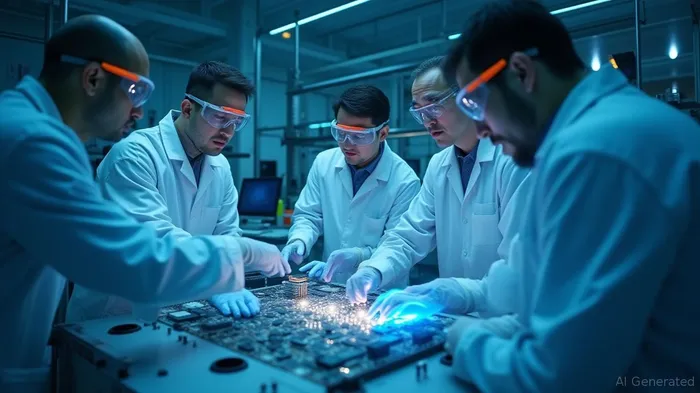
Florida's Dual Play: Innovation and Infrastructure
Florida's Florida Semiconductor Institute (FSI) is a microcosm of this transformation. Its new $80 million Advanced Technology Center in Jacksonville—part of a $45 million state-funded expansion—is creating 10,000+ high-wage jobs by 2030. The FSI's focus on advanced packaging (e.g., 300mm fan-out wafer-level technology) and ultrawide bandgap materials not only extends Moore's Law but also positions U.S. firms to dominate emerging markets like EVs and 5G. Meanwhile, the Microelectronics Commons Program, funded by the CHIPS Act, is fostering a national network of shared facilities, including UF's Nanoscale Research Facility, which houses a 7,300 sq. ft. cleanroom. These investments are critical to reducing reliance on foreign suppliers and insulating the economy from trade shocks.
AI as the Catalyst for Efficiency and Sustainability
UF's research extends beyond hardware. Its HiPerGator AI supercomputer powers breakthroughs in sustainability, such as Juan Manuel Restrepo-Flórez's work modeling the full environmental impact of chip production—including resource depletion—and Joshua Moon's development of PFAS-free wastewater solutions. These innovations are not just environmentally sound; they're economically vital. The semiconductor industry's energy consumption is projected to double every three years, and silicon shortages by 2040 loom. Companies like Xcimer Energy (a UF-linked startup) and Phoenix Semiconductor are leveraging this research to pioneer resource-efficient materials, ensuring long-term competitiveness.
Investment Implications: Targeting R&D and Federal Leverage
Investors seeking resilience should prioritize firms with three key traits:
1. Strong R&D partnerships with academic institutions like UF, which provide access to cutting-edge technologies and federal grants.
2. Exposure to federal infrastructure spending, particularly via the CHIPS Act's $3 billion Advanced Packaging Program and the $20 million allocated to UF's SMART USA hub.
3. Sustainability-focused innovation, as regulations tighten and consumer demand for eco-friendly products grows.
Leading candidates include:
- Applied Materials (AMAT): A semiconductor equipment giant with $1.2 billion in CHIPS Act funding and ties to Florida's advanced packaging initiatives.
- Lam Research (LRCX): A key supplier to U.S. chipmakers, benefiting from domestic production incentives.
- NVIDIA (NVDA): Leveraging AI to optimize chip design, with direct involvement in UF's digital twin projects.
The company's stock has risen 35% since 2023, reflecting investor confidence in its role in semiconductor infrastructure.
Conclusion: Building an Economy for the 2030s
Florida's semiconductor renaissance is more than an industrial strategy—it's a model for economic resilience. By anchoring innovation in academia, leveraging federal spending, and prioritizing sustainability, the state is demonstrating how the U.S. can insulate its economy from global disruptions. Investors who align with this vision—through firms deeply integrated into this ecosystem—will be positioned to weather tariff uncertainties and capture the upside of a tech-driven recovery. The semiconductor sector, once a niche investment, is now a pillar of national economic strategy. The time to act is now.

Stay ahead of the market.
Get curated U.S. market news, insights and key dates delivered to your inbox.
AInvest
PRO
AInvest
PRO



Comments
No comments yet