
Semiconductors and AI in the Crosshairs: Navigating U.S.-China Tech Decoupling for Profitable Investments
The escalating U.S.-China trade and technology rivalry has reshaped global supply chains, creating both risks and opportunities for investors in the semiconductor and artificial intelligence (AI) sectors. With Washington's aggressive push to decouple critical technologies from China—via policies like the CHIPS Act and stringent export controls—the stage is set for firms with resilient infrastructure and exposure to domestic demand to thrive. Here's how investors can capitalize on this seismic shift.
The CHIPS Act: A Catalyst for U.S. Semiconductor Supremacy
The 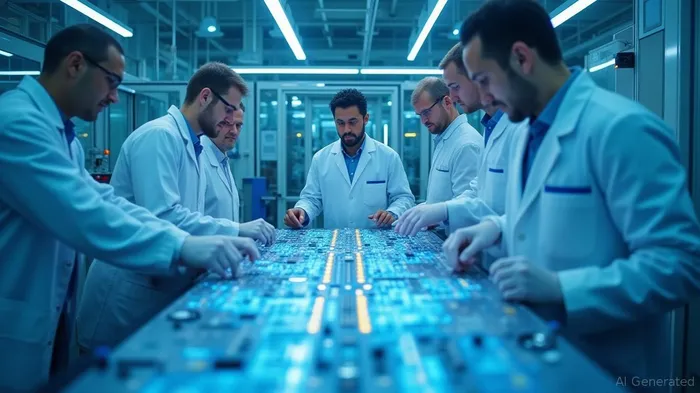
U.S. semiconductor manufacturing, once dominated by Asian players, is undergoing a renaissance thanks to the CHIPS Act. The law has injected over $32.5 billion in grants and loans to companies like Intel, Samsung, and Micron, funding projects that promise to create hundreds of thousands of jobs and reduce reliance on Chinese manufacturing. Key beneficiaries include:
- Intel ($INTC): Awarded $7.865 billion to expand its Arizona fabs and develop “Secure Enclave” facilities for advanced chips.
- Micron ($MU): Secured $6.165 billion to build DRAM production in New York and Idaho, aiming to boost U.S. memory chip output from 2% to 10% by 2035.
- Samsung ($SSNLF): Received $4.745 billion to fund a Texas-based $37 billion investment in leading-edge logic chips.
Investors should monitor these firms' progress against milestones, as funding is tied to delivery of facilities and jobs. The CHIPS Act's tax incentives (25% credit for semiconductor investments) further sweeten the deal for companies scaling up domestic production.
Export Controls: Squeezing China's Tech Ambitions
The U.S. has weaponized its export controls to stifle China's semiconductor and AI advances. New rules target:
1. Advanced Chips and Manufacturing Equipment: The Foreign Direct Product Rule (FDPR) now applies to foreign-made semiconductors containing any U.S.-origin components, cutting off Chinese firms like Huawei and YMTC from global supply chains.
2. AI Model Training: Guidance bars U.S. tech from aiding Chinese AI development, with strict due diligence on transactions involving entities in “countries of concern.”
3. Critical Materials: U.S. polysilicon producers like Hemlock Semiconductor ($325M in CHIPS grants) and wafer makers such as GlobalWafers ($406M) are shoring up raw material security, reducing reliance on China's dominance in silicon carbide (SiC).
These measures have forced Chinese firms to pivot to less advanced technologies or invest heavily in domestic alternatives. For U.S. investors, this creates a “moat” around companies with irreplaceable expertise—such as ASML ($ASML), whose EUV lithography machines remain unmatched globally.
AI's New Frontier: Domestic Innovation and Defense
The decoupling has accelerated AI R&D in the U.S., with the CHIPS Act funding initiatives like the SMART USA institute (a $285M digital twins hub) and Advanced Packaging Piloting Facilities in Arizona. Companies with AI chip specialization stand to gain:
- SK hynix ($SKHNF): Its $3.87 billion Indiana plant will produce high-bandwidth memory (HBM) for AI, supported by $458M in grants.
- Amkor Technology ($AMKR): Advanced packaging facilities in Arizona ($407M in grants) are critical for integrating AI chips into real-world applications.
Investors should also watch for winners in AI infrastructure, such as NVIDIA ($NVDA), whose GPUs dominate the training of large language models. Despite China's efforts to replicate this, U.S. sanctions have slowed its access to key components.
Investment Strategy: Prioritize Resilience and Domestic Demand
The path to profit in this environment requires focusing on firms that:
1. Benefit from CHIPS Act funding: IntelINTC--, MicronMU--, and Samsung are direct recipients, with clear timelines and government backing.
2. Control critical tech nodes: ASML's EUV machines and Coherent's ($CHC) laser tools for semiconductor manufacturing are irreplaceable.
3. Focus on AI specialization: NVIDIANVDA--, SK hynix, and AmkorAMKR-- are aligning with U.S. priorities for AI-driven industries like autonomous vehicles and healthcare.
4. Avoid exposure to China: Companies with minimal supply chain reliance on Chinese materials or manufacturing—like Entegris ($ETG), a U.S.-based semiconductor materials leader—offer safer bets.
Risks and Considerations
- Global Supply Chain Friction: Over-reliance on U.S. production could raise costs and slow innovation if global collaboration is stifled.
- Geopolitical Volatility: China may retaliate with its own export controls or diplomatic pressure on U.S. allies.
- Technological Leapfrogging: China's subsidies for domestic firms (e.g., DeepSeek's advanced AI models) could erode U.S. advantages if controls are circumvented.
Conclusion
The U.S.-China tech decoupling is a multiyear trend with clear winners and losers. Investors who back firms with robust U.S. manufacturing footprints, advanced R&D, and minimal China exposure will find themselves on the right side of history. As the CHIPS Act reshapes the semiconductor landscape and export controls tighten, the next decade will reward those who bet on resilience—and punish those clinging to outdated supply chains.

Stay ahead of the market.
Get curated U.S. market news, insights and key dates delivered to your inbox.
AInvest
PRO
AInvest
PRO



Comments
No comments yet