
Semiconductor Supremacy: Navigating the New Geopolitical Landscape of Tech Decoupling
The global semiconductor industry is at a crossroads, caught between escalating U.S.-China trade tensions and the urgent demand for advanced chips to power AI, electric vehicles (EVs), and defense systems. As tariffs, export controls, and retaliatory measures redefine supply chain dynamics, investors must focus on companies positioned to thrive in this era of techno-nationalism. The structural realignment of the semiconductor sector presents both risks and opportunities—here's how to separate the winners from the losers.
The New Geopolitical Reality: Tariffs and Technological Decoupling
The U.S. has weaponized tariffs and export controls to slow China's semiconductor ambitions. By January 2025, Section 301 tariffs on Chinese semiconductors surged to 50%, stacking with a 20% Fentanyl tariff and a 10% baseline rate, pushing the total duty burden to 80% for imports into the U.S. (see ). Meanwhile, the Bureau of Industry and Security (BIS) has imposed sweeping controls on advanced computing chips, semiconductor manufacturing equipment (SME), and AI technologies.
China, in turn, has retaliated with tariffs on U.S. goods and tightened its grip on critical sectors. Its anti-dumping duty of 74.9% on U.S. POM copolymers (a material used in semiconductor equipment) and reciprocal tariffs on non-semiconductor products highlight the escalation. Yet, China's reliance on U.S. electronic design automation (EDA) tools—evident in its scramble after the May 2025 EDA export restrictions—reveals its persistent vulnerability in chip design.
Winners in the Realignment: U.S. and Allied Dominance
The clearest beneficiaries are firms with irreplaceable technical or geopolitical advantages:
TSMC (TSM): Taiwan's semiconductor giant remains the gold standard for advanced node production. With U.S. subsidies and a $12 billion plant in Arizona, TSMCTSM-- is fortifying its position in the “friend-shoring” supply chain. Its partnership with IntelINTC-- and QualcommQCOM-- ensures access to cutting-edge designs, while its dominance in 3nm and 2nm nodes insulates it from U.S.-China friction.
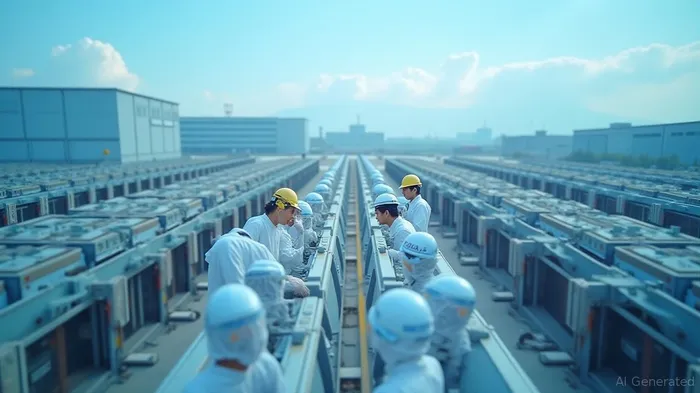
Applied Materials (AMAT): The leading supplier of semiconductor manufacturing equipment (SME), AMAT's tools are critical to advanced chip production. Its control over deposition, etch, and metrology systems gives it leverage in both U.S. and non-Chinese markets. BIS's restrictions on SME exports to China have amplified demand for its alternatives in allied nations.
ASML (ASML): The Dutch lithography giant holds a near-monopoly on extreme ultraviolet (EUV) machines required for 7nm and smaller chips. U.S.-led export controls on ASML's technology to China have solidified its role as a linchpin in the “allied semiconductor axis.”
China's Niche Strengths: Opportunities with Caveats
While U.S. policies aim to isolate China's semiconductor sector, certain domestic firms retain irreplaceable niche capabilities:
- SMIC (0981.HK): Despite U.S. restrictions, SMIC's progress in 14nm and 28nm nodes positions it as a critical supplier for non-advanced applications. Its survival hinges on domestic demand and alternative technology sourcing.
- Huawei (HWT): Despite U.S. sanctions, Huawei's AI and networking expertise could drive demand for its own semiconductor designs, especially in 5G and cloud infrastructure.
However, investors must weigh these opportunities against risks like supply chain disruptions and sudden policy shifts. The July 2025 reversal of EDA restrictions—a temporary truce—highlights the volatility of U.S.-China negotiations.
Risks and Considerations
- Overexposure to Export Controls: Companies reliant on China's market or supply chains (e.g., ASML's EUV sales to SMIC) face regulatory headwinds.
- Supply Chain Fragmentation: The bifurcation of supply chains into U.S.-led and China-led blocs may increase costs and reduce economies of scale.
- Technological Leapfrogging: China's focus on quantum computing and alternative chip architectures could disrupt current dominance structures.
Investment Strategy: Play the Long Game
The structural demand for advanced semiconductors—driven by AI, EVs, and defense—is undeniable. Investors should prioritize:
1. Global Leaders with Geopolitical Shelter: TSMC, AMATAMAT--, and ASMLASML-- are core holdings for their entrenched positions and U.S.-allied partnerships.
2. China's Niche Players with Strategic Value: SMIC and Huawei offer asymmetric upside if diplomatic tensions ease, but they require hedging via derivatives or geographic diversification.
3. Materials and Equipment Suppliers: Companies like Entegris (ENTG) (critical materials) and Lam Research (LRCX) (etching tools) benefit from the capital expenditure boom in allied fabs.
Avoid pure-play Chinese semiconductor stocks without clear competitive moats; their valuations already reflect geopolitical uncertainty.
Conclusion: The Chips Are Down—Invest in Resilience
The U.S.-China tech war is reshaping the semiconductor industry into a two-tiered system: one anchored by U.S.-allied innovation, and another constrained by export controls. While volatility will persist, the winners will be firms that align with the strategic priorities of techno-nationalist governments. For investors, this is not a bet against China's long-term ambitions but a recognition that the next decade of chip dominance will be decided in the boardrooms of TSMC and the factories of ASML.
In this high-stakes game, the players with the most resilient supply chains, the deepest R&D pipelines, and the strongest government ties will emerge as the kings of the silicon age.

Stay ahead of the market.
Get curated U.S. market news, insights and key dates delivered to your inbox.




Comments
No comments yet