
The Semiconductor Shift: How U.S.-China Tensions Are Redrawing the Investment Landscape
The escalating U.S.-China trade war has transformed the global semiconductor industry into a battleground of tariffs, export controls, and geopolitical strategy. As both nations tighten restrictions on advanced chip technologies and raw materials, supply chains are fracturing—and rebirthing—around new centers of production and innovation. For investors, this is a pivotal moment to capitalize on asymmetric advantages emerging in advanced manufacturing and artificial intelligence (AI), while navigating the risks of prolonged technological decoupling.
Tariffs and Trade Barriers: A Catalyst for Supply Chain Restructuring
The U.S. has weaponized tariffs to reshape semiconductor supply chains, targeting Chinese manufacturers with layered duties that now average 80% on certain chips (see Figure 1). These include:
- Section 301 tariffs (50% on semiconductors as of 2025, escalating to 75% in 2026).
- Fentanyl-related duties (20% on all Chinese goods, including chips).
- Reciprocal “Liberation Day” tariffs (temporarily reduced to 10% but likely to rebound).
Meanwhile, China has retaliated by restricting exports of critical materials like gallium and germanium, key inputs for chip manufacturing. This mutual strangulation has forced global firms to diversify production outside the U.S.-China axis. The result? A geopolitical arbitrage opportunity for investors in regions like Taiwan, South Korea, Malaysia, and the U.S.
Technological Decoupling: A Long-Term Tailwind for U.S. Chipmakers
The U.S. is not just imposing tariffs—it's walling off advanced semiconductor technology from China. Export controls under the Bureau of Industry and Security (BIS) now blockXYZ-- sales of 7nm/5nm chips and equipment like extreme ultraviolet (EUV) lithography machines. These restrictions have stifled China's ability to scale production of cutting-edge chips, despite massive subsidies under its “Made in China 2025” plan.
This creates a moat around U.S.-allied manufacturers, particularly those benefiting from the CHIPS Act. Subsidies worth $52 billion are fueling U.S. factories like:
- TSMC's $40 billion Arizona plant (targeting 3nm and 5nm nodes by 2027).
- Intel's Ohio chiplet hub (focused on 20A/18A process nodes).
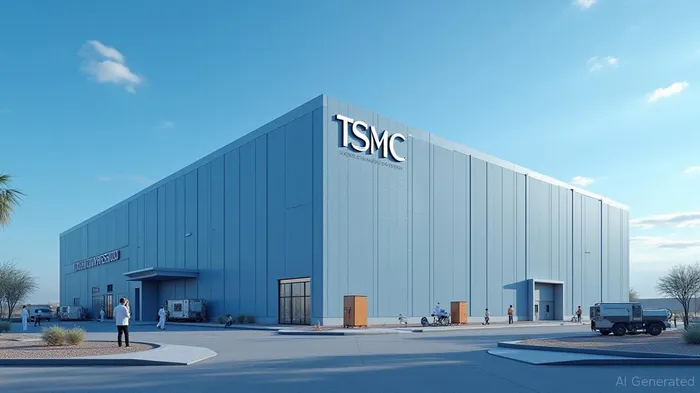
The CHIPS Act ensures these firms can compete with Asian rivals despite higher labor costs. A shows how subsidies have accelerated its U.S. expansion. Investors should prioritize companies with direct ties to these projects, such as Applied Materials (chip equipment) and Lam Research (semiconductor tools), which are critical to maintaining U.S. manufacturing leadership.
AI: The New Growth Engine for Semiconductor Demand
While trade tensions dominate headlines, the real driver of long-term semiconductor growth is AI. The global AI chip market is projected to hit $500 billion by 2028, with U.S. firms like NVIDIA and AMD dominating the high-margin segment for data center GPUs.
The U.S. has a structural advantage here: its open innovation ecosystem—fed by venture capital, academic partnerships, and talent—fuels AI-driven chip design. For example, NVIDIA's H100 GPUs power 80% of AI training workloads, while AMD's MI300A is gaining traction in hyperscale data centers.
Investors should also watch emerging players in chiplet architectures and 3D packaging (e.g., TSMC's CoWoS), which enable higher performance and energy efficiency—critical for next-gen AI systems.
Risks and Mitigation Strategies
- Geopolitical Volatility: A U.S.-China détente could reduce tariffs and export controls, compressing margins for firms reliant on subsidies. Mitigation: Focus on companies with diversified revenue streams (e.g., Intel's CPU/AP business alongside foundry services).
- Overcapacity in AI Chips: Overinvestment in AI data centers may lead to oversupply. Mitigation: Prioritize firms with defensible IP (e.g., custom AI accelerators) or vertical integration (e.g., Apple's M-series chips).
- Supply Chain Fragility: Concentration of raw materials (e.g., Taiwan's dominance in wafers) poses risks. Mitigation: Invest in recycling startups (e.g., Ascend Elements) and firms securing rare earth minerals outside China.
Investment Thesis: Buy the Shift, Not the Conflict
The semiconductor industry is undergoing a geopolitically engineered reset. While trade tensions are disruptive in the short term, they are creating structural advantages for U.S. and allied manufacturers in advanced nodes and AI.
Top Picks:
- TSMC (TPE:2330): The foundry leader's U.S. expansion and cutting-edge process nodes make it a “buy” despite near-term volatility.
- NVIDIA (NVDA): AI's insatiable demand for GPUs justifies its premium valuation.
- ASML (ASML): Monopoly on EUV lithography equipment positions it as a critical enabler of U.S. and EU chip production.
Avoid: Chinese firms like SMIC, which face insurmountable hurdles in advanced nodes due to export controls.
Conclusion
The U.S.-China trade war has turned semiconductors into a geopolitical chessboard. For investors, the path to profit lies in backing firms that benefit from decoupling, not resisting it. The CHIPS Act's subsidies, AI's insatiable appetite for compute power, and the fragmented supply chain are all tailwinds for U.S. chipmakers. The risks? Yes—but the rewards of riding this structural shift are too large to ignore.
The future belongs to those who align with the new order.

Stay ahead of the market.
Get curated U.S. market news, insights and key dates delivered to your inbox.




Comments
No comments yet