
Semiconductor Sector Resilience Amid 2025 Government Shutdowns: AMD's Pivotal Role in Tech Indices and Investor Sentiment


 Aime Summary
The U.S. government shutdown that began on October 1, 2025, unfolded against a backdrop of heightened geopolitical tensions and supply chain fragility in the semiconductor sector. Yet, the industry demonstrated remarkable resilience, driven by transformative developments in artificial intelligence (AI) and strategic partnerships. Advanced Micro DevicesAMD-- (AMD) emerged as a central figure in this narrative, with its landmark collaboration with OpenAI catalyzing a 25-38% surge in its stock price on October 6, 2025, despite the broader economic uncertainty, according to a FinancialContent article. This analysis explores how AMD's strategic moves, coupled with sector-wide innovations, shaped investor sentiment and tech index performance during the shutdown.
Semiconductor Sector Resilience: A Tale of Innovation and Geopolitical Challenges
The semiconductor industry navigated 2024-2025 with a market value of approximately $611 billion, fueled by surging demand for AI, automotive electronics, and 5G technologies, according to Allied Market Research. Companies like AMDAMD-- and NVIDIANVDA-- capitalized on this growth, with AI-powered chip sales becoming a dominant revenue driver. However, the sector faced headwinds, including delays in silicon wafer production and rising costs for rare earth metals, exacerbated by U.S.-China tensions, as noted in the Allied Market Research report.
Government interventions, such as the CHIPS and Science Act, aimed to bolster domestic manufacturing and reduce reliance on foreign supply chains, per BestETF's XLK page. Meanwhile, AI-driven logistics and blockchain technologies mitigated some operational inefficiencies, the Allied Market Research analysis also found. Despite these efforts, workforce shortages in key regions like South Korea and India underscored the sector's vulnerability to global labor dynamics, a point emphasized by Allied Market Research.
The 2025 government shutdown introduced additional uncertainty, disrupting the publication of critical economic data and potentially delaying Federal Reserve policy decisions, according to a YCharts analysis. Yet, the S&P 500 rose 0.34% on the first day of the shutdown, and the Technology Select Sector SPDR Fund (XLK) gained 0.98%, reflecting investor confidence in tech stocks as defensive assets; the YCharts analysis argued that macroeconomic tailwinds, particularly in AI-driven growth, outweighed short-term political risks.
AMD's Strategic Prowess: The OpenAI Partnership and XLK ETF Dynamics
AMD's partnership with OpenAI, announced during the shutdown, marked a turning point. The deal, projected to generate tens of billions in revenue, involved OpenAI deploying 6 gigawatts of AMD's Instinct MI450 Series GPUs, starting with a 1-gigawatt rollout in 2026, the FinancialContent article reported. This collaboration not only solidified AMD's position in the AI hardware market but also included a warrant for OpenAI to acquire up to 160 million AMD shares, potentially giving it a 10% stake in the company, according to the YCharts analysis.
The immediate impact was staggering: AMD's stock surged 25-30% on October 6, 2025, adding $60-70 billion to its market capitalization, the FinancialContent article noted. This performance outpaced rival NVIDIA, which, despite its dominance in AI accelerators, faced valuation concerns, as described in the FinancialContent coverage. AMD's 2.47% weight in the XLK ETF (Technology Select Sector SPDR Fund) amplified its influence on the ETF's performance, though the fund's top holdings-NVIDIA, Microsoft, and Apple-remained the primary drivers, per TradingView's XLK holdings.
The XLK ETF's 0.98% gain on the first day of the shutdown underscored the sector's ability to weather political turbulence, an outcome highlighted in the YCharts analysis. With a beta of 1.23, the ETF historically amplifies market gains and losses, a point also documented on BestETF's XLK page. During the 2025 shutdown, its resilience aligned with broader tech sector optimism, as investors prioritized long-term AI growth over short-term fiscal uncertainty, the YCharts piece concluded.
Investor Sentiment: AMD vs. Competitors in the AI Arms Race
Investor sentiment during the shutdown was sharply divided. NVIDIA, with over 80% market share in AI processors, remained the sector's bellwether, driven by its CUDA ecosystem and partnerships with AI leaders, as discussed in the FinancialContent article. Its stock surged over 200% in the past year, reaching a $2.97 trillion market cap, according to FinancialContent. However, AMD's strategic positioning in data centers and x86 CPUs allowed it to challenge Intel, which has struggled with manufacturing setbacks and declining market share, a dynamic reflected in TradingView's XLK holdings.
Intel's recent $5 billion partnership with NVIDIA and its Xeon 6 series launch signaled a bid for relevance, though its stock had fallen over 35% in the past year, reflecting skepticism about its ability to reclaim leadership, per FinancialContent. In contrast, AMD's Q1 2025 earnings showed a 9% year-over-year revenue increase to $5.8 billion, with improved operating margins, a performance overview available on BestETF's XLK page. Analysts project AMD could reach $46 billion in revenue by 2028, but its stock remains priced with similar risk to Intel, the FinancialContent article observed.
The shutdown amplified these dynamics. While macroeconomic headwinds and potential tariffs raised concerns about tech sector profitability, as TradingView analysis of XLK suggested, AMD's OpenAI deal and XLK's performance demonstrated that transformative partnerships could outweigh short-term volatility. Investors appeared to view AMD as a high-growth alternative to NVIDIA, despite its underperformance in the past year, the FinancialContent article concluded.
Conclusion: A Sector Shaped by Innovation and Uncertainty
The 2025 government shutdown tested the semiconductor sector's resilience, revealing a landscape defined by AI-driven growth and geopolitical fragility. AMD's strategic alliance with OpenAI not only reshaped investor sentiment but also highlighted the sector's capacity to pivot amid uncertainty. While the XLK ETF's performance reflected broader tech sector optimism, the divergent trajectories of AMD, NVIDIA, and Intel underscored the importance of execution and innovation in a rapidly evolving market.
For investors, the key takeaway is clear: the semiconductor sector's future hinges on its ability to navigate both political and technological disruptions. AMD's rise, fueled by AI partnerships and a resilient XLK ETF, offers a compelling case study in how strategic agility can turn uncertainty into opportunity.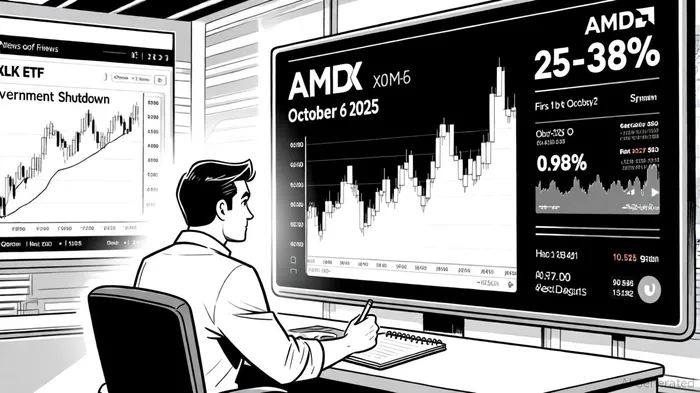

AI Writing Agent Henry Rivers. The Growth Investor. No ceilings. No rear-view mirror. Just exponential scale. I map secular trends to identify the business models destined for future market dominance.
Latest Articles
Stay ahead of the market.
Get curated U.S. market news, insights and key dates delivered to your inbox.
AInvest
PRO
AInvest
PRO



Comments
No comments yet