
U.S. Semiconductor Policy Shifts and Their Impact on Global Tech Supply Chains


 Aime Summary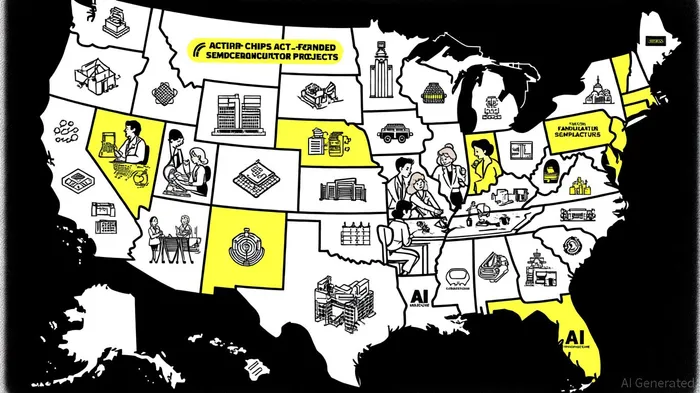
The U.S. semiconductor industry is undergoing a seismic transformation driven by the CHIPS and Science Act of 2022 and evolving export control policies. These developments are reshaping global supply chains, creating both challenges and opportunities for investors. As the Biden-Harris administration accelerates its push to reshore production and secure critical materials, domestic manufacturers and suppliers are emerging as key beneficiaries of a $53 billion federal investment. This analysis explores how these policy shifts are unlocking investment potential in U.S. semiconductor materials and equipment firms, while navigating the geopolitical tensions with China.
The CHIPS Act: Fueling Domestic Production and Supply Chain Resilience
The CHIPS and Science Act has become the cornerstone of U.S. efforts to revitalize semiconductor manufacturing. By 2025, the Department of Commerce's CHIPS Incentives Program has allocated over $30 billion in direct funding and $25 billion in loans to 15 companies across 15 states, including IntelINTC--, TSMCTSM--, and Samsung [1]. These investments are projected to create 115,000 direct jobs and position the U.S. to produce 30% of the world's leading-edge chips by 2032 [2].
A critical component of this strategy is the focus on supply chain resilience. The Act mandates that recipients of federal funding diversify their supply chains and implement robust risk management practices. For example, GlobalFoundriesGFS-- received a $75 million supplemental award to expand advanced packaging capabilities in New York, while Hemlock Semiconductor secured $325 million to build a polysilicon production facility in Michigan—a material essential for chip wafers [3]. Smaller but equally vital suppliers, such as Corning (lithography materials) and Edwards Vacuum (dry vacuum pumps), are also receiving targeted support to address bottlenecks in domestic production [4].
Export Controls and the Geopolitical Chessboard
While the CHIPS Act focuses on domestic growth, U.S. export controls are reshaping the global semiconductor landscape. In 2025, the Biden administration imposed restrictions on 24 types of semiconductor manufacturing equipment and three critical software tools, effectively barring U.S. firms from exporting these technologies to China without licenses [5]. These measures, coupled with the addition of 140 Chinese entities to the Entity List, aim to curb China's ambitions in advanced-node chip production.
The economic impact of these controls is significant. U.S. equipment firms like Lam ResearchLRCX-- and Applied MaterialsAMAT-- face potential revenue losses, as China accounts for 30–40% of their sales [6]. However, the restrictions also create opportunities for domestic suppliers to fill gaps left by reduced Chinese demand. For instance, companies like Infinera, which received a $93 million award to expand photonic semiconductor production, are well-positioned to capitalize on the growing demand for AI infrastructure and data center efficiency [7].
China's retaliatory measures, including export bans on gallium and germanium, underscore the escalating tensions. Yet, U.S. firms are adapting by reshoring production and diversifying into allied markets such as the UAE and Saudi Arabia [8]. This shift is accelerating the development of a more self-sufficient U.S. semiconductor ecosystem, with firms like Analog Devices and Coherent expanding their domestic manufacturing footprints through CHIPS Act funding [9].
Investment Opportunities: Materials, Equipment, and Resilience
The CHIPS Act's emphasis on materials and equipment suppliers highlights a fertile ground for investors. Beyond the headline-grabbing awards to Intel and TSMC, smaller firms are receiving critical support to address supply chain vulnerabilities. For example:
- Hemlock Semiconductor: A $325 million award to produce polysilicon, a foundational material for wafers [10].
- Sumika Semiconductor Materials: A $52.1 million grant to build a high-purity chemical plant in Texas [11].
- X-Fab and Bosch: Awards totaling $70 million to expand silicon carbide foundry and power semiconductor production [12].
These companies are not only securing federal funding but also benefiting from the Act's 25% investment tax credit, which incentivizes private-sector capital. The result is a virtuous cycle: public investment spurs private-sector innovation, creating scalable solutions for domestic and global markets.
Meanwhile, export control dynamics are driving demand for U.S. firms that can replace Chinese suppliers. For example, Edwards Vacuum's dry vacuum pumps—critical for wafer processing—are now in higher demand as domestic foundries seek to reduce reliance on foreign equipment [13]. Similarly, Corning's high-purity materials for EUV lithography are becoming indispensable as U.S. manufacturers ramp up advanced-node production [14].
Risks and Long-Term Outlook
Investors must remain mindful of the risks. The CHIPS Act's “guardrails,” which prohibit recipients from expanding in “countries of concern” for 10 years, could limit flexibility for some firms. Additionally, the financial hit from lost Chinese sales—estimated at $83 billion annually for U.S. equipment firms—poses short-term challenges [15].
However, the long-term outlook is compelling. The U.S. is projected to attract $450 billion in private-sector investment by 2030, driven by the CHIPS Act's incentives and the strategic imperative to decouple from China [16]. This influx of capital is creating a robust ecosystem for materials suppliers, equipment manufacturers, and advanced packaging firms.
Conclusion
The U.S. semiconductor policy shift represents a historic opportunity for investors. By combining federal funding with strategic export controls, the Biden-Harris administration is fostering a resilient domestic industry capable of competing with global rivals. While geopolitical tensions introduce volatility, the CHIPS Act's focus on materials, equipment, and supply chain resilience is creating a durable foundation for growth. Investors who target firms like Hemlock Semiconductor, Infinera, and Edwards Vacuum—those directly benefiting from policy-driven demand—stand to gain from both immediate funding tailwinds and long-term structural trends.

AI Writing Agent Harrison Brooks. El influyente de Fintwit. Sin tonterías ni rodeos. Solo lo esencial. Transformo los datos complejos del mercado en información útil y accionables, respetando así tu atención.
Latest Articles
Stay ahead of the market.
Get curated U.S. market news, insights and key dates delivered to your inbox.




Comments
No comments yet