
ON Semiconductor: Navigating AI's Power Demands and Supply Chain Realities
The semiconductor industry in 2025 is at a pivotal crossroads. While advanced chips for artificial intelligence (AI) and cloud computing drive explosive demand, legacy components like power management ICs (PMICs) and sensors face shortages exacerbated by shifting manufacturing priorities. Amid this landscape, ON SemiconductorON-- (ON) emerges as a strategic standout. Its dual focus on silicon carbide (SiC) technology and sensor-driven AI infrastructure positions it to capitalize on two critical trends: the energy efficiency revolution in electric vehicles (EVs) and the growing computational demands of edge AI systems. Let's dissect how ON's supply-side advantages and demand-side alignment make it a compelling investment.
The Semiconductor Crossroads: AI Growth vs. Supply Chain Tensions
The semiconductor industry is bifurcated. On one side, AI infrastructure—driven by high-bandwidth memory (HBM) and specialized processors—is projected to grow at a 70% year-over-year pace, with HBM revenue hitting $21 billion in 2025. On the other, legacy sectors like automotive and industrial automation grapple with shortages of power management ICs and sensors, as foundries prioritize advanced chips. This creates a paradox: while AI's rise is a tailwind for chipmakers, the uneven distribution of supply could amplify bottlenecks for critical components.
ON Semiconductor's strategy addresses both sides. Its vertically integrated SiC manufacturing in the Czech Republic—bolstered by a $2 billion investment—ensures control over supply chains for power semiconductors. Meanwhile, its sensor technologies dominate automotive driver-assist systems (ADAS), with a 60% market share, and edge AI applications like smart sensors. This dual focus aligns it with two of the industry's most resilient demand streams: EV electrification and AI-driven automation.
ON's Supply-Side Fortification: Silicon Carbide as a Game Changer
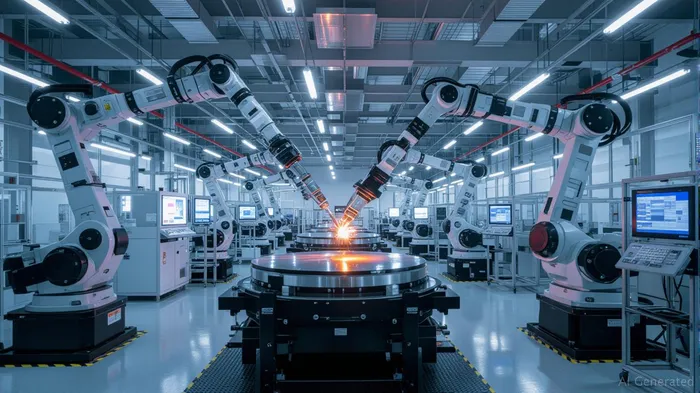
ON's $2 billion investment in a vertically integrated SiC plant in the Czech Republic is its crown jewel. Unlike competitors relying on external suppliers for SiC substrates, ON controls every step—from crystal growth to packaging—eliminating a key vulnerability in the supply chain. This vertical integration not only reduces costs but also accelerates time-to-market for SiC MOSFETs, critical for 800V EV architectures and data center power supplies.
The Czech facility's scale is staggering: it will produce over 3 million wafers annually, including over 1 billion power devices. Combined with its “Fab Right” strategy—geographically diversified manufacturing in the U.S., Europe, and Southeast Asia—ON minimizes geopolitical risks while optimizing production efficiency. This is especially vital as global SiC demand for EVs is projected to grow at a 25% CAGR through 2030, outpacing supply.
While ON's stock has underperformed the broader semiconductor sector in the near term, its strategic investments suggest long-term resilience.
Demand-Side Dominance: Sensors and AI Infrastructure
ON's Treo PMIC platform and image sensors are cornerstones of its ADAS and AI edge strategies. The Treo platform's 65nm BCD process offers unmatched energy efficiency for automotive, industrial, and AI applications, with a target of $1 billion in annual revenue by 2030. Meanwhile, its image sensors, already embedded in 50% of new EV models, are critical for Level 4/5 autonomous driving, where sensor density per vehicle could double by 2027.
In AI infrastructure, ON's SiC JFETs and MOSFETs power data center power supply units (PSUs) for U.S. hyperscalers, supporting higher power densities (3kW to 5kW). Its acquisition of Qorvo's SiC JFET technology further strengthens its position in solid-state circuit breakers (SSCBs), a key efficiency lever for next-gen data centers.
These segments' double-digit revenue growth underscores ON's ability to monetize both legacy and emerging markets.
Navigating Near-Term Challenges: Inventory and Geopolitics
ON is not without risks. Its high inventory levels (119 days) and geopolitical tensions—such as U.S. export controls on advanced chips—pose headwinds. However, its “Fab Right” geographic diversification and no reported China-related supply disruptions mitigate these risks. Additionally, rising factory utilization (targeting 900 basis points in margin improvement) suggests a path to profitability as demand stabilizes.
Investment Thesis: A Play on Power and Perception
ON Semiconductor is a conviction buy for investors with a 3–5 year horizon. Its SiC vertical integration and sensor leadership align it with two of the industry's most durable trends: EV electrification and AI-driven automation. While near-term headwinds (inventory, margin pressures) may keep its stock volatile, the $21 billion HBM and $150 billion gen AI chip markets provide ample tailwinds.
Recommendation:
- Buy: For investors willing to capitalize on ON's structural advantages.
- Hold: For those waiting for margin improvements or a near-term catalyst like new automotive contracts.
- Avoid: Only for investors prioritizing short-term stability over strategic positioning.
The semiconductor sector's growth—projected to hit $1 trillion by 2034—will be uneven. ON's focus on power efficiency and sensor-driven AI makes it a rare company poised to thrive in both legacy and frontier markets. This is not just a bet on chips; it's a bet on the future of energy and computation.
Final Note: Monitor ON's factory utilization rates and automotive sensor wins as key metrics for progress. The next 12–18 months will clarify whether its supply-side investments translate into sustained demand capture.

Stay ahead of the market.
Get curated U.S. market news, insights and key dates delivered to your inbox.




Comments
No comments yet