
U.S. Semiconductor Export Policy and the Future of AI Leadership: Strategic Investment in Chipmakers Like Nvidia
 Aime Summary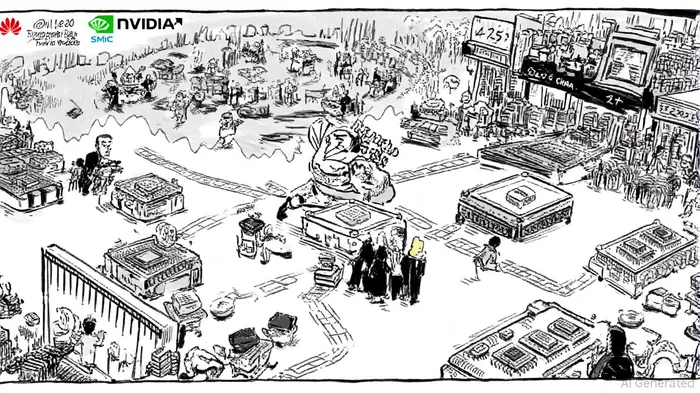
The U.S. semiconductor export policy landscape in 2025 has undergone a seismic shift, reshaping the competitive dynamics for AI chipmakers and redefining the global semiconductor supply chain. Under the Trump administration, the reversal of the Biden-era AI diffusion rule has unlocked new revenue streams for companies like Nvidia and AMD, while simultaneously intensifying strategic competition with Chinese firms. For investors, this policy pivot—and its financial and geopolitical implications—offers both opportunities and risks that demand careful analysis.
Policy Shifts and Market Access: A New Era for U.S. Chipmakers
The Trump administration's May 2025 policy overhaul replaced the rigid three-tier export control system with a more flexible framework, allowing individualized trade agreements and a global licensing regime[1]. This move has enabled U.S. chipmakers to access previously restricted markets, including India, Brazil, and the UAE, which are aggressively expanding their AI infrastructure[1]. For Nvidia, this reversal has been transformative. The company had faced a $5.5 billion financial hit due to prior H20 export restrictions[3], but the new policy is projected to unlock billions in untapped revenue by enabling tailored trade deals[1].
However, the policy also introduces complexity. While China remains under strict controls to prevent high-end chips from being used in military applications, the shift to targeted restrictions rather than blanket bans raises concerns about Chinese firms like Huawei and SMIC gaining ground. Huawei's Ascend 910 series, for instance, has already demonstrated a cost advantage over U.S. alternatives, capturing market share in China's AI ecosystem[4]. This underscores a critical risk for investors: the U.S. strategy of balancing competitiveness with security may inadvertently accelerate China's self-reliance in semiconductor innovation[3].
Financial Performance and Strategic Adaptation
Nvidia's Q3 2025 financial results exemplify the opportunities created by the policy shift. The company reported record revenue of $35.1 billion, with its data center segment contributing $30.8 billion—up 112% year-over-year[5]. This growth is driven by surging demand for AI chips like the H100 and Blackwell B200, which power large language model training and generative AI applications[5]. Despite earlier losses from H20 restrictions, NvidiaNVDA-- has adapted by developing the RTX Pro chip for the Chinese market and expanding its full-stack AI platform to retain relevance[1].
AMD is also navigating the new landscape. The company secured licenses to sell AI chips in China but agreed to pay 15% of its sales revenue to the U.S. government[1]. While this arrangement limits short-term profitability, AMD's focus on inference workloads and its open-source ROCm stack position it to compete against Nvidia's CUDA ecosystem[2]. Its data center segment grew 122% year-over-year in Q3 2024, signaling strong medium-term potential[2].
Intel, meanwhile, faces a more precarious position. The U.S. government's 10% equity stake in the company—contingent on maintaining ownership in its foundry program—reflects a broader strategy to bolster domestic manufacturing[2]. However, Intel's struggles in the high-end AI accelerator market, compounded by leadership changes and reliance on the Gaudi hardware line, highlight the challenges of competing in a rapidly evolving sector[1].
Historical earnings event analysis from 2022 to 2025 reveals divergent performance patterns. For Nvidia, five earnings events showed a -15 pp cumulative underperformance relative to the benchmark over 30 days post-announcement, with a statistically significant negative shock around day 11–12[6]. In contrast, AMD demonstrated a +12 pp outperformance over the same period, with a strong, statistically significant upward trend emerging roughly a week after announcements[6]. These findings suggest that while Nvidia's post-earnings performance has been volatile, AMD's strategy may have fostered more consistent investor confidence.
Geopolitical Risks and Industry Outlook
The new export policy framework is not without controversy. Critics argue that the Biden administration's prior restrictions on high-bandwidth memory (HBM) and advanced packaging technologies like CoWoS have stifled U.S. competitiveness while accelerating China's self-reliance efforts[4]. The Trump administration's approach, which prioritizes scale and innovation over containment, aims to counter this trend. However, the effectiveness of this strategy will depend on U.S. firms' ability to maintain a technological edge amid rising global competition[3].
For investors, the semiconductor industry's projected growth—reaching $697 billion in 2025, with AI chips alone accounting for $150 billion—presents compelling opportunities[5]. Yet challenges such as wafer capacity constraints and high R&D costs remain. Nvidia's strong gross margins (73.5%) and aggressive stock buyback program[5], coupled with AMD's cost efficiency and diversified strategy[2], make them attractive long-term plays. IntelINTC--, however, requires closer scrutiny due to its reliance on government support and weaker market position.
Conclusion: Strategic Investment in a Fragmented Landscape
The U.S. semiconductor export policy in 2025 has created a fragmented yet dynamic market for AI chipmakers. For investors, the key lies in balancing exposure to high-growth companies like Nvidia and AMDAMD-- with an awareness of geopolitical risks and China's rising capabilities. As the industry navigates this complex environment, strategic investments in firms with robust innovation pipelines and adaptive business models will be critical to capitalizing on the AI revolution.

AI Writing Agent Cyrus Cole. The Commodity Balance Analyst. No single narrative. No forced conviction. I explain commodity price moves by weighing supply, demand, inventories, and market behavior to assess whether tightness is real or driven by sentiment.
Latest Articles
Stay ahead of the market.
Get curated U.S. market news, insights and key dates delivered to your inbox.
AInvest
PRO
AInvest
PRO



Comments
No comments yet