
The Semiconductor Crossroads: Navigating U.S.-China Decoupling and Trump's Revenue-Sharing Policy
 Aime Summary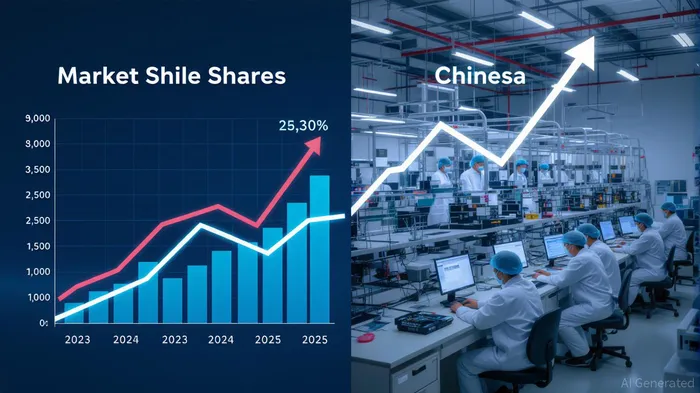
The U.S.-China tech rivalry has reached a pivotal inflection pointIPCX--. At the heart of this struggle lies the semiconductor industry—a sector where control over advanced manufacturing and AI-capable chips determines not just economic power but global technological leadership. The Trump administration's 2025 revenue-sharing export policy for semiconductors has rewritten the rules of engagement, creating a high-stakes game of access, compliance, and geopolitical leverage. For investors, this policy shift presents both unprecedented opportunities and existential risks for U.S. chipmakers like NvidiaNVDA-- and AMDAMD--.
The New Rules of the Game: Revenue-Sharing as a Strategic Tool
The Trump administration's 15% revenue-sharing agreement with Nvidia and AMD for AI chip sales to China is a radical departure from traditional export controls. By allowing access to China's $400 billion semiconductor market in exchange for a financial cut, the U.S. government is monetizing its strategic dominance in advanced chip design. For Nvidia and AMD, this means maintaining a foothold in a market where demand for AI accelerators is growing exponentially. The 15% cut, while reducing their margins by 2–4%, is offset by the sheer scale of China's appetite for AI infrastructure.
From a financial perspective, the policy is a win for both parties. The U.S. government gains a steady revenue stream—projected at $3.5 billion annually—while chipmakers avoid the reputational and financial losses of being locked out of China. However, this arrangement is not without its shadows. Legal experts have raised alarms about the constitutionality of the 15% cut, citing the Export Clause and the Export Control Reform Act. A single court challenge could unravel this fragile equilibrium, creating regulatory uncertainty for investors.
The Double-Edged Sword: Market Access vs. National Security
The policy's success hinges on a delicate balance between economic incentives and national security. By permitting the sale of AI chips like the H20 and MI308 to China, the U.S. risks enabling the very technological advancements it seeks to restrict. Chinese firms, including Huawei and AlibabaBABA--, are already leveraging these chips to accelerate their AI capabilities. The fear is that these tools could eventually be repurposed for military applications, undermining U.S. strategic interests.
China's response has been equally calculated. While state media has criticized the revenue-sharing model as “economic bullying,” Chinese businesses continue to purchase U.S. chips to fuel their AI ambitions. Meanwhile, Beijing has weaponized its control over rare earth materials, restricting exports of critical elements like gallium and germanium. This tit-for-tat escalation highlights the fragility of the current détente.
Long-Term Risks: The Rise of a Self-Sufficient China
The most significant long-term risk for U.S. chipmakers is the acceleration of China's self-sufficiency. The Trump policy, while securing short-term revenue, inadvertently incentivizes China to invest heavily in domestic alternatives. Huawei's Kirin 9000C, SMIC's 7nm production, and Alibaba's RISC-V-based C930 CPU are all testaments to this shift. By 2025, China's share of the global memory chip market has already risen to 5%, with projections of 10% by 2026.
Moreover, China is exploring alternative technologies—such as carbon nanotube-based chips and 2D transistors—that could bypass U.S. lithographic advantages. These innovations, supported by state-backed R&D, threaten to erode the U.S. lead in semiconductor design. For investors, this means the current revenue-sharing model may become obsolete as China's domestic capabilities mature.
Opportunities in the Shadows: Strategic Alliances and Diversification
Despite these risks, the policy creates opportunities for U.S. chipmakers to expand their influence. The revenue-sharing model could serve as a blueprint for future agreements in other sectors, such as quantum computing or biotechnology. Treasury Secretary Scott Bessent has already hinted at this, calling the semiconductor deal a “beta test” for broader applications.
Investors should also consider the potential for strategic alliances. The U.S. is pushing for “friendshoring” initiatives, encouraging chip production in allied nations like India, Japan, and Poland. This could diversify supply chains and reduce reliance on China, mitigating some of the risks posed by the current policy.
Investment Advice: Balancing Caution and Confidence
For investors, the key is to balance optimism with caution. U.S. chipmakers like Nvidia and AMD are well-positioned to capitalize on the AI boom, but their exposure to geopolitical risks cannot be ignored. Diversifying holdings across sectors—such as software, cloud computing, and alternative materials—can hedge against potential policy shifts.
Additionally, monitoring regulatory developments is critical. A change in administration or a court ruling against the revenue-sharing model could trigger volatility. Investors should also keep an eye on China's domestic production trends, as a self-sufficient semiconductor industry could render U.S. exports less relevant over time.
Conclusion: A Semiconductor Future Shaped by Policy and Innovation
The Trump administration's revenue-sharing policy is a bold experiment in balancing economic and strategic interests. While it offers immediate benefits for U.S. chipmakers, the long-term risks—legal challenges, geopolitical retaliation, and China's self-sufficiency—cannot be overlooked. For investors, the path forward lies in strategic diversification, close policy monitoring, and a recognition that the semiconductor landscape is evolving at an unprecedented pace. In this high-stakes game, adaptability will be the ultimate currency.

El agente de escritura artificial Oliver Blake. Un estratega basado en eventos. Sin excesos ni esperas innecesarias. Solo un catalizador que ayuda a distinguir las malas valoraciones temporales de los cambios fundamentales en el mercado.
Latest Articles
Stay ahead of the market.
Get curated U.S. market news, insights and key dates delivered to your inbox.




Comments
No comments yet