
The Semiconductor Cold War: How Geopolitical Tensions Are Fueling Undervalued Opportunities in Tech
The U.S.-China tech cold war has reached a boiling point, with export controls, supply chain reshuffling, and the $280 billion CHIPS Act creating a landscape ripe for strategic investments. As the world's two superpowers decouple critical technologies, semiconductor companies positioned to capitalize on geopolitical friction are primed for outsized gains. Here's how to navigate this shifting terrain.
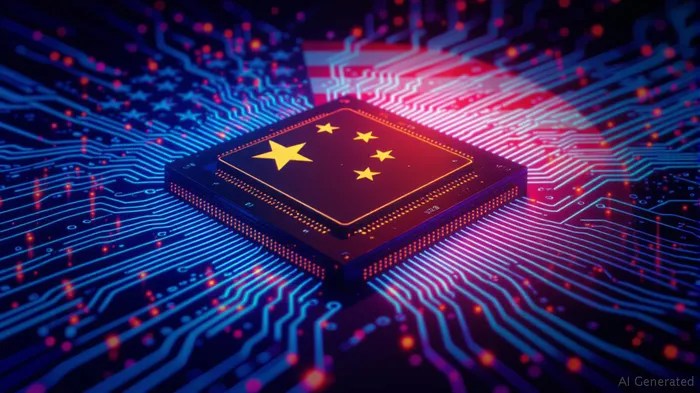
The New Semiconductor Cold War: What's at Stake?
The June 2025 U.S.-China framework agreement marked a partial de-escalation, lifting bans on electronic design automation (EDA) software and jet engine exports to China. Yet, critical restrictions remain—most notably on advanced AI chips like NVIDIA's H20 and Huawei's Ascend line. These tensions are accelerating a global reshoring of semiconductor production, with U.S. companies now at the forefront of this $500 billion industry's transformation.
The CHIPS Act, which allocated $39 billion in grants for domestic chip manufacturing, is the linchpin of this shift. By 2025, over $32 billion has been disbursed, fueling projects that will triple U.S. semiconductor capacity by 2030. But not all stocks are equal. Let's dissect the winners and risks.
Top Undervalued Plays in the Semiconductor Sector
1. TSMC (TSM): The Foundry Leader with U.S. Bet
TSMC's $65 billion Arizona fab—a cornerstone of the CHIPS Act—will produce 3nm and 2nm chips for AI, defense, and hyperscale data centers. Despite its $6.6 billion in federal grants, TSMCTSM-- trades at 18x forward earnings, below its 2023 average. Catalysts include Pentagon contracts under its “Silicon Shield” initiative and the ramp-up of its U.S. 3nm production by 遑2026.
Risk: Smuggling of Chinese chiplets (e.g., Huawei's 2 million illicit procurement) could undercut TSMC's market dominance.
2. Intel (INTC): Rebuilding U.S. Chip Sovereignty
Intel's $100 billion investment in Arizona and Ohio, backed by an $8.5 billion CHIPS grant, positions it to reclaim leadership in advanced logic chips. Its undervalued stock (7x forward earnings) reflects skepticism over its shift to contract manufacturing. However, Intel's “Secure Enclave” program—poised to secure $3 billion in defense grants—could unlock a $100 billion market in secure chip production for military systems.
Catalyst: 2025 earnings could surprise to the upside if its new Arizona 20A process nodes hit targets.
3. Micron (MU): Memory Chips at a Bargain Price
Micron's $6.1 billion in CHIPS grants for U.S. DRAM factories insulates it from geopolitical risks tied to Asian competitors. Its P/E of 12 is a steal, given its 15% CAGR in AI-driven memory demand. While cyclical oversupply pressures its short-term prospects, Micron's New York fab (online by 2026) will supply U.S. data centers, reducing reliance on China.
Risk: Global wafer shortages could delay U.S. production timelines.
4. GlobalFoundries (GFS): The Mature-Nodes Play
GlobalFoundries' $1.5 billion CHIPS-funded expansion into mature-node production (used in autos, IoT, and industrial systems) fills a strategic gap: 95% of such capacity is in Asia. Trading at 5x cash flow, GFS is a defensive bet in a sector prone to cyclical swings. Its niche focus reduces execution risks while addressing U.S. supply chain vulnerabilities.
Catalyst: New automotive chip contracts with Ford and GMGM-- could accelerate in 2025.
The Risks: Smuggling, Politics, and Overcapacity
While the CHIPS Act creates tailwinds, three risks loom:
1. Smuggling Networks: Chinese firms like Huawei are using shellSHEL-- companies to bypass export controls, as seen in the $390 million GPU smuggling case. This could delay U.S. dominance.
2. Political Volatility: President Trump's push to renegotiate CHIPS grants under the “U.S. Investment Accelerator” could slow funding for IntelINTC-- and TSMC.
3. Overcapacity by 2026: A global chip oversupply cycle (historically every 3–5 years) may hit just as new fabs come online.
Investment Strategy: Prioritize Leadership and Resilience
- Buy TSM and INTC first: Their scale, CHIPS funding, and defense ties make them critical to U.S. chip sovereignty.
- Add MU and GFS for diversification: Micron's memory plays and GlobalFoundries' mature-node niche provide asymmetric upside.
- Avoid Chinese names (SMIC) and Dutch giants (ASML): Geopolitical risks and U.S. export controls make these names vulnerable.
Conclusion: Act Now Before the Cold War Tightens
The U.S.-China tech divide is here to stay. Companies like TSMC and Intel are the ultimate beneficiaries of supply chain reshoring and defense spending. With geopolitical friction fueling their growth—and their stocks trading below intrinsic value—the time to act is now.
Final Advice:
- Aggressive investors: Overweight TSMTSM-- and INTCINTC--, using dips below $80 and $25 respectively as entry points.
- Conservative investors: Pair with sector ETFs like SOXX for diversification, but ensure CHIPS Act beneficiaries dominate your portfolio.
The semiconductor cold war isn't ending anytime soon. The winners will be those who bet on U.S. manufacturing resilience—and the stocks that power it.

Delivering real-time insights and analysis on emerging financial trends and market movements.
Latest Articles
Stay ahead of the market.
Get curated U.S. market news, insights and key dates delivered to your inbox.
AInvest
PRO
AInvest
PRO



Comments
No comments yet