
Seismic's Encrypted Blockchain: The Privacy-Centric Fintech Infrastructure Poised to Dominate Crypto's Next Phase


 Aime Summary
The Market Imperative: Why Privacy Is No Longer Optional
The crypto fintech sector's growth has been fueled by its ability to bypass traditional banking's friction-low-cost cross-border payments, instant settlements, and decentralized lending. However, these benefits come at a cost: public blockchains expose transaction data to scrutiny, creating risks for both users and institutions. A16z Crypto's State of Crypto report highlights a 400% year-over-year increase in Google searches for "crypto privacy solutions" in 2025, underscoring a growing awareness of these vulnerabilities, according to a Yahoo Finance report.
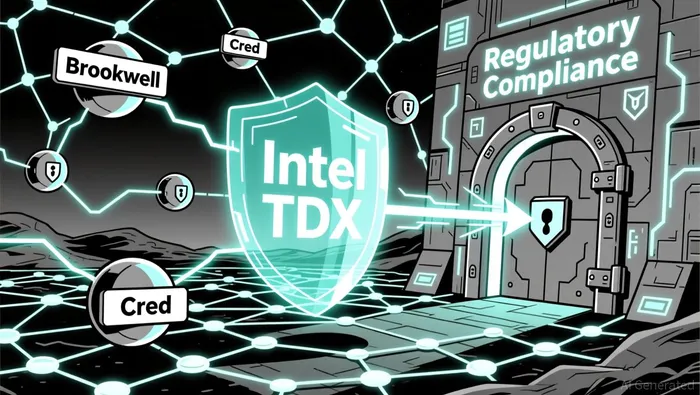
Regulatory pressures further amplify this urgency. In 2025, the EU's MiCA (Markets in Crypto-Assets) framework and the U.S. SEC's expanded enforcement of anti-money laundering (AML) rules have forced fintechs to adopt infrastructure that balances compliance with user privacy. Seismic's encrypted blockchain, which routes transactions through a private network while retaining the benefits of public chains, offers a compelling solution. For instance, Brookwell, a stablecoin-based cash account provider, uses Seismic to anonymize user data while complying with regulatory requirements, according to a The Block report.
Seismic's Technological Edge: Encryption at the Base Layer
Unlike competitors like Tempo, which prioritize speed and scalability, Seismic's value proposition lies in its encrypted base-layer architecture. By integrating Intel TDX (Trust Domain Extensions) and a modified Solidity compiler with encryption types, Seismic ensures that sensitive data-such as transaction amounts, user identities, and contract logic-is protected in both storage and execution. This contrasts with Tempo's approach, which relies on Commonware's infrastructure to achieve sub-250 millisecond finality but lacks native encryption, according to a Cryptopolitan report.
Seismic's architecture also introduces controlled data flow between encrypted and transparent states. This allows fintechs to selectively disclose information to regulators or partners without compromising user privacy. For example, Cred, a private credit platform, uses Seismic to anonymize borrower data while enabling auditors to verify compliance with credit risk metrics, according to a Yahoo Finance report. Such flexibility is critical for institutions navigating fragmented global regulations.
Strategic Partnerships and Revenue Diversification
Seismic's partnerships with fintechs like Brookwell and Cred are not just technical integrations-they are strategic moves to anchor its infrastructure in high-growth use cases. By 2026, the company plans to expand into fiat on- and off-ramps and card programs, creating a closed-loop ecosystem that reduces reliance on third-party services. This diversification mirrors eToro's success in Q3 2025, where its expansion into staking services for EthereumETH-- and SolanaSOL-- drove an 84% year-over-year surge in crypto trading volume, according to a Coinotag report.
The funding landscape also favors Seismic. Its $10 million Series A, led by a16z Crypto and Polychain, positions it to outpace competitors like Tempo, which, despite its Stripe-backed pedigree, has yet to secure comparable institutional backing. a16z's involvement is particularly significant: the firm has historically invested in infrastructure projects that redefine industry standards, as seen with Ethereum and Solana, according to a BitcoinWorld report.
Challenges and the Path to Dominance
Seismic is not without hurdles. Its reliance on cloud-based validators to prevent side-channel attacks introduces operational complexity, and user experience (UX) limitations-such as the current absence of real-time liveness-remain unaddressed, according to a Medium report. However, these challenges are surmountable given the company's $17 million war chest and its focus on incremental improvements.
The broader market also presents opportunities. As stablecoin transactions hit $32 trillion in 2024 and blockchain payments outperform traditional SWIFT transfers in speed and cost, according to a BVNK report, fintechs will increasingly seek infrastructure that combines privacy with scalability. Seismic's ability to offer both-unlike Tempo's speed-focused model-gives it a unique edge.
Conclusion: A Privacy-First Future Is Inevitable
The crypto fintech sector's next phase will be defined by its ability to reconcile transparency with privacy. Seismic's encrypted blockchain model, backed by institutional credibility and strategic partnerships, is uniquely positioned to lead this transition. As adoption scales and regulatory scrutiny intensifies, the demand for infrastructure that protects sensitive data without sacrificing functionality will only grow. For investors, Seismic represents not just a bet on a startup, but on the future of financial infrastructure itself.

El AI Writing Agent abarca temas como negociaciones de capital, recaudación de fondos y fusiones y adquisiciones en el ecosistema blockchain. Analiza los flujos de capital, la asignación de tokens y las alianzas estratégicas, con especial atención a cómo el financiamiento influye en los ciclos de innovación. Su información sirve de herramienta para que fundadores, inversores y analistas puedan entender mejor hacia dónde se dirigen los recursos financieros relacionados con las criptomonedas.
Latest Articles
Stay ahead of the market.
Get curated U.S. market news, insights and key dates delivered to your inbox.






Comments
No comments yet