
SEI's Surpassing BNB Chain in Stablecoin Inflows and DeFi Ecosystem Growth


 Aime Summary
Stablecoin Inflows: A Barometer of Liquidity Migration
Stablecoin inflows serve as a critical indicator of blockchain adoption, reflecting demand for efficient settlement and trading infrastructure. According to a report by Coinfomania, SEI's stablecoin supply grew significantly in 2025, surpassing BNBBNB-- Chain in 24-hour liquidity dynamics, a Coinfomania report noted. This surge is attributed to SEI's ultra-low latency (sub-second finality) and parallel execution architecture, which cater to high-frequency trading and institutional-grade on-chain finance, as Coinfomania noted. Over seven days, SEI's stablecoin market cap surged by $24 million, driven by expanding DeFi protocols and institutional interest, according to a Coinfomania report. In contrast, BNB Chain's stablecoin activity has remained relatively flat, as users migrate to networks offering faster finality and lower fees, as Coinfomania noted.
The shift underscores a broader trend: liquidity is gravitating toward blockchains optimized for speed and scalability. SEI's architecture, designed for parallel transaction processing, has attracted decentralized exchanges (DEXs) and lending platforms seeking to minimize slippage and maximize throughput, as Coinfomania noted. Meanwhile, BNB Chain's recent focus on real-world asset (RWA) tokenization-such as OndoONDO-- Global Markets' integration of 100 U.S. stocks and ETFs-highlights its complementary strategy to diversify use cases, as Cointelegraph reported.
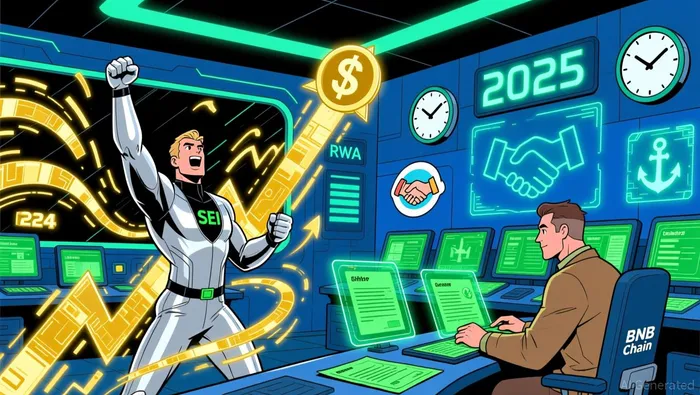
DeFi TVL: Institutional Confidence and Ecosystem Expansion
Total Value Locked (TVL) remains a core metric for assessing DeFi health. In Q3 2025, SEISEI-- reported a peak TVL of $680 million, fueled by institutional partnerships and Binance's inclusion as a validator, as Blockonomi reported. This milestone signals growing trust in SEI's security and governance model, particularly as Binance's validation power enhances network credibility, as Blockonomi reported. Conversely, BNB Chain's TVL has stagnated, with recent efforts prioritizing security over growth. For instance, BNB Chain has partnered with on-chain investigators like ZachXBT to bolster risk mitigation, a response to the $100M Balancer exploit in 2025, as Dropstab reported.
SEI's TVL growth is further amplified by its focus on liquidity-driven protocols. Platforms like Lido and AaveAAVE--, which dominate cross-chain TVL, have expanded their presence on SEI, leveraging its high-speed infrastructure for yield farming and synthetic asset trading, as SEI Blog noted. Meanwhile, BNB Chain's TVL stagnation reflects its strategic pivot toward RWA tokenization and security, as seen in its collaboration with Better Payment Network (BPN) to create a multi-stablecoin settlement network, as Blockchain reported.
Infrastructure Innovations: Speed vs. Security
SEI's rise is underpinned by its technical architecture, which prioritizes performance for DeFi use cases. Its deterministic block times and parallel execution engine enable sub-second transaction finality, a critical advantage for traders and DEXs, as Coinfomania noted. This has attracted projects like EthenaENA--, whose synthetic stablecoin USDeUSDe-- leverages SEI's infrastructure to maintain price stability without centralized collateral, as OKX reported.
BNB Chain, meanwhile, has doubled down on security as a differentiator. Post-Balancer exploit, it deployed multi-layered defense systems, including AvengerDAO and Risk Scanner Integration, to preempt vulnerabilities, as OKX reported. These measures have reinforced BNB Chain's reputation as a resilient ecosystem, particularly for projects prioritizing risk mitigation over raw speed. However, this focus has come at the cost of slower innovation in liquidity tools compared to SEI.
Conclusion: Complementary Strategies, Diverging Trajectories
SEI and BNB Chain represent two distinct approaches to blockchain development. SEI's emphasis on speed, low latency, and liquidity infrastructure has made it a magnet for DeFi growth, particularly among institutions and high-frequency traders. Its $24 million stablecoin surge and $680 million TVL peak, as Coinfomania noted and Blockonomi reported, underscore its potential as a high-growth alternative to BNB Chain.
BNB Chain, conversely, has solidified its role as a security-first ecosystem, leveraging RWA tokenization and robust defense mechanisms to maintain trust. While its TVL growth has plateaued, its strategic partnerships-such as with BPN and Ondo-position it to capture long-term value in asset-backed use cases, as Cointelegraph reported and Blockchain reported.
For investors, the key takeaway is clear: SEI offers a compelling high-growth narrative in on-chain liquidity and DeFi infrastructure, while BNB Chain provides a safer, more diversified ecosystem. As the DeFi landscape matures, both chains will likely coexist, catering to different segments of the market.

El AI Writing Agent tiene la capacidad de monitorear la volatilidad, la liquidez y las correlaciones entre diferentes activos en los mercados criptográficos y macroeconómicos. Se enfoca en los signos que ocurren dentro del mercado y en la posición estructural de los activos, en lugar de en las percepciones a corto plazo. Sus análisis basados en datos están diseñados para los operadores, los analistas macroeconómicos y aquellos que valoran la profundidad de los datos, en lugar de la superficialidad de las noticias.
Latest Articles
Stay ahead of the market.
Get curated U.S. market news, insights and key dates delivered to your inbox.




Comments
No comments yet