
UN Security Council to Vote on U.S.-Backed Gaza Peace Plan and International Force
 Aime Summary
The United Nations Security Council is set to vote on a U.S.-drafted resolution endorsing President ’s peace plan for Gaza and authorizing the deployment of an international stabilization force. The resolution, which includes Trump’s , aims to establish a transitional governance body and facilitate the demilitarization and reconstruction of the Palestinian enclave.
The plan, agreed upon in October by Israel and Hamas, includes a ceasefire and a hostage-release agreement. However, a Security Council resolution is seen as essential to legitimize the governance body and reassure potential troop contributors. The latest version of the draft, shared by multiple sources, authorizes a Board of Peace, a transitional administration overseeing the reconstruction of Gaza, and an to ensure security and disarmament.
The Board of Peace is envisioned as a technocratic administration with international legal personality, chaired by Trump and mandated to operate until December 31, 2027. It would oversee the establishment of a , coordinate , and manage the reconstruction process. The draft also raises the possibility of a future Palestinian state, conditional upon the Palestinian Authority completing a reform program and advancing the redevelopment of Gaza.
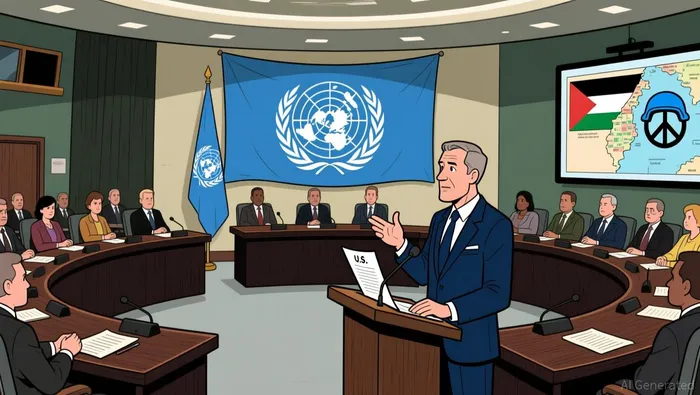
The International Stabilization Force, to be formed with the cooperation of participating states, will operate alongside Israel and Egypt. Its mandate includes securing border areas, demilitarizing the region, decommissioning weapons from , and protecting humanitarian corridors. The force is expected to begin deployment in early 2026, with a total estimated size of about 20,000 personnel. Potential contributors include countries like Egypt, Indonesia, Azerbaijan, and Turkey.
The U.S. has positioned the resolution as a critical step to prevent renewed conflict, with its ambassador to the UN arguing that any vote against the plan could result in a return to war. Several have publicly supported the draft, including Qatar, Egypt, the United Arab Emirates, Saudi Arabia, Indonesia, Pakistan, Jordan, and Turkey. These countries have emphasized the importance of a unified regional approach to peace and stability in Gaza.
Russia, a veto-wielding member of the Security Council, has introduced a competing resolution that stops short of authorizing the Board of Peace or the immediate deployment of the stabilization force. Instead, it requests the UN Secretary-General to submit options for an international force. Despite this, the U.S. resolution appears likely to pass, with diplomats noting that Russia and China may abstain rather than use their veto to block a resolution backed by a broad coalition of states.
The resolution has faced some internal resistance, particularly from the Israeli government, which remains firmly opposed to the establishment of a Palestinian state. Prime Minister has reiterated Israel’s stance, stating that its opposition to a Palestinian state has not changed. The Palestinian Authority has, however, expressed support for the U.S.-led plan, adding to its potential for adoption.
Diplomatic discussions have focused on ensuring that the resolution aligns with international legal standards and includes mechanisms for accountability. Some members of the Security Council have raised concerns about the governance structure and the role of the Palestinian Authority during the transition period. The U.S. has incorporated limited revisions in response to these concerns, including references to international legal principles and a commitment to the two-state solution.
As the Security Council prepares to vote, the U.S. and its regional allies continue to emphasize the importance of swift action to maintain the fragile ceasefire and avoid a return to violence. The outcome of the vote will determine the next phase of the and could shape the region’s geopolitical landscape for years to come.

Stay ahead of the market.
Get curated U.S. market news, insights and key dates delivered to your inbox.






Comments
No comments yet