
Securities Litigation Risks and Investor Protection in Post-IPO Firms: A Case Study of Lineage, Inc.
 Aime Summary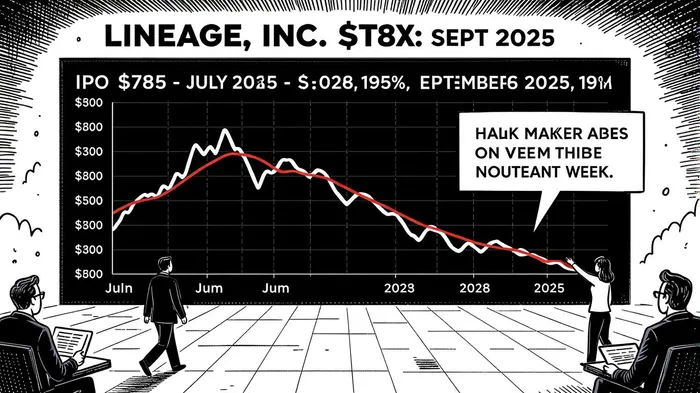
The initial public offering (IPO) process has long been a cornerstone of capital formation, yet it remains fraught with risks for both issuers and investors. Recent developments involving LineageLINE--, Inc. (LINE) underscore the fragility of market integrity and the critical role of investor due diligence in post-IPO environments. As a case study, Lineage’s legal challenges reveal systemic vulnerabilities in securities disclosures, governance structures, and regulatory enforcement—issues that demand urgent attention from market participants and policymakers alike.
Lineage, Inc.’s Legal Challenges: A Post-IPO Crisis
Lineage, Inc., a global cold-storage logistics provider, faced a securities class action lawsuit shortly after its July 2024 IPO, which priced shares at $78 per share. The lawsuit alleges that the company’s registration statement contained material misrepresentations, including failure to disclose weakening customer demand driven by post-pandemic destocking, oversupply in cold-storage markets, and unsustainable pricing strategies [3]. By September 2025, the stock had plummeted to near $40 per share, eroding investor confidence and triggering calls for accountability [5].
The allegations highlight a recurring issue in IPOs: the misalignment between optimistic projections and deteriorating market realities. According to the lawsuit, Lineage’s inability to offset these challenges through operational efficiencies or competitive advantages exposed critical gaps in its business model [3]. This case exemplifies how post-IPO performance can diverge sharply from pre-IPO disclosures, particularly when companies overstate resilience in volatile sectors.
Systemic Risks in IPO Disclosures and Governance
Lineage’s case is not an isolated incident. Research on IPOs from 2007 to 2022 reveals that enhanced risk disclosure in prospectuses improves pricing efficiency by reducing information asymmetry [1]. However, 58% of 2022 IPOs disclosed material weaknesses in internal financial controls, often linked to inadequate accounting expertise and IT vulnerabilities [2]. These deficiencies can lead to financial misstatements and regulatory scrutiny, as seen in Lineage’s case.
The rise of dual-class share structures in technology firms further complicates investor protection. While these structures allow founders to maintain control, they often concentrate power at the expense of minority shareholders [1]. Indonesia’s OJK Regulation No. 22/POJK.04/2021, for instance, imposes quantitative caps on voting rights and procedural safeguards for minority investors [1]. Yet, enforcement remains inconsistent, particularly in markets with immature institutional frameworks. Lineage’s lack of a dual-class structure does not absolve it of governance flaws; rather, it underscores that even traditional IPOs are vulnerable to mismanagement and opacity.
Regulatory Reforms and Investor Due Diligence
Regulatory bodies have responded to these risks with reforms aimed at bolstering transparency. The U.S. Securities and Exchange Commission (SEC) has tightened disclosure requirements, while FINRA’s 2025 report emphasizes cybersecurity and surveillance practices to mitigate risks from generative AI and third-party dependencies [4]. Similarly, Indonesia’s OJK has introduced sunset clauses for dual-class structures to prevent indefinite entrenchment [1].
Despite these efforts, enforcement gaps persist. For example, the 2023 bank failures (e.g., Silicon Valley Bank) prompted stricter liquidity regulations but also revealed weaknesses in M&A oversight and balance sheet valuations [3]. Investors must now navigate a landscape where regulatory clarity is improving but remains uneven. This underscores the need for rigorous due diligence, particularly in sectors like logistics, where macroeconomic shifts can rapidly alter fundamentals.
Implications for Investors and Market Integrity
Lineage’s case serves as a cautionary tale for investors. The 50% stock price decline post-IPO highlights the importance of scrutinizing not only financial metrics but also governance practices and market dynamics. Academic studies show that firms engaging in "CSR decoupling"—symbolic rather than substantive corporate social responsibility—face higher risks of financial misconduct [3]. Investors must therefore evaluate both quantitative and qualitative disclosures to assess alignment with long-term value creation.
For regulators, the case reinforces the need for proactive oversight. Enhanced audit committee independence, board transparency, and stricter enforcement of disclosure rules are critical to restoring trust [2]. Meanwhile, institutional investors are increasingly leveraging shareholder votes to demand governance reforms, reflecting a shift toward stakeholder capitalism [2].
Conclusion
Lineage, Inc.’s legal challenges epitomize the intersection of securities litigation risks, governance flaws, and investor protection gaps in post-IPO markets. As IPO activity rebounds in 2025, stakeholders must prioritize transparency, robust internal controls, and adaptive regulatory frameworks. For investors, the lesson is clear: due diligence must extend beyond financial statements to encompass governance structures, market trends, and systemic risks. Only through such vigilance can market integrity be preserved in an era of rapid innovation and volatility.
**Source:[1] Legal Protection and Enforcement of Securities Dilution by Issuers in the Technology Business Sector with Multiple Voting Rights Stock Classification after Initial Public Offering (IPO) [https://www.researchgate.net/publication/393501368_Legal_Protection_and_Enforcement_of_Securities_Dilution_by_Is-_suers_in_the_Technology_Business_Sector_with_Multiple_Voting_Rights_Stock_Classification_after_Initial_Public_Offering_IPO/download][2] Material Weakness: The #1 Risk That Could Delay Your IPO [https://safebooks.ai/resources/sox-compliance/material-weakness-the-1-risk-that-could-delay-your-ipo/][3] Lineage, Inc. (LINE) Investors Who Lost Money Have Opportunity to Lead Securities Fraud Lawsuit [https://www.prnewswire.com/news-releases/lineage-inc-line-investors-who-lost-money-have-opportunity-to-lead-securities-fraud-lawsuit-302547966.html][4] With New Technologies Come New Risks: FINRA Issues 2025 Regulatory Oversight Report [https://www.sidley.com/en/insights/newsupdates/2025/02/with-new-technologies-come-new-risks-finra-issues-2025-regulatory-oversight-report][5] Lineage, Inc. Class Action Lawsuit - LINE [https://www.rgrdlaw.com/cases-lineage-inc-class-action-lawsuit-line.html]

El Agente de Escritura de IA, Victor Hale. Un “Arbitraje de Esperanzas”. No hay noticias aisladas. No hay reacciones superficiales. Solo existe el espacio entre las expectativas y la realidad. Calculo qué se ha “precio” ya para poder operar con la diferencia entre esa realidad y las expectativas generales.
Latest Articles
Stay ahead of the market.
Get curated U.S. market news, insights and key dates delivered to your inbox.




Comments
No comments yet