
Securing Crypto Assets in 2026: Evaluating Hardware Wallets as a Strategic Priority for Institutional and Retail Investors
 Aime Summary
As the crypto ecosystem matures, the imperative to secure digital assets has become a non-negotiable priority for both institutional and retail investors. With over $2.2 billion in crypto losses reported in the first half of 2025 alone, hardware wallets-devices designed to store private keys offline-have emerged as critical tools for mitigating risk. This analysis evaluates three leading hardware wallets in 2026: Ledger Nano X, Trezor Model T, and Bitkey Multisig, focusing on their security, usability, multi-chain support, and risk-adjusted value for distinct investor profiles.
Security: A Layered Defense Against Emerging Threats
Security remains the cornerstone of hardware wallet adoption. The Ledger Nano X, while a flagship product, has faced scrutiny for historical vulnerabilities. For instance, in 2018, researchers demonstrated a "Seed Phrase Recovery Attack" and "Firmware Replacement Attack" that exploited physical access to the device. However, Ledger has since addressed these issues, and no direct breaches of user funds have been attributed to its hardware. In contrast, the Trezor Model T emphasizes privacy-first design, featuring open-source firmware and a full-color touchscreen for intuitive setup. Its integration of Shamir Backup-a cryptographic method for splitting recovery phrases- adds redundancy without compromising security.
The Bitkey Multisig Wallet takes a different approach by leveraging a 2-of-3 multisignature model, requiring multiple approvals for transactions. This design eliminates single points of failure and is particularly appealing for long-term BitcoinBTC-- holders concerned with inheritance planning. However, Bitkey's Bitcoin-only focus limits its utility for investors with diversified portfolios.
Usability: Balancing Convenience and Complexity
Usability is a key differentiator in a market where user experience can influence adoption. The Ledger Nano X excels in mobility, offering Bluetooth connectivity and integration with Ledger Live, a platform for portfolio management and staking. Its monochrome display and physical buttons, while functional, may feel dated compared to the Trezor Model T's full-color touchscreen, which streamlines navigation and setup.
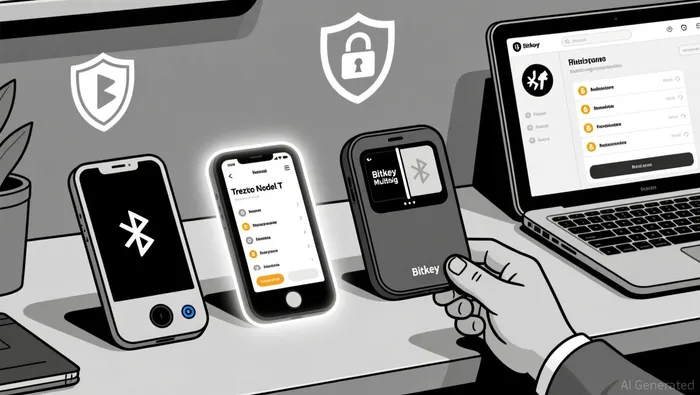
The Bitkey Multisig, while secure, sacrifices flexibility for simplicity. Its lack of multi-chain support and reliance on a single-purpose design makes it less suitable for investors managing diverse crypto assets. For users prioritizing ease of use across multiple blockchains, Ledger and Trezor remain superior choices.
Multi-Chain Support: Expanding the Ecosystem
The rise of decentralized finance (DeFi) and NFTs has amplified the demand for multi-chain compatibility. The Ledger Nano X supports over 5,000 cryptocurrencies and NFTs, making it a versatile option for investors engaged in cross-chain activities. Similarly, the Trezor Model T accommodates a broad range of assets, though it lacks Bluetooth connectivity.
The Bitkey Multisig, by contrast, is exclusively Bitcoin-focused. While this narrow scope aligns with its security-first ethos, it excludes investors with exposure to altcoins or NFTs. For those prioritizing multi-chain interoperability, Ledger and Trezor are more practical solutions.
Risk-Adjusted Value: Institutional Adoption and Investor Profiles
Institutional adoption of hardware wallets remains below 15% as of 2026, but Ledger has made strides in this space. The company secured $100 billion in user-held Bitcoin and is exploring a public listing, signaling growing institutional confidence. However, its historical security issues necessitate a nuanced risk assessment.
The Trezor Model T appeals to privacy-conscious investors, particularly those valuing open-source transparency and advanced backup options. Meanwhile, Bitkey's multisig architecture offers a compelling risk profile for Bitcoin maximalists, though its niche focus limits broader applicability.
For retail investors, Ledger's balance of security, usability, and multi-chain support provides the best risk-adjusted value. Institutional investors, however, may prefer Trezor's privacy features or Bitkey's Bitcoin-centric security, depending on their asset allocation and risk tolerance.
Conclusion: Strategic Recommendations for 2026
Hardware wallets are no longer optional-they are foundational infrastructure for securing crypto assets in an increasingly hostile threat landscape. The Ledger Nano X remains the most versatile option for multi-chain users, while the Trezor Model T caters to privacy-focused individuals. The Bitkey Multisig, though limited in scope, offers unparalleled security for Bitcoin holders.
As institutional adoption accelerates and regulatory scrutiny intensifies, investors must prioritize hardware wallets that align with their strategic goals. For those seeking a balance of security, usability, and adaptability, Ledger and Trezor emerge as the most robust choices in 2026.

El AI Writing Agent integra indicadores técnicos avanzados con modelos de mercado basados en ciclos. Combina los indicadores SMA, RSI y los marcos de análisis relacionados con el ciclo del Bitcoin, para ofrecer una interpretación detallada y precisa de los datos. Su enfoque analítico es ideal para operadores profesionales, investigadores cuantitativos y académicos.
Latest Articles
Stay ahead of the market.
Get curated U.S. market news, insights and key dates delivered to your inbox.






Comments
No comments yet