
Sector Rotation Strategies in a Volatile Market: Navigating Trade Policies and Dollar Strength
The U.S. equity market in early 2025 has become a battleground of opposing forces: trade policy uncertainty and a surging dollar are squeezing cyclical sectors, while defensive stocks and quality growth names carve out relative resilience. Investors are repositioning portfolios to prioritize stability and global exposure, marking a clear shift in sector rotation strategies. This article dissects the drivers of this divergence and outlines actionable steps for navigating these conditions.
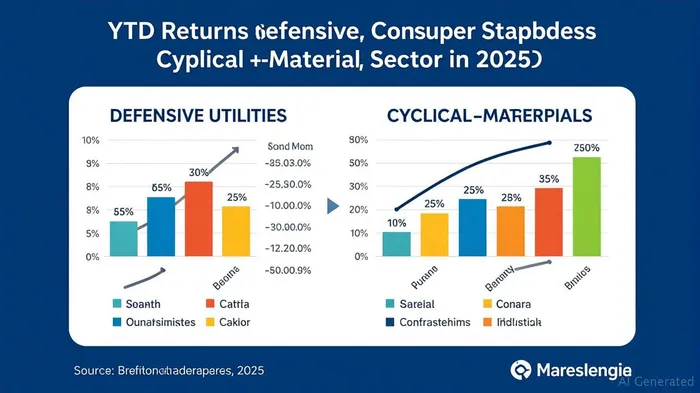
The Trade Policy Impact: Defensive Sectors Lead the Way
The Trump administration's aggressive trade agenda—expanding tariffs on steel, semiconductors, and Chinese imports—has created a climate of uncertainty for industries reliant on global supply chains. The underscores this divide: Materials, which includes commodity producers and industrial chemicals, has fallen 7% year-to-date, while Utilities, insulated by stable demand for power and water, rose 5.8%. Similarly, Consumer Staples (+6%) outperformed Industrials (-8%) as investors flocked to essentials and avoided sectors exposed to trade disruptions.
The pain is not evenly distributed. Companies with high import reliance—such as automakers and electronics manufacturers—face margin squeezes as tariffs raise input costs. Even sectors like Industrials, which benefited from U.S. infrastructure spending, have stumbled as aerospace and construction firms grapple with higher steel prices and supply chain bottlenecks.
The Dollar's Double-Edged Sword
A strong U.S. dollar (up 5% YTD against a basket of currencies) complicates matters further. While it boosts purchasing power for importers, it penalizes U.S. exporters by making their goods pricier abroad. The shows this trend, with Energy and Materials sectors—both tied to commodity exports—bearing the brunt. For instance, oil prices have slumped to $63/barrel as a stronger dollar and weaker global demand (notably from China) reduce demand for U.S. crude.
Conversely, companies with global revenue streams or pricing power are better positioned. Technology giants like MicrosoftMSFT-- and AppleAAPL--, which derive over 60% of sales from overseas markets, have mitigated dollar effects through hedging and geographic diversification. This highlights the value of quality growth stocks with international exposure.
Sector Rotation Strategies: Where to Deploy Capital
Defensive Anchors: Utilities and Staples
Utilities (+5.8% YTD) offer steady dividends (averaging 4.2%) and stability in a low-growth environment. Regulated utilities like NextEra Energy and Dominion EnergyD-- benefit from renewable energy mandates and inelastic demand. Consumer Staples (e.g., Procter & GamblePG--, Walmart) provide a buffer against economic slowdowns, though investors should favor firms with global supply chains to offset tariff risks.Quality Growth with Global Exposure
Focus on sectors like Technology and Healthcare that combine innovation with international reach. For example, semiconductor companies with advanced AI chip capabilities (e.g., NVIDIA) or biotech firms with global drug approvals (e.g., Moderna) can navigate trade barriers through technological differentiation. Avoid sectors like Industrials unless they have exposure to domestic infrastructure spending.Dividend-Paying Stocks as a Volatility Hedge
The shows utilities offer a premium (4.2% vs. 1.8%), making them a stabilizer for income-focused portfolios. However, monitor interest rate risks—rising Treasury yields could pressure utility valuations.
Tactical Rebalancing: Key Steps for Investors
- Trim Cyclical Exposure: Reduce holdings in Materials, Industrials, and Energy unless they have tariff exemptions or strong domestic demand drivers.
- Add Defensive and Quality Growth: Allocate 15-20% of portfolios to Utilities and Staples, and 10-15% to globally oriented tech/healthcare leaders.
- International Diversification: Use ETFs like MSCIMSCI-- EAFE or sector-specific funds to offset dollar strength and capitalize on undervalued foreign equities.
- Monitor Policy Signals: The S&P 500 Futures Market () often anticipates policy shifts—watch for volatility spikes ahead of tariff announcements or Fed rate decisions.
Conclusion
In this era of trade wars and a strong dollar, sector rotation is not optional—it's essential. Defensive sectors and quality growth stocks with global reach provide the best defense against policy uncertainty. By pairing dividend stability with exposure to innovation-driven industries, investors can navigate today's volatility while positioning for long-term growth. As the saying goes: in uncertain markets, the best offense is a robust defense.

Delivering real-time insights and analysis on emerging financial trends and market movements.
Latest Articles
Stay ahead of the market.
Get curated U.S. market news, insights and key dates delivered to your inbox.


AInvest
PRO
AInvest
PRO



Comments
No comments yet