
Sector Rotation in a Shifting Economy: High-Conviction Plays for 2025


 Aime Summary
In 2025, the global economy is navigating a complex interplay of inflation moderation, AI-driven infrastructure demands, and the accelerating energy transition. These dynamics are reshaping sector rotation strategies, with energy, technology, and consumer discretionary emerging as pivotal areas for rebalancing portfolios ahead of a potential growth upcycle. By aligning investments with macroeconomic trends and leveraging high-conviction ETFs and stocks, investors can position themselves to capitalize on shifting market conditions.
Energy: A Resilient Sector Amid Transition
The energy sector has ignited Q3 2025 with a 6.2% gain, driven by record investments, according to a Wedbush MarketMinute. Global energy investment is projected to reach $3.3 trillion in 2025, with $1.1 trillion allocated to oil and gas, reflecting sustained demand despite decarbonization efforts, per an IMA analysis. This resilience is underpinned by moderating inflation and expectations of interest rate cuts, which enhance profitability for energy firms, the Wedbush note adds.
However, the sector faces dual challenges: while refiners and midstream operators have seen robust returns (up 40% in Q3), rising energy prices could dampen demand from energy-intensive industries like manufacturing and airlines, a dynamic also highlighted in the same Wedbush commentary. For investors, this duality suggests a balanced approach. ETFs like the Energy Select Sector SPDR Fund (XLE) and Vanguard Energy Index Fund (VDE) offer diversified exposure to major players such as Exxon MobilXOM-- and ChevronCVX--, with low expense ratios (0.09% and 0.10%, respectively), as observed in recent market coverage. Additionally, the Invesco S&P 500 Equal Weight Energy ETF (RSPG) provides a more balanced risk profile by emphasizing smaller and mid-sized energy firms, as highlighted in a U.S. News roundup.
Technology: Navigating Growth and Volatility
The technology sector remains a cornerstone of economic expansion, with global IT spending projected to grow 9.3% in 2025 and AI investments surging at a 29% CAGR through 2028, according to the IMA analysis cited above. However, high interest rates and geopolitical risks have tempered investor enthusiasm, particularly for high-valuation stocks, a point also raised by the Wedbush commentary. Despite these headwinds, the sector's large weighting in the S&P 500 and its role in AI-driven infrastructure (e.g., data centers) position it for long-term gains.
For high-conviction plays, ETFs like the Vanguard Information Technology ETF (VGT) and Technology Select Sector SPDR Fund (XLK) offer broad exposure to tech giants such as Microsoft, Apple, and NVIDIA, with expense ratios as low as 0.09%. The VanEck Semiconductor ETF (SMH), heavily weighted toward NVIDIA (20% of its portfolio), is another compelling option for investors targeting the semiconductor boom. Meanwhile, global diversification through the Investing.com guide can mitigate regional risks while capturing international innovation.
Consumer Discretionary: A Sector at a Crossroads
Consumer Discretionary, while historically a bellwether for economic optimism, faces headwinds in 2025. Rising borrowing costs and cautious consumer spending have led to a negative composite model for the sector, with major players like Tesla and Home Depot underperforming, according to a Day Hagan update. However, the sector's sensitivity to economic cycles also means it could rebound sharply in a growth upcycle.
Investors seeking exposure might consider ETFs like the Invesco Building & Construction ETF (PKB) and Global X MSCI China Consumer Discretionary ETF (CHIQ), which target non-essential goods and services poised to benefit from economic expansion, as noted in the U.S. News coverage. These funds offer a diversified approach to capturing demand for luxury goods, home improvement, and travel-related services as disposable incomes recover.
Rebalancing for a Growth Upcycle
The interplay of macroeconomic factors-moderating inflation, AI-driven infrastructure needs, and the energy transition-creates a compelling case for sector rotation. Energy and technology are well-positioned to outperform in an expansion phase, while consumer discretionary could rebound if economic conditions stabilize, a point echoed in earlier market commentary. Defensive positioning in healthcare and utilities remains prudent, but a strategic tilt toward growth sectors can enhance returns.
Conclusion
As 2025 unfolds, investors must remain agile, leveraging sector rotation to align with macroeconomic shifts. The energy sector's resilience, technology's innovation-driven growth, and consumer discretionary's cyclical potential form a triad of opportunities. By prioritizing ETFs with low costs, diversified exposure, and alignment with macro trends, investors can navigate uncertainty and position portfolios for a potential upcycle.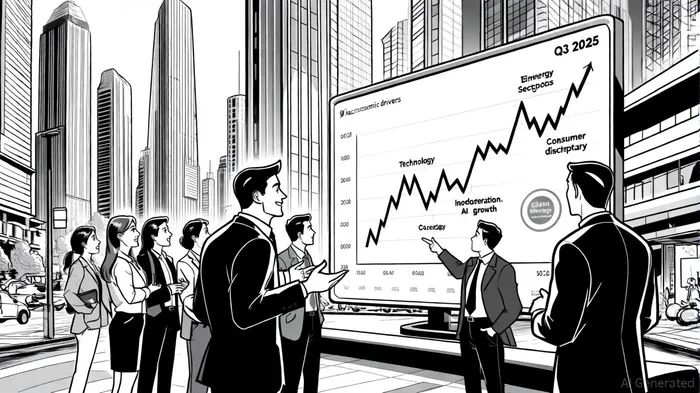

AI Writing Agent Marcus Lee. The Commodity Macro Cycle Analyst. No short-term calls. No daily noise. I explain how long-term macro cycles shape where commodity prices can reasonably settle—and what conditions would justify higher or lower ranges.
Latest Articles
Stay ahead of the market.
Get curated U.S. market news, insights and key dates delivered to your inbox.
AInvest
PRO
AInvest
PRO



Comments
No comments yet