
Sector Rotation Opportunities Amid Service Sector Softness
 Aime Summary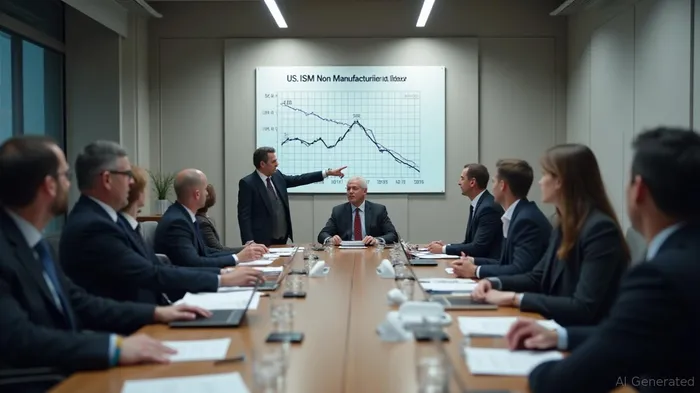
The U.S. ISM Non-Manufacturing Index, a critical barometer of the services sector, has weakened to 52.6 in March 2025, marking a significant decline from its October 2024 peak of 55.8. By July 2025, the index had further softened to 50.1, signaling a slowdown in economic activity. This contraction, driven by tariff-related disruptions, rising input costs, and employment challenges, has created divergent market responses across sectors. Investors must now navigate these dynamics to identify opportunities in Consumer Staples and Energy, two sectors with contrasting trajectories.
The Services Sector: A Tapering Expansion
The March 2025 reading of 52.6 reflected pre-tariff ordering activity, with businesses stockpiling imports ahead of anticipated policy shifts. However, the subsequent decline to 50.1 in July underscores a broader malaise. Key components of the index, such as the Employment Index (46.4 in July 2025) and Prices Index (69.9), highlight persistent inflationary pressures and labor market fragility. The Supplier Deliveries Index (51.0) also indicates prolonged supply chain delays, compounding operational costs.
This softness has ripple effects across the economy. The services sector accounts for ~80% of U.S. GDP, and its contraction signals reduced consumer spending, tighter corporate budgets, and heightened uncertainty. For investors, this environment demands a strategic shift in sector exposure, favoring industries with pricing power and resilience to macroeconomic headwinds.
Consumer Staples: Defensive Resilience Amid Uncertainty
The Consumer Staples sector, encompassing food, beverage, and household goods, has shown mixed performance. While the Food, Beverage & Tobacco Products industry reported growth in June 2025, broader challenges persist. Rising material costs, driven by tariffs on raw materials like aluminum and steel, have squeezed margins. Additionally, consumer demand remains cautious, with households prioritizing essentials over discretionary spending.
However, Consumer Staples remains a defensive play. Companies like Procter & Gamble (PG) and Coca-Cola (KO) have demonstrated pricing resilience, passing on cost increases to consumers while maintaining market share. The sector's low volatility and stable cash flows make it a safe haven in a slowing economy. Investors should focus on firms with strong brand equity and supply chain flexibility to mitigate input cost risks.
Energy: A Contrarian Play Amid Geopolitical and Policy Shifts
In contrast, the Energy sector has outperformed, particularly in Petroleum & Coal Products and Utilities. The Energy Index expanded in both June and July 2025, driven by geopolitical tensions and rising natural gas prices. Tariffs on imported energy infrastructure components have also spurred domestic production, benefiting firms like ExxonMobil (XOM) and Chevron (CVX).
The sector's strength is further bolstered by infrastructure spending and data center demand, which require significant energy inputs. However, investors must balance near-term gains with long-term risks, such as regulatory shifts toward renewables and potential oversupply in global oil markets. A tactical approach—overweighting energy producers with strong balance sheets and underweighting coal-dependent firms—could yield asymmetric returns.
Actionable Insights for Sector Rotation
- Increase Exposure to Energy: With tariffs and geopolitical instability driving demand, energy producers are well-positioned to capitalize on higher prices. Prioritize companies with low production costs and diversified reserves.
- Defensive Positioning in Consumer Staples: Allocate capital to high-quality staples firms with pricing power and strong cash flow generation. Avoid smaller players vulnerable to input cost shocks.
- Monitor Policy Developments: Tariff adjustments and trade policy changes will continue to shape sector dynamics. Stay attuned to legislative updates and their implications for supply chains.
- Rebalance Based on ISM Trends: The ISM Non-Manufacturing Index remains a leading indicator. If the index dips below 50, consider further defensive positioning; if it stabilizes above 50, selectively rotate into cyclical sectors.
Conclusion
The U.S. services sector's weakening to 52.6 in March 2025 and its subsequent contraction to 50.1 in July 2025 highlight a fragile economic backdrop. While Consumer Staples offers defensive resilience, Energy presents a contrarian opportunity amid geopolitical and policy-driven tailwinds. By strategically rotating between these sectors, investors can hedge against macroeconomic risks while capitalizing on divergent market responses. The key lies in agility—adjusting exposure as data evolves and policy landscapes shift.


Stay ahead of the market.
Get curated U.S. market news, insights and key dates delivered to your inbox.




Comments
No comments yet