
Sector Rotation Opportunities Amid Divergent U.S. Retail and Construction Market Dynamics
 Aime Summary
The U.S. economy in 2025 is marked by a striking divergence between the retail and construction sectors. While retail sales surged 3.47% year-over-year (YoY) in November 2025, . This divergence creates a compelling case for sector rotation strategies, as investors navigate shifting consumer demand and capital allocation priorities.
Construction: A Foundation of Stability, But Limited Upside
The construction sector, though growing at a slower pace, remains anchored by institutional and public infrastructure projects. Nonresidential construction spending is expected to reach $2.23 trillion in 2025, driven by healthcare, education, and renewable energy initiatives. Government funding for sustainability and broadband expansion has provided a tailwind, but the sector faces headwinds from financing constraints and regulatory uncertainty. For example, , yet private-sector projects remain subdued due to high borrowing costs.
Investors in construction should focus on firms with exposure to public contracts or those leveraging green energy mandates. Companies like Bechtel Group (BC) and Fluor CorporationFLR-- (FLR) are positioned to benefit from long-term infrastructure pipelines. However, the sector's growth is inherently cyclical and tied to macroeconomic stability, making it a defensive play rather than a high-growth opportunity.
Retail: A Tale of Two Sectors—Resilience and Fragmentation
U.S. retail sales in 2025 reflect a fragmented landscape. , month-over-month (MoM) performance was flat or declining in key categories. E-commerce growth, once a double-digit juggernaut, . This slowdown underscores a shift in consumer behavior, with shoppers prioritizing value and delaying purchases amid inflation and tariff pressures.
Yet, certain retail subsectors are thriving. , , , driven by holiday demand and value-conscious consumers. WalmartWMT-- (WMT) and TargetTGT-- (TGT) capitalized on this trend, with Walmart reporting double-digit growth in its membership program and Target leveraging private-label brands to absorb tariff costs. Meanwhile, nonstore retailers and electronics stores faced declines, highlighting the uneven recovery.
Sector Rotation: Balancing Growth and Stability
The divergence between retail and construction presents a strategic opportunity for investors to rotate capital between growth and stability. Here's how:
- Overweight Retail Subsectors with Resilient Demand:
- E-commerce with a Value Edge: Retailers like AmazonAMZN-- (AMZN) and Shopify (SHOP) are adapting to slower e-commerce growth by emphasizing price competitiveness and logistics efficiency.
Niche Retailers: Companies specializing in digital products (e.g., Adobe Systems, ADBE) or experiential retail (e.g., Best Buy, BBY) are capturing market share in a fragmented landscape.
Underweight Construction Unless Tied to Public Infrastructure:
Avoid speculative construction plays without clear public-sector contracts. Instead, focus on firms like KBR (KBR) or AECOM (ACM) with strong government ties.
Monitor Macroeconomic Catalysts:
- Tariff adjustments, inflation trends, and wage growth will continue to shape consumer spending. Retailers with agile supply chains (e.g., Costco, COST) and construction firms with green energy expertise (e.g., Jacobs Engineering, J) are best positioned to navigate these shifts.
Investment Advice: A Dual-Strategy Approach
- Short-Term (2025–2026): Allocate 60% to retail subsectors with strong YoY growth (e.g., digital products, sporting goods) and 40% to construction firms with public infrastructure exposure.
- Long-Term (2027+): Rebalance toward construction as infrastructure spending accelerates and retail normalization occurs, particularly in e-commerce.
The U.S. economy's divergent sector dynamics in 2025 highlight the importance of agility in portfolio management. By capitalizing on retail's fragmented growth and construction's stable but limited upside, investors can hedge against macroeconomic volatility while capturing value in both cyclical and structural trends.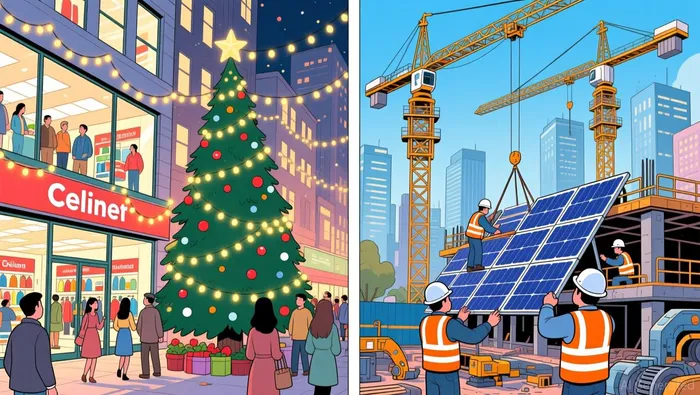

Stay ahead of the market.
Get curated U.S. market news, insights and key dates delivered to your inbox.




Comments
No comments yet