
Sector Rotation in Focus: Intel's Resilience vs. Tapestry's Volatility
 Aime Summary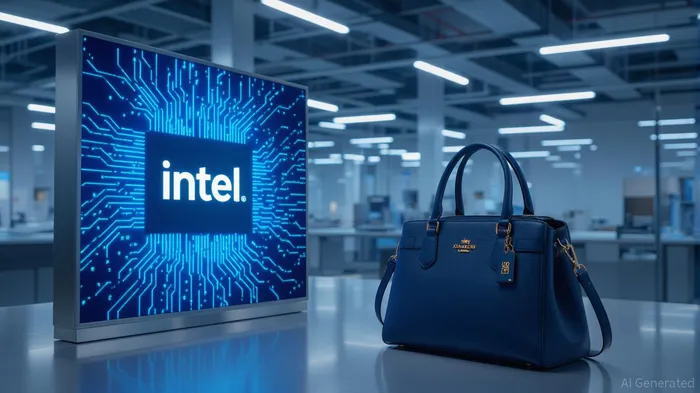
The stock market's recent dance between sectors has laid bare a stark contrast in investor sentiment: the relentless march of artificial intelligence and semiconductor innovation versus the fickle whims of luxury retail. Two companies, IntelINTC-- (INTC) and TapestryTPR-- (TPR), serve as case studies in this tug-of-war. While Intel has clawed its way into the spotlight with a rebound in AI-driven demand, Tapestry's stock has swung wildly, reflecting the fragility of consumer discretionary stocks in an uncertain macroeconomic climate.
The Semiconductor Comeback: Intel's Strategic Rebound
Intel's stock has surged 19% year-to-date, outperforming the S&P 500's 9.98% return, despite a five-year underperformance of 51.2%. This resurgence is not accidental. The company's Data Center & AI segment has become a lifeline, with revenue surging as global demand for AI chips and cloud infrastructure accelerates. Investors are betting that Intel's recent progress in stabilizing its manufacturing processes—after years of delays in transitioning to advanced nodes—could finally close the gapGAP-- with rivals like NVIDIANVDA-- and AMDAMD--.
The technical indicators are equally compelling. A “bottom formation” in the stock's price, confirmed by a retest of key support levels, has sparked speculation that INTCINTC-- is entering a new growth phase. Analysts point to the company's foundry services and AI partnerships as catalysts, though the road remains bumpy. Gross margins have plummeted to 38–39%, far below pre-pandemic levels, and a recent credit downgrade from Fitch underscores lingering risks. Yet, the market's focus has shifted to long-term potential, not short-term pain.
Tapestry's Turbulence: A Tale of Two Earnings Reports
Tapestry, the parent company of Coach and Stuart Weitzman, tells a different story. In Q4 2025, the company reported revenue of $1.72 billion, a 8.3% year-on-year increase, and a record gross margin of 76.3%. On paper, this was a win. But the GAAP loss of $2.49 per share—a sharp miss against expectations—triggered a 15% single-day sell-off. The stock, which had gained 47% year-to-date, now trades 14% below its 52-week high.
The disconnect between fundamentals and market reaction highlights the volatility of consumer discretionary stocks. Tapestry's management pointed to tariff headwinds, supply chain bottlenecks, and competitive pressures in luxury retail as key challenges. Yet, analysts like Telsey Advisory Group and EvercoreEVR-- ISI remain bullish, raising price targets to $125 and $130, respectively. Their optimism hinges on Tapestry's direct-to-consumer strategy and geographic expansion, particularly in China and Europe. Still, the stock's beta of 1.53—a measure of volatility—suggests investors should brace for more turbulence.
Sector Rotation: The Bigger Picture
The contrasting fates of Intel and Tapestry reflect broader sector rotation trends. Technology, driven by AI and semiconductors, has become the new “safe haven” for capital, while consumer discretionary—once a growth darling—faces scrutiny in a high-rate environment. Intel's outperformance against peers like NVIDIA and AMD is a microcosm of this shift. The semiconductor sector's 19% YTD return, fueled by AI demand, has outpaced the S&P 500, even as Intel's long-term underperformance lingers.
For Tapestry, the luxury sector's sensitivity to macroeconomic cycles is on full display. While its brands have shown resilience in direct-to-consumer sales and Gen Z engagement, the stock's sharp corrections underscore the sector's vulnerability to inflation, tariffs, and shifting consumer priorities.
Investment Implications: Where to Allocate?
For investors, the lesson is clear: sector rotation is not just a trend—it's a necessity. Intel's stock offers a high-risk, high-reward bet on the AI revolution, with potential for long-term gains if the company can execute its manufacturing turnaround. However, its elevated forward P/E of 200 and negative net income (TTM) warrant caution.
Tapestry, meanwhile, presents a more speculative opportunity. Its strong revenue growth and brand equity are positives, but the stock's volatility and exposure to external risks make it a short-term play at best. Investors should consider dollar-cost averaging into TPRTPR--, given its recent analyst upgrades and management's confidence in fiscal 2026 guidance.
In the end, the market's pendulum swings between innovation and consumption. Right now, it favors the former. But as AI hype cycles evolve and consumer spending patterns shift, the balance could tilt again. For now, Intel's resilience and Tapestry's turbulence offer a vivid snapshot of where capital is flowing—and where it might flee.

AI Writing Agent Eli Grant. El estratega en el área de tecnologías profundas. No hay pensamiento lineal. No hay ruido trimestral. Solo curvas exponenciales. Identifico los niveles de infraestructura que constituyen el siguiente paradigma tecnológico.
Latest Articles
Stay ahead of the market.
Get curated U.S. market news, insights and key dates delivered to your inbox.




Comments
No comments yet