
Sector Rotation in Focus: Capital Markets Outperform as Auto Parts Grapple with Inventory Overhang
 Aime Summary
The December 2025 U.S. business inventories report, which surged to 0.2%—well above expectations—has become a focal point for investors dissecting sectoral divergence. While the broader economy grapples with a mismatch between production and demand, the Capital Markets sector has emerged as a standout performer, contrasting sharply with the Auto Parts industry's struggles. This divergence underscores a critical opportunity for strategic sector rotation, favoring financials over industrials in a high-interest-rate environment.
The Auto Parts Sector: A Perfect Storm of Overproduction and Tariff Pressures
The automotive industry's inventory crisis has reached historic levels, with 3.15 million unsold new vehicles valued at over $150 billion languishing in dealer lots. This surplus stems from automakers' aggressive overproduction in 2024, fueled by an overestimation of post-pandemic demand recovery. Now, with interest rates at 5.25% and consumer sentiment at a 15-year low (53.3 in December 2025), demand has failed to materialize.
The Auto Parts industry, a critical cog in this supply chain, faces cascading challenges. Prolonged inventory dwell times—Stellantis at 128 days, luxury brands like Jaguar and Lincoln exceeding 150 days—have forced suppliers to reassess operational strategies. Automakers' heavy discounting (up to $5,000 per vehicle) has further eroded profit margins, while the Trump administration's 2025 tariffs on steel and aluminum have added $1,000–$2,000 to the cost of new vehicles. These tariffs, under Section 232 of the Trade Expansion Act, are expected to ripple through the supply chain, increasing parts costs and delaying production adjustments.
Advance Auto Parts (AAP) exemplifies the sector's struggle. Despite closing 700 underperforming stores and investing $50 million in store upgrades, the company's comp sales growth remains tepid. Its market hub strategy—centralized distribution centers serving 60–90 stores—aims to improve parts availability but faces headwinds from shifting consumer behavior. With the average age of U.S. vehicles rising and affordability constraints persisting (Cox Automotive/Moody's Affordability Index at 37.4), the sector's path to recovery is clouded.
Capital Markets: Leveraging High Rates and Regulatory Tailwinds
While the Auto Parts sector falters, the Capital Markets sector has thrived in the current environment. The KBW Bank Index has historically outperformed the S&P 500 by 3.2% during periods of low consumer sentiment (UMCSI < 60), a pattern reinforced in December 2025. Banks like JPMorgan Chase (JPM) and Bank of America (BAC) have capitalized on the Fed's 5.25% terminal rate, expanding net interest margins and leveraging robust capital ratios (14–16%).
Post-2008 regulatory reforms, including Basel III and stress tests, have fortified banks' balance sheets, enabling them to weather economic downturns. The Federal Reserve's quantitative tightening has also boosted deposit demand, allowing banks to offer higher yields on savings accounts and CDs. This dynamic has created a “Goldilocks” scenario: inflation is easing, but rates remain high enough to sustain profitability.
Sector Rotation: A Strategic Imperative
The inventory surge and sectoral divergence present a clear case for rotation into Capital Markets and away from Auto Parts. Historical data shows the S&P 500 Automotive Index underperforms the broader market by 8–12% during UMCSI declines below 55, while banks deliver consistent outperformance. For instance, JPMorgan's net interest income grew 18% year-over-year in 2025, driven by rate hikes and loan growth in commercial real estate and consumer lending.
Investors should prioritize banks with strong capital positions and exposure to high-yield sectors. Conversely, Auto Parts firms remain vulnerable to inventory overhang, tariff-driven cost pressures, and shifting consumer preferences. The sector's reliance on discretionary spending and its sensitivity to macroeconomic shifts make it a high-risk bet in the current climate.
Looking Ahead: Policy and Market Catalysts
The Federal Reserve's policy trajectory will be pivotal. If inflation expectations fall below 3.5% by mid-2026, a rebalancing toward cyclical sectors like industrials may emerge. However, until then, Capital Markets remains the preferred asset class. Investors should monitor the KBW Bank Index's performance against the S&P 500 Automotive Index and track the Fed's rate path for signals of a potential shift.
Conclusion
The December 2025 inventory surge has exposed stark sectoral divergences, with Auto Parts grappling with overproduction and tariffs while Capital Markets thrives on rate-driven tailwinds. Strategic investors are advised to underweight automotive exposure and overweight banks, leveraging the sector's structural advantages in a high-rate environment. As the economy navigates this transition, agility in portfolio allocation will be key to capitalizing on emerging opportunities.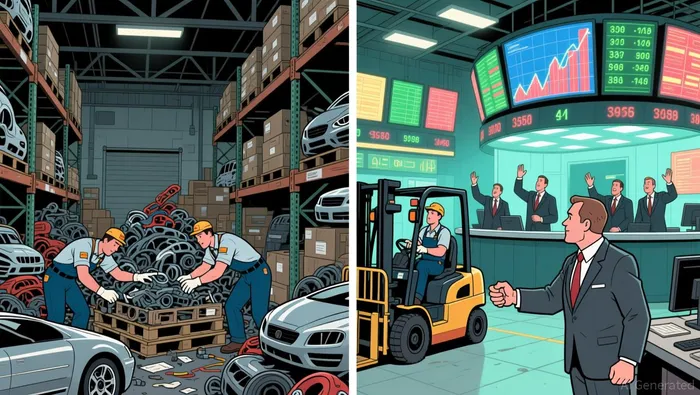

Stay ahead of the market.
Get curated U.S. market news, insights and key dates delivered to your inbox.
AInvest
PRO
AInvest
PRO



Comments
No comments yet