
Sector Rotation in Financial Markets: Semiconductor Slump vs. Banking Resilience
The global economy's tug-of-war between growth optimism and structural headwinds has never been more evident than in the divergent paths of the semiconductor and financial sectors. While ASML's recent growth warning and stock selloff underscore the fragility of cyclical tech, Wall Street banks like Goldman SachsGS-- have demonstrated remarkable resilience, driven by sticky fee income and robust balance sheets. This contrast offers investors a clear roadmap: rotate capital toward defensive sectors anchored by recurring revenue models while hedging against macro risks like Fed policy shifts and China demand dynamics.
The Semiconductor Slump: A Perfect Storm of Overhang and Uncertainty
ASML's July 2025 warning—its first in over a decade—sent shockwaves through markets, with its stock plunging 7% on fears of a prolonged chip oversupply. The Dutch firm, a bellwether for global semiconductor demand, cited rising macroeconomic and geopolitical risks, including U.S.-China trade tensions and potential export controls. Despite strong Q2 bookings driven by AI-driven demand, CEO Christophe Fouquet admitted that confirming 2026 growth is “not possible yet,” signaling a potential break in its decade-long expansion streak.
The semiconductor sector's woes reflect a broader industry overhang. After years of supply shortages that fueled price hikes and capital spending booms, demand is now cooling as inflation and geopolitical fragmentation disrupt supply chains. Chinese chipmakers, which accounted for 27% of ASML's sales over three quarters, face looming U.S. export restrictions, further clouding visibility.
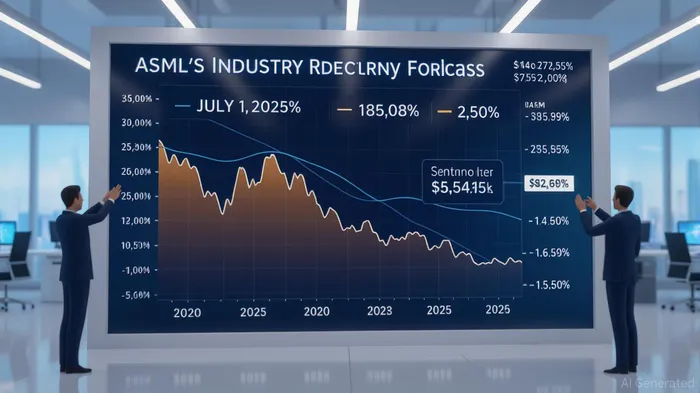
Investors in tech cyclicals now face a stark reality: the sector's growth is increasingly tied to macroeconomic and geopolitical tailwinds that are anything but assured.
Banking's Resilience: Sticky Fees and Strong Balance Sheets
In stark contrast, Wall Street banks like GoldmanGS-- Sachs delivered a masterclass in navigating macro turbulence. Q2 2025 earnings showed Goldman's net revenues surged 12% year-over-year to $14.6 billion, fueled by record equities trading and a rebound in M&A activity. The firm's sticky fee income—driven by client-driven flows in volatile markets and a 71% jump in advisory fees—highlighted its ability to thrive in uncertainty.
The financial sector's strength stems from two pillars:
1. Recurring Revenue Models: Goldman's Asset and Wealth Management (AWM) division, which now manages $3.3 trillion in assets, exemplifies this. With fee-based inflows for 30 consecutive quarters, AWM's 22% pre-tax margin underscores the durability of its revenue streams.
2. Balance Sheet Discipline: Goldman's Common Equity Tier 1 (CET1) ratio of 14.5%—well above regulatory requirements—enabled a 33% dividend hike. This capital flexibility positions banks to capitalize on opportunities like infrastructure financing and private credit, even as macro risks loom.
The sector's resilience is further bolstered by Fed policy. While rising rates pressure borrowers, they boost net interest income (NII), which rose 28% year-over-year for Goldman. Banks with strong deposit bases—like Associated Banc-CorpASB--, which grew core deposits by 4% in Q1 2025—can extend this advantage.
Investment Implications: Rotate Defensively, Hedge Strategically
The semiconductor-banking divergence creates a clear sector rotation strategy:
- Shift to Defensive Financials:
- Focus on Recurring Revenue: Banks like Goldman Sachs (GS) and JPMorganJPM-- (JPM) with high AUM and fee-based income offer insulation from cyclical downturns.
Leverage Rate-Hike Benefits: Institutions with stable funding (e.g., Associated Banc-Corp (ASBC)) benefit as NII expands.
Avoid Tech Cyclicals Until Clarity Emerges:
Hold off on semiconductorON-- stocks until supply-demand imbalances resolve and geopolitical risks subside. ASML's valuation—now at 14x forward P/E versus the sector's 15x—reflects this caution, but further declines could follow if export controls bite.
Monitor Key Wildcards:
- Fed Policy: A pause in rate hikes could ease near-term pressure on banks' loan margins but might buoy risk assets like tech.
- China Demand: Improved U.S.-China trade clarity could reignite semiconductor demand but also boost cross-border banking activity.
Conclusion: Anchoring Portfolios in Structural Strength
The semiconductor slump and banking resilience highlight a critical truth: in an era of geopolitical fragmentation and macro uncertainty, structural advantages matter most. Investors should favor sectors with recurring revenue models and defensive balance sheets while staying nimble on wildcards like Fed policy and China's tech ambitions. For now, the pivot to financials—exemplified by Goldman's 12% Q2 rally—appears the safer bet.
In the months ahead, watch for ASML's Chinese sales trends and the Fed's next move. A pullback to $650-$670 for Goldman's stock could present a buying opportunity, while a semiconductor rebound may depend on a resolution of U.S.-China trade disputes. Until then, the sector rotation playbook is clear: defensive first, cyclical later.

Stay ahead of the market.
Get curated U.S. market news, insights and key dates delivered to your inbox.
AInvest
PRO
AInvest
PRO



Comments
No comments yet