
Sector Rotation in 2026: Banking and Automotive in the Shadow of CPI Volatility
 Aime Summary
The December 2025 U.S. Consumer Price Index (CPI) report, released on January 13, 2026, confirmed a 2.7% annual increase in the all-items index, slightly below the 3.0% rise in the prior 12-month period. While this moderation suggests easing inflationary pressures, the report also highlighted divergent sectoral trends: energy prices surged 4.2% year-over-year, driven by a 11.3% spike in fuel oil and 6.9% rise in electricity, while shelter costs climbed 3.0%. These dynamics create a fertile ground for sector rotation strategies, particularly in banking and automotive stocks, where inflation-credit spending interplay can unlock asymmetric returns.
The Inflation-Credit Spending Nexus
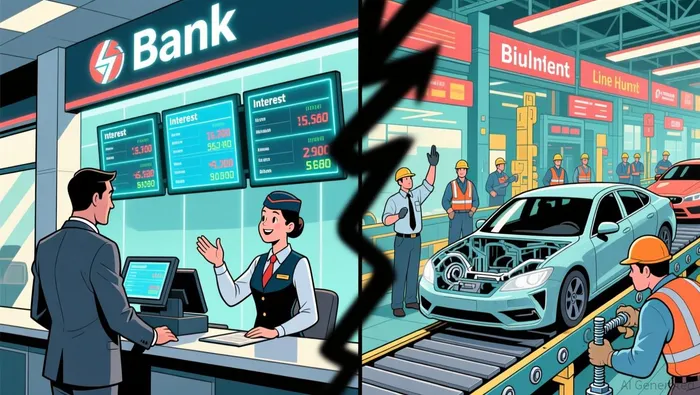
The Federal Reserve's response to CPI data directly shapes credit conditions, which in turn influence sector performance. For instance, if inflation undershoots expectations (e.g., a 2.5% annual CPI instead of 2.7%), the Fed may delay rate hikes or even cut rates, reducing borrowing costs. This scenario benefits automotive stocks, as lower interest rates make auto loans more affordable, boosting demand. Conversely, banks face margin compression in a low-rate environment, as net interest income declines.
Conversely, if inflation persists near 2.7% or rises further, the Fed may maintain a hawkish stance, supporting banks' net interest margins. However, higher energy and food prices could dampen consumer spending on durable goods like cars, pressuring automotive margins. The key is to align sector exposure with the Fed's likely policy trajectory, as inferred from CPI trends.
Banking Sector: A Tale of Margins and Policy Sensitivity
The banking sector's performance is inextricably linked to interest rate differentials. The 2.7% CPI, while below the 3.0% peak, still exceeds the Fed's 2% target, suggesting continued caution in monetary policy. Banks with strong deposit bases and diversified fee income (e.g., JPMorgan ChaseJPM--, Bank of America) may outperform in a high-rate environment. However, if inflation undershoots and the Fed pivots to rate cuts, regional banks with higher loan-to-deposit ratios could face sharper margin declines.
Investors should monitor the 10-year Treasury yield and Fed Funds futures to gauge market expectations for rate cuts. A narrowing yield curve (e.g., 10-year yield dropping below 3.5%) would signal a pivot, prompting a rotation out of banks and into sectors insulated from rate sensitivity.
Automotive Sector: Energy Prices and Credit Elasticity
The automotive sector's exposure to energy costs and credit conditions is multifaceted. The 4.2% annual rise in energy prices, particularly fuel oil and electricity, increases production costs for automakers. However, lower interest rates (triggered by undershooting CPI) could offset this by boosting consumer demand. For example, a 50-basis-point rate cut could reduce auto loan rates from 7% to 6.5%, potentially increasing new car sales by 5–10%.
Electric vehicle (EV) manufacturers like TeslaTSLA-- and traditional automakers with EV transition plans (e.g., FordF--, GM) may benefit disproportionately from lower energy prices, as cheaper electricity reduces the cost of EV ownership. Additionally, a shift to rate cuts could drive demand for used cars, a segment that saw a 3.6% annual price increase in November 2025. Investors should prioritize automakers with strong balance sheets and exposure to EVs, as these firms are better positioned to navigate both inflationary and deflationary cycles.
Actionable Strategies for Sector Rotation
- CPI Undershooting Playbook: If the December 2025 CPI confirms a 2.5% annual rate, rotate into automotive ETFs (e.g., IYK) and underweight banking stocks. Use Treasury Inflation-Protected Securities (TIPS) to hedge against residual inflation risks.
- Inflation Persistence Strategy: If CPI remains near 2.7%, maintain overweight positions in banks (e.g., XLB) and energy-linked sectors (e.g., XLE). Short-term rate hikes will support bank margins, while energy prices sustain demand for industrial and commercial vehicles.
- Hedging Divergences: Use options spreads (e.g., bull call spreads on automotive stocks and bear put spreads on banks) to capitalize on sectoral divergences without full-position bets.
Conclusion: Navigating the CPI Crossroads
The December 2025 CPI report underscores the importance of dynamic sector allocation. While the 2.7% annual inflation rate suggests a stabilizing economy, the energy and shelter components highlight structural pressures. Investors who align their portfolios with the Fed's policy outlook—whether tightening or easing—can exploit mispricings in banking and automotive stocks. As the January 13 CPI data solidifies the inflation narrative, the next 90 days will be critical for recalibrating sector exposures to capitalize on the inflation-credit spending dynamic.

Stay ahead of the market.
Get curated U.S. market news, insights and key dates delivered to your inbox.




Comments
No comments yet