
Secretary of The Department of Commerce Lutnick Lied? DOJ Files Reveal 13-Year Epstein Link, Triggering Bipartisan Resignation Calls
 Aime Summary
The Department of Commerce continues to maintain that Secretary Howard Lutnick had "limited interaction" with disgraced financier Jeffrey Epstein. However, newly released Department of Justice (DOJ) documents present irrefutable evidence contradicting these claims, sparking a political firestorm in Washington. While Lutnick publicly stated he severed all ties in 2005 due to moral objections, federal records expose a sustained relationship spanning over a decade, involving private island visits and joint venture agreements. The disclosure has shattered the Secretary's credibility, uniting lawmakers from both sides of the aisle. As Republican Representative Thomas Massie succinctly stated to CNN, Lutnick has "a lot of explaining to do" and should resign immediately to "make the President's life easier." With the Trump administration's economic policy heavily reliant on the Commerce Department, this governance crisis threatens to derail upcoming trade initiatives, injecting new risk premiums into US equity markets.
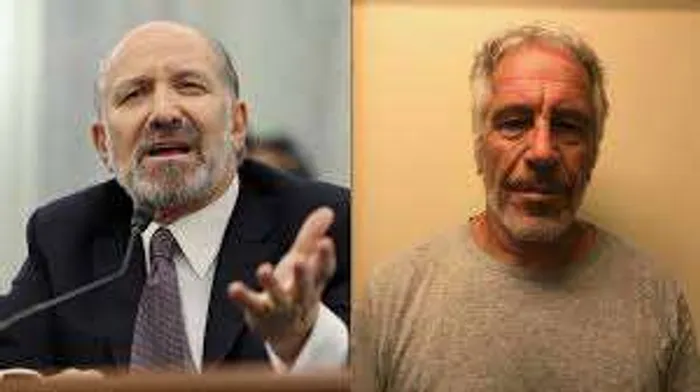
The Architect of Trump's Economy: A Profile in Crisis
To understand the gravity of these allegations, one must recognize Howard Lutnick’s pivotal role in the current administration and the financial sector. Before his confirmation as Commerce Secretary in 2025, Lutnick served as the CEO of Cantor Fitzgerald for nearly three decades. He is a figure deeply entrenched in Wall Street history, known for his resilience following the September 11 attacks, where his firm lost 658 employees, including his brother. This narrative of resilience helped him build a reputation as a tough, decisive leader.
Transitioning from finance to politics, Lutnick became a cornerstone of Donald Trump’s 2024 campaign, serving as a top donor and co-chair of the presidential transition team. His appointment as Commerce Secretary was viewed by Wall Street as a signal that the administration would prioritize aggressive trade enforcement and deregulation. As the primary architect of the administration's tariff strategies and export controls—particularly concerning semiconductor restrictions on China—Lutnick’s standing is directly tied to the stability of US trade policy. A leadership vacuum or a crippled Secretary at Commerce introduces significant uncertainty for multinational corporations (MNCs) and the broader S&P 500, particularly for sectors sensitive to cross-border supply chains.
The "Zero Contact" Myth vs. documented Reality
The core of the controversy lies in the stark divergence between Lutnick’s public narrative and the forensic reality provided by the DOJ. In a podcast interview last year, Lutnick categorically stated that after a 2005 visit to Epstein’s Manhattan home—where he was reportedly "disgusted" by the presence of a massage room—he and his wife decided they would "never be in a room with that man again." He framed this as a definitive moral break.
However, the unsealed documents paint a picture of continued social and professional entanglement. The timeline of contradictions is extensive:
- 2011: Emails from Epstein’s assistant confirm a scheduled "drinks" meeting with Lutnick.
- 2012: Perhaps most damaging is the revelation that Lutnick scheduled a lunch at Epstein’s private residence on Little St. James in the U.S. Virgin Islands. Follow-up correspondence from Epstein’s staff relayed the message, "Good to see you," shattering the "never in a room again" defense.
- 2012 (Business Ties): Unlike mere social calls, documents show a signed stock purchase agreement where both men, representing their respective entities, acquired shares in the ad-tech company Adfin. This represents a direct financial partnership occurring seven years after the alleged "break."
- 2018: As late as May 2018, Lutnick communicated with Epstein regarding neighborhood opposition to a construction project (the Frick Museum expansion) near their Upper East Side properties.
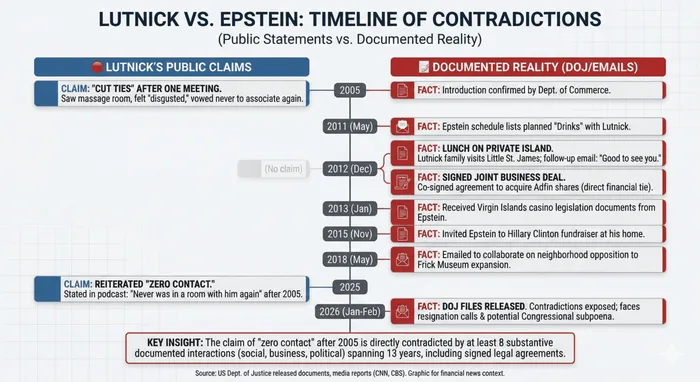
(See Figure 1: Timeline of Contradictions)
This evidence suggests that rather than a moral separation, the relationship transitioned into a transactional alliance that persisted until shortly before Epstein’s arrest. The existence of a signed business agreement in 2012 is particularly problematic for a sitting Commerce Secretary, as it raises questions about due diligence and disclosure during his Senate confirmation hearings.
Political Fallout: Bipartisan Calls for Resignation
The political reaction has been swift and, notably, bipartisan. While Democrats were expected to leverage this against the administration, the defection of key Republicans signals that Lutnick’s position is becoming untenable.
Senator Adam Schiff (D-CA) accused Lutnick of "lying to the American people," asserting that the Secretary’s dishonesty regarding his association with a convicted pedophile calls into question his "judgment and professional ethics." House Oversight Committee Democrat Robert Garcia echoed this sentiment on social media platform X, stating, "He said he had zero contact after 2005. We now know they did business together. He must resign or be fired."
More concerning for the White House is the stance of Representative Thomas Massie (R-KY). Massie’s comments to CNN—that Lutnick should resign to protect the President—indicate that Congressional support is fracturing. Furthermore, House Oversight Committee Chairman James Comer (R-KY) has not ruled out subpoenaing Lutnick. Comer emphasized that the committee is seeking answers from "anyone who may have information," noting that the committee has already engaged with Epstein’s associate, Ghislaine Maxwell.
Despite this, the White House continues to mount a defense. Spokesperson Kush Desai stated on Monday that the President has assembled a "transformative cabinet" and that Lutnick remains focused on the American people. The Department of Commerce dismissed the allegations as a "failed attempt by the mainstream media to distract from the administration's achievements," citing record investment figures. However, with the Senate Judiciary Committee likely to initiate an inquiry into whether Lutnick perjured himself during confirmation vetting, the administration's defense may soon become a liability.
Market Implications and Conclusion
For investors, the Lutnick scandal is not merely a tabloid headline; it is a material risk factor. The Commerce Department is currently the operational hub for the administration's "America First" trade agenda. Lutnick is the signatory on critical export control licenses and the lead negotiator on pending tariff frameworks with the European Union and Asian partners.
If Lutnick is forced to resign, we anticipate three immediate market effects:
- Policy Paralysis: A transition period would pause the implementation of new trade restrictions. While this might provide a temporary relief rally for semiconductor stocks (e.g., NVIDIA, AMD) and importers, it introduces long-term ambiguity.
- Increased Volatility: Uncertainty regarding the successor could lead to volatility in the US Dollar Index (DXY). A replacement viewed as more hawkish (like Robert Lighthizer) could spike bond yields, while a moderate pick might soften the dollar.
- Governance Discount: Persistent scandals at the cabinet level can lead to a "governance discount" on US assets, as foreign capital questions the stability of the administration's policy execution.

Tianhao Xu is currently a financial content editor, focusing on fintech and market analysis. Previously, he worked as a full-time forex trader for several years, specializing in global currency trading and risk management. He holds a master’s degree in Financial Analysis.
Latest Articles
Stay ahead of the market.
Get curated U.S. market news, insights and key dates delivered to your inbox.


AInvest
PRO
AInvest
PRO



Comments
No comments yet