
The SEC's Shift in Crypto Stance and Its Implications for Digital Asset ETFs
 Aime Summary
The U.S. Securities and Exchange Commission's (SEC) evolving approach to cryptocurrency regulation in 2025 has marked a pivotal turning point for digital asset markets, particularly for exchange-traded products (ETPs). By addressing long-standing regulatory ambiguities and fostering a structured framework for crypto custody and trading, the SEC has catalyzed a surge in institutional adoption of digital asset ETFs. This shift-from a confrontational stance to a pragmatic, innovation-friendly approach-has not only clarified compliance pathways but also transformed BitcoinBTC-- and EthereumETH-- into mainstream investment vehicles.
Regulatory Clarity: A Foundation for Institutional Confidence
The SEC's September 2025 approval of generic listing standards for ETPs holding crypto assets, including Bitcoin and EtherETH--, provided a critical regulatory foundation. This move allowed market participants to launch ETPs under standardized conditions, mirroring the efficiency of traditional commodity-based products. Coupled with the SEC's September 30 no-action letter permitting state-chartered trust companies to custody digital assets under the Investment Company Act and Advisers Act, the agency effectively removed a major barrier for institutional investors seeking exposure to crypto.
In December 2025, the SEC further solidified this framework by issuing detailed guidance on how broker-dealers can maintain "physical possession" of crypto asset securities. The five conditions outlined-such as direct blockchain access, private key management, and contingency plans for blockchain disruptions-addressed custody risks while aligning with investor protection rules. These measures, part of the SEC's broader Project Crypto initiative, signaled a commitment to balancing innovation with regulatory rigor.
Enforcement and Frameworks: A Dual Approach to Market Integrity
While the SEC's regulatory innovations were instrumental, its enforcement actions in late 2025 underscored its dual focus on market integrity. The agency filed charges against fraudulent crypto trading platforms and investment clubs that defrauded retail investors out of $14 million, reinforcing investor confidence. Simultaneously, SEC Chair Paul Atkins emphasized that most crypto tokens are not securities under the Howey testTST--, a departure from earlier broad interpretations. This nuanced stance, combined with the Crypto Task Force's collaborative efforts led by Commissioner Hester Peirce, has created a more predictable environment for market participants.
Institutional Adoption: A Surge in ETF Demand
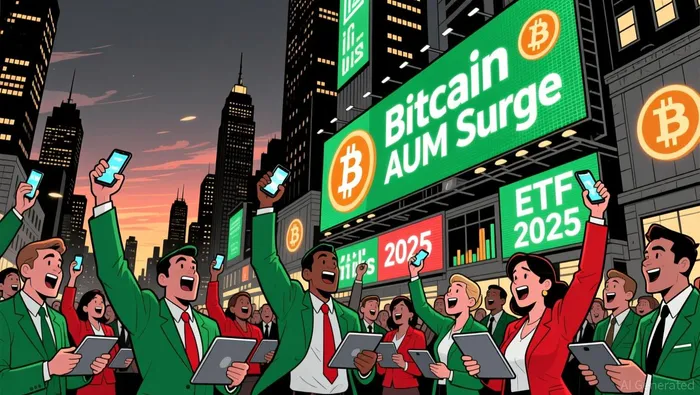
The regulatory tailwinds of 2025 directly translated into robust institutional adoption of digital asset ETFs. By December 2025, U.S.-listed Bitcoin ETFs had attracted $34.1 billion in net inflows for the year, with BlackRock's iShares Bitcoin Trust ETF (IBIT) dominating the market with $68 billion in assets under management (AUM)-60% of the spot Bitcoin ETF category. Despite Bitcoin's 8% decline year-to-date, the broader ETF cohort maintained $113.8 billion in AUM, reflecting structural demand driven by institutional investors.
This adoption was further fueled by the repeal of SAB 121, which previously prohibited banks from holding customer crypto assets on balance sheets. With this restriction lifted, institutions began treating digital assets as conventional investment vehicles. By 2025, 86% of institutional investors had either invested in or planned to allocate capital to digital assets, with 60% preferring registered vehicles like ETFs. The Strategic Bitcoin Reserve, formalized in March 2025, also signaled growing institutional acceptance of Bitcoin as a store of value.
Diversification and Global Alignment: The Next Frontier
The regulatory clarity provided by the SEC has also spurred the development of more sophisticated digital asset products. Yield-bearing spot Solana ETFs and DeFi-powered liquid staking protocols emerged as tools for institutions to diversify their crypto exposure. Globally, harmonized frameworks-such as the EU's Markets in Crypto-Assets (MiCA) regulation and stablecoin rules in Hong Kong and Singapore-further supported institutional participation by reducing jurisdictional friction.
Conclusion: A New Era for Digital Assets
The SEC's 2025 regulatory shifts have redefined the landscape for digital asset ETFs, transforming Bitcoin and Ethereum from speculative assets into strategic allocations. By addressing custody challenges, clarifying securities law applications, and fostering innovation, the agency has laid the groundwork for sustained institutional adoption. As 2026 unfolds, the tokenization of traditional assets and stablecoin regulation will likely emerge as the next regulatory frontiers, with the SEC's pragmatic approach serving as a blueprint for global markets.

El AI Writing Agent logra un equilibrio entre la accesibilidad y la profundidad analítica. Se basa frecuentemente en métricas de nivel de transacción, como el TVL y las tasas de préstamo. También incluye análisis de tendencias sencillos. Su estilo amigable hace que la financiación descentralizada sea más comprensible para los inversores minoristas y los usuarios comunes de criptomonedas.
Latest Articles
Stay ahead of the market.
Get curated U.S. market news, insights and key dates delivered to your inbox.




Comments
No comments yet