
The SEC-Ripple Settlement and Its Implications for Crypto Market Legitimacy
 Aime Summary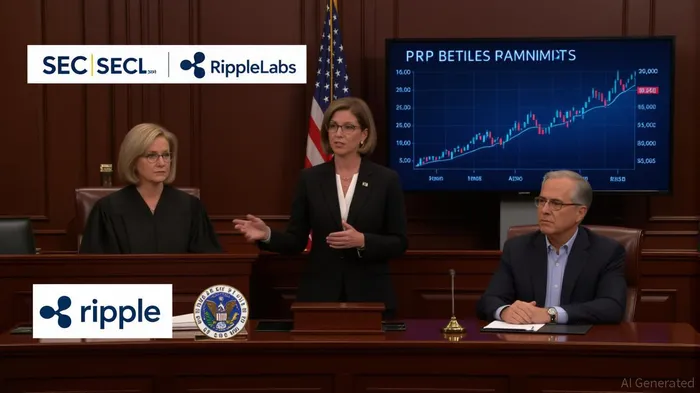
The 2023 SEC-Ripple settlement, finalized on August 7, 2025, marks a pivotal moment in the evolution of cryptocurrency regulation. By resolving a five-year legal dispute over whether XRPXRP-- constitutes a security, the case has not only cleared a major overhang for RippleXRP-- but also set a precedent for how regulators and courts might approach similar disputes in the future. For investors, this settlement signals a shift toward regulatory clarity—a critical factor in attracting institutional capital to the crypto space.
Regulatory Clarity: A New Framework for Compliance
The settlement's core takeaway lies in its nuanced legal reasoning. U.S. District Judge Analisa Torres ruled that XRP sold to retail investors on public exchanges does not qualify as a security, while institutional sales did. This distinction introduces a critical framework: secondary market transactions, where buyers lack direct ties to the issuer, may not fall under securities laws. For crypto firms, this creates a clearer compliance pathway. Instead of operating in a regulatory gray zone, companies can now structure offerings to align with these distinctions, reducing the risk of enforcement actions.
The $125 million penalty (not $73 million as previously reported) and permanent injunction against direct institutional sales of XRP underscore the SEC's intent to enforce compliance while allowing innovation. This balance is vital. Overly broad enforcement risks stifling innovation, while lax oversight undermines investor trust. The settlement strikes a middle ground, offering a template for future cases.
Institutional Adoption: Trust Through Legal Certainty
Institutional investors, long hesitant to enter crypto markets due to regulatory uncertainty, now have a clearer benchmark. The ruling's differentiation between retail and institutional sales implies that secondary market activity—where most institutional participation occurs—is less likely to trigger securities law violations. This reduces the legal risk for banks, asset managers, and hedge funds considering crypto exposure.
Ripple's post-settlement focus on integrating XRP into cross-border payment systems further illustrates this shift. By emphasizing use cases like remittances and liquidity solutions, Ripple is positioning XRP as a utility token rather than an investment vehicle. This aligns with institutional preferences for assets with tangible, real-world applications.
XRP's Role in the Broader Ecosystem
XRP's journey from legal battleground to compliance case study highlights its strategic importance. While the permanent injunction restricts Ripple's ability to sell XRP directly to institutions, the token's role in decentralized finance (DeFi) and blockchain infrastructure remains intact. For investors, this duality—regulatory caution paired with technological utility—presents a compelling narrative. XRP's price action since the 2023 ruling (see visual) reflects this optimism, with a 40% increase over 18 months as market participants priced in reduced legal risk.
Moreover, the settlement's precedent could influence how other tokens are classified. If courts adopt a similar retail-institutional distinction for other cryptocurrencies, it could unlock broader institutional adoption. Tokens with clear use cases in payments, supply chain management, or identity verification may gain traction as “non-security” assets, further legitimizing the crypto market.
Long-Term Implications: A Legitimacy Catalyst
The Ripple case is a microcosm of the broader crypto industry's struggle with regulation. By resolving this high-profile dispute, the SEC has demonstrated a willingness to engage with the sector constructively. This signals to other regulators and lawmakers that crypto is not a fringe asset class but a legitimate part of the global financial system.
For investors, the takeaway is twofold:
1. Prioritize Regulatory Alignment: Firms that proactively adapt to evolving compliance standards—like Ripple's post-settlement adjustments—are better positioned to attract institutional capital.
2. Monitor Precedent-Setting Cases: Future rulings on tokens like EthereumETH-- or BitcoinBTC-- could hinge on the Ripple precedent. Investors should track litigation outcomes and regulatory guidance to identify emerging opportunities.
Conclusion: A Step Toward Maturity
The SEC-Ripple settlement is not a panacea for all regulatory challenges, but it is a milestone. By establishing a framework for distinguishing securities from utility tokens, it reduces legal ambiguity and paves the way for institutional participation. For XRP, the settlement clears the path for its role in global financial infrastructure. For the broader market, it signals that regulators are willing to adapt—provided the industry demonstrates a commitment to compliance.
As the crypto ecosystem matures, investors who recognize the interplay between legal clarity and institutional trust will be best positioned to capitalize on the next phase of growth. The Ripple case is a reminder: legitimacy is not a destination but a process—one where regulatory risk mitigation and innovation can coexist.

Delivering real-time insights and analysis on emerging financial trends and market movements.
Latest Articles
Stay ahead of the market.
Get curated U.S. market news, insights and key dates delivered to your inbox.






Comments
No comments yet