
The SEC-Ripple Legal Resolution and XRP's Path to Mainstream Adoption
 Aime Summary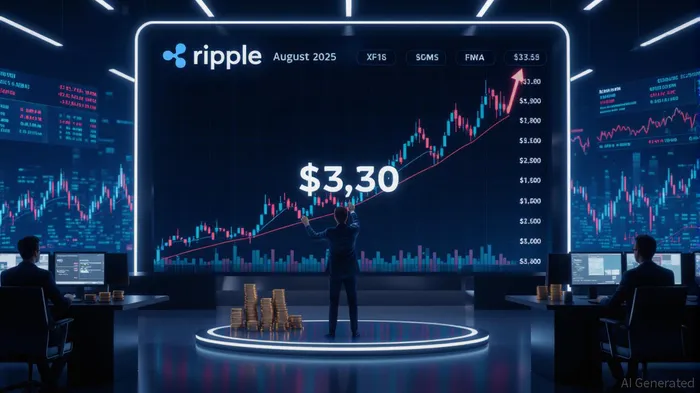
The U.S. Securities and Exchange Commission's (SEC) long-standing legal battle with RippleXRP-- Labs has finally reached its conclusion, and the implications for XRP—and the broader crypto market—are seismic. After a five-year legal saga, the SEC and Ripple jointly dismissed their appeals on August 7, 2025, effectively ending the dispute over whether XRPXRPI-- qualifies as a security. This resolution, coupled with XRP's 11% price surge to $3.30 in the days following the announcement, signals a pivotal shift in institutional and retail confidence. For investors, this is a rare moment where regulatory clarity and market momentum align to unlock long-term value in the digital asset space.
Regulatory Clarity: A Game-Changer for XRP
The 2023 ruling by U.S. District Judge Analisa Torres was a watershed moment. She distinguished between XRP sold to retail investors on public exchanges (non-securities) and institutional sales (securities), a nuanced framework the SEC had previously resisted. This legal distinction has now been codified into a $125 million settlement, with Ripple agreeing to pay fines for the institutional sales portion of the case. Crucially, the SEC granted Ripple a tailored waiver, removing its “bad actor” designation and restoring the company's access to private fundraising tools under Regulation D.
This regulatory clarity has done more than resolve a legal dispute—it has created a blueprint for how courts and regulators might evaluate other tokens. As any seasoned investor knows, uncertainty is the enemy of growth. By establishing a clear line between retail and institutional transactions, the ruling reduces the risk of overgeneralization in future enforcement actions. This is particularly important for tokens like XRP, which are designed for utility (e.g., cross-border payments) rather than speculative investment.
Institutional Confidence Rebounds
The market's reaction to the resolution has been swift and decisive. Galaxy DigitalGLXY--, a crypto investment firm led by Mike Novogratz, disclosed a $34 million XRP position in its Q2 2025 SEC filing—a move that underscores the return of institutional capital to the asset class. South Korea's BDACS, a regulated crypto custody provider, has also launched institutional-grade XRP custody solutions for exchanges like Upbit and Coinone, further legitimizing the token's role in global financial infrastructure.
The data tells a compelling story. XRP's 24-hour trading volume spiked to $4.6 billion post-settlement, while futures volume surged 200% in a single day. Open interest hit a 2025 high, indicating strong speculative and leveraged trading activity. These metrics suggest that institutional players are not just watching the space—they're actively positioning for growth.
Retail Sentiment and the Road to ETF Approval
Retail investors have also responded enthusiastically. XRP's price rebound to $3.30—a multi-year high—was driven by renewed optimism about the token's future. The odds of an XRP ETF approval have jumped to 77%, with major asset managers like Grayscale, Bitwise, and WisdomTreeWT-- already submitting applications. BlackRock's potential entry into the XRP ETF market, though unconfirmed, has further stoked speculation.
For retail investors, the resolution removes a major overhang. The token's bull flag pattern on its price chart suggests a potential move toward $8 in the medium term, with $4.00 as a critical breakout level. On-chain indicators, such as the MVRV golden cross, also point to a 640% rally potential from $3.30—a scenario that would push XRP toward $24.42. While short-term volatility remains (whale selling pressure has temporarily stalled the rally), the underlying fundamentals are robust.
Strategic Moves by Ripple and the Broader Market
Ripple itself is capitalizing on the newfound clarity. The company has applied for a National Trust Bank charterCHTR-- in New York, aiming to integrate XRP and its stablecoin, RLUSD, into traditional financial systems. This move could revolutionize cross-border payments by offering faster, cheaper alternatives to legacy systems. Additionally, Ripple's $200 million acquisition of RAIL Financial—a firm that combines stablecoins with traditional finance—signals a strategic pivot toward hybrid financial infrastructure.
The broader market is also shifting. The SEC's decision to adopt a case-by-case approach to crypto regulation under the Trump administration has created a more accommodating environment for innovation. This regulatory pivot, combined with the Ripple settlement, could set a precedent for how other tokens are evaluated, reducing the risk of blanket enforcement actions.
Investment Implications and the Path Forward
For investors, the key takeaway is clear: regulatory clarity is a catalyst for growth. XRP's price rebound and institutional adoption demonstrate that the market is ready to reward assets that align with clear legal frameworks. While volatility remains inherent to crypto, the post-settlement environment offers a unique opportunity to position for long-term gains.
Here's how to approach this opportunity:
1. Buy on Dips: XRP's $3.00 support level has held strong. A pullback to this level could present a low-risk entry point.
2. Monitor ETF Filings: The approval of an XRP ETF would be a game-changer, opening the door for traditional investors.
3. Diversify Exposure: Pair XRP with other regulated digital assets to hedge against sector-specific risks.
In conclusion, the SEC-Ripple resolution is more than a legal win—it's a green light for XRP's mainstream adoption. As regulatory clarity continues to reshape the crypto landscape, XRP stands at the forefront of a new era where digital assets are no longer outliers but integral components of global finance. For investors with a long-term horizon, the message is simple: this is the time to act.

Delivering real-time insights and analysis on emerging financial trends and market movements.
Latest Articles
Stay ahead of the market.
Get curated U.S. market news, insights and key dates delivered to your inbox.




Comments
No comments yet