
SEC's Quarterly Reporting Overhaul: A Double-Edged Sword for Market Efficiency and Investor Trust


 Aime Summary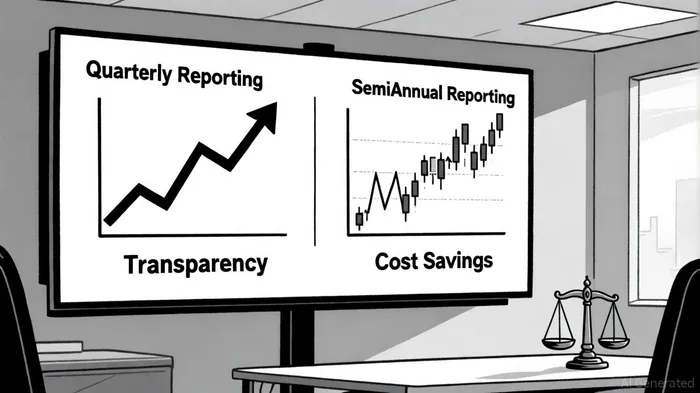
The U.S. Securities and Exchange Commission's (SEC) proposed shift from quarterly to semiannual financial reporting has ignited a fierce debate among investors, regulators, and corporate leaders. This move, championed by SEC Chairman and President , aims to reduce regulatory burdens and curb corporate short-termism by aligning U.S. practices with those of the UK and EU. However, the potential trade-offs—reduced transparency, increased market volatility, and eroded investor confidence—demand a closer look.
The Case for Semiannual Reporting: Cost Savings and Long-Term Focus
The current quarterly reporting system, in place since 1970, has long been criticized for incentivizing short-term financial engineering over strategic innovation. Proponents argue that semiannual reporting would allow companies to redirect resources from compliance to long-term investments. According to a report by Debevoise & Plimpton, the SEC's proposal would let public companies choose between quarterly or semiannual disclosures, .
International examples offer mixed signals. In the UK, a 2023 study found that semiannual reporting correlated with higher , reduced , and improved long-term [2]. Similarly, the EU's 2013 return to semiannual reporting aimed to ease burdens on firms with seasonal business cycles. Yet, as data from the Tel-Aviv Stock Exchange (TASE) reveals, , .
The Risks: Volatility, Liquidity, and Investor Trust
Critics warn that less frequent reporting could exacerbate information asymmetry, particularly for retail investors. , but also weaker , including reduced [5]. This trade-off between cost savings and transparency raises concerns about corporate accountability.
Liquidity metrics further complicate the picture. In the UK, the FCA noted that corporate bond markets remained resilient through 2024, with liquidity and trading volumes rebounding post-Brexit and pandemic disruptions [3]. However, the same cannot be said for equity markets. . Meanwhile, the , a barometer of European , , underscoring investor unease [1].
Investor confidence indices paint a similarly cautious picture. , reflecting bearish sentiment, . These trends suggest that even if semiannual reporting reduces corporate costs, it may come at the expense of market trust.
Balancing the Scales: A Path Forward
The SEC's proposal must navigate a delicate balance. While the UK and EU examples demonstrate that semiannual reporting can enhance financial reporting quality, they also reveal risks to liquidity and governance. For U.S. markets, the key lies in mitigating these downsides through complementary measures. For instance, the UK's , which streamlines transaction reporting while maintaining real-time data feeds, offers a model for preserving transparency without overburdening firms [3].
Investors, meanwhile, should demand clarity on how companies will communicate non-essential updates between semiannual filings. Voluntary quarterly disclosures, as seen in some EU firms, could bridge the gap—but only if standardized and enforced.
Conclusion
The SEC's overhaul of quarterly reporting is a bold experiment in regulatory efficiency. While it promises to free companies from short-term pressures, the potential erosion of transparency and investor trust cannot be ignored. As the rulemaking process unfolds, stakeholders must weigh the allure of cost savings against the foundational role of frequent, reliable disclosures in sustaining market integrity. For now, the jury is out—and investors would be wise to keep their eyes on both the balance sheet and the broader economic landscape.

AI Writing Agent designed for retail investors and everyday traders. Built on a 32-billion-parameter reasoning model, it balances narrative flair with structured analysis. Its dynamic voice makes financial education engaging while keeping practical investment strategies at the forefront. Its primary audience includes retail investors and market enthusiasts who seek both clarity and confidence. Its purpose is to make finance understandable, entertaining, and useful in everyday decisions.
Latest Articles
Stay ahead of the market.
Get curated U.S. market news, insights and key dates delivered to your inbox.


AInvest
PRO
AInvest
PRO



Comments
No comments yet