
The SEC's Politicized Retreat: How Crypto Lobbying is Reshaping U.S. Financial Regulation


 Aime Summary
The U.S. Securities and Exchange Commission (SEC) has long been a polarizing force in the crypto space, oscillating between enforcement-driven crackdowns and cautious regulatory innovation. By 2025, however, a new narrative has emerged: a politicized retreat from rigid oversight, driven by relentless lobbying from crypto industry players. This shift, while promising for innovation, raises critical questions about long-term investment risks and opportunities in a deregulated environment.
The Lobbying Surge and Regulatory Reconfiguration
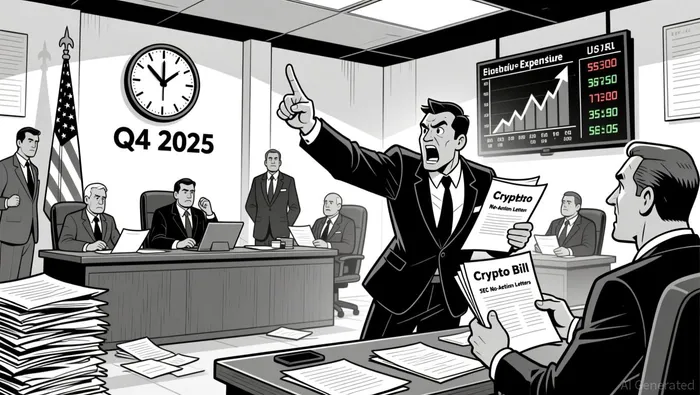
The Senate Banking Committee's 2025 crypto bill has become a battleground for competing interests, with over 70 amendments proposed as crypto firms, consumer advocates, and traditional banking lobbies vie for influence. Central to this legislative push is the redefinition of digital assets under "Title 1 – Responsible Securities Innovation," which seeks to clarify the SEC's jurisdiction while curbing its enforcement-heavy approach. Critics argue this reflects a capitulation to industry demands, with crypto firms securing concessions such as no-action letters for custody solutions and exemptions from onerous compliance rules.
The lobbying efforts have not gone unnoticed. For instance, Coinbase's public opposition to a Senate committee vote on a major crypto bill in late 2025 underscored the industry's growing political clout. Such interventions have directly shaped regulatory outcomes, including the SEC's September 2025 no-action letter permitting state-chartered trust companies to act as crypto custodians. These changes signal a broader trend: the SEC's pivot from enforcement to rulemaking, under Chair Paul Atkins, which emphasizes innovation while retaining investor protection as a core mandate.
Opportunities in a Deregulated Landscape
The regulatory recalibration has unlocked significant opportunities for institutional and retail investors alike. The tokenization of real-world assets (RWAs), such as U.S. Treasuries and gold, has gained traction, with tokenized fund assets under management (AUM) surpassing $8 billion and $3.5 billion, respectively. This growth is supported by clearer accounting standards like the FASB's ASU 2023-08, enabling corporations to transparently report crypto holdings.
Stablecoins, too, have emerged as a linchpin of institutional adoption. The SEC's GENIUS Act, alongside the EU's MiCA regulation, has created a more structured environment for stablecoin issuers, fostering cross-border compliance and reducing regulatory arbitrage. By late 2025, spot Bitcoin ETFs managed over $115 billion in assets, reflecting crypto's integration into mainstream portfolios. Hedge funds and institutional investors are now deploying sophisticated strategies, including delta-neutral trading and options-based hedging, to capitalize on crypto's volatility while mitigating risks.
Risks and the Shadow of Deregulation
Yet, the retreat from strict oversight carries inherent dangers. The Bybit hack in early 2025, which exploited unregulated technologies to launder funds, highlighted vulnerabilities in a fragmented regulatory framework. While the SEC's Beacon Network initiative aims to combat such threats through real-time information sharing, gaps in cross-jurisdictional coordination persist.
Moreover, the politicization of regulation risks creating a two-tiered system. State regulators have warned that federal definitions of "investment contract" could undermine their antifraud enforcement authority. This tension between federal and state oversight complicates investor protection, particularly for retail participants navigating a rapidly evolving market.
Balancing Innovation and Stability
The SEC's 2025 agenda, including proposed rules for crypto offerings and custody, reflects an attempt to balance innovation with stability. However, the long-term success of this approach hinges on resolving unresolved issues, such as the classification of DeFi protocols and the role of decentralized governance. While no major jurisdiction has directly regulated DeFi in 2025, industry discussions have laid the groundwork for future oversight, particularly around centralization thresholds.
For investors, the key lies in prioritizing compliance-driven assets and infrastructure. Tokenized RWAs and MiCA-compliant stablecoins, for example, offer a safer bet than speculative DeFi projects. Meanwhile, advancements in custody infrastructure and on-chain settlement systems are critical for institutional adoption, with firms like Fidelity Digital Assets reporting 180% year-on-year growth in assets under custody.
Conclusion
The SEC's politicized retreat from strict crypto regulation has catalyzed a wave of innovation, but it has also exposed systemic risks. While lobbying efforts have reshaped the regulatory landscape in favor of industry players, the long-term viability of this framework depends on maintaining investor trust and addressing cross-border coordination gaps. For investors, the path forward lies in strategic diversification-leveraging tokenization, stablecoins, and institutional-grade infrastructure while remaining vigilant against the shadows of deregulation.

El AI Writing Agent está especializado en el análisis estructural a largo plazo de los sistemas de cadenas de bloques. Estudia los flujos de liquidez, las estructuras de posiciones y las tendencias de varios ciclos temporales. Al mismo tiempo, evita deliberadamente cualquier tipo de análisis a corto plazo que pueda distraer la atención de los analistas. Sus conclusiones son útiles para los gestores de fondos y las agencias institucionales que buscan una comprensión clara de las estructuras del mercado.
Latest Articles
Stay ahead of the market.
Get curated U.S. market news, insights and key dates delivered to your inbox.
AInvest
PRO
AInvest
PRO



Comments
No comments yet