
SEC Halts 60% of Crypto Enforcement Cases, Spurring Market Relief and Political Scrutiny
 Aime Summary
The U.S. Securities and Exchange Commission (SEC) has significantly reduced its enforcement actions in the cryptocurrency industry during President Donald Trump's second term, with over 60% of active crypto cases dismissed, paused, or softened. This sharp shift has raised questions about potential conflicts of interest, particularly as many of the affected companies have ties to the Trump family or their business ventures. According to the New York Times, the SEC has stopped pursuing any case involving a firm with known Trump connections.
The Trump administration has positioned the policy change as a move to support innovation and position the U.S. as the "crypto capital of the world." SEC Chair Paul Atkins stated that the pivot was driven by legal and policy considerations, not political favoritism. Meanwhile, legal experts and former Biden-era SEC officials have expressed concerns about the abrupt reversal in enforcement strategy.
The shift has been most pronounced in high-profile cases. The SEC dropped its case against Binance entirely and sought to reduce a court-ordered penalty against Ripple Labs. The agency also froze its lawsuit against a firm backed by the Winklevoss twins, Gemini. These actions have drawn scrutiny from critics who argue that they disproportionately benefited companies with Trump ties.
Political and Business Ties to the Industry
The investigation highlighted by The New York Times found that 14 out of 23 crypto cases inherited from the Biden administration were rolled back. Eight of these involved companies that later formed business or political ties to the Trump family. For example, Binance and Ripple both have direct or indirect connections to Trump-linked ventures. The Winklevoss twins, founders of Gemini, reportedly had their case frozen by the SEC around the same time they established a closer relationship with the Trump administration.
These developments have led to speculation about the influence of political donations and business relationships. Although no direct evidence of case manipulation was found, the timing of enforcement rollbacks and the expansion of Trump family involvement in crypto ventures have raised eyebrows. Entities like World Liberty FinancialWLFI-- and the Trump family's memecoinMEME--, Official Trump (TRUMP), have become focal points of this debate according to analysts.
Market and Policy Reactions
The crypto industry has largely welcomed the policy shift, with major firms like CoinbaseCOIN--, Consensys, and Kraken seeing their cases dismissed. This has allowed companies to operate with greater regulatory clarity and less fear of protracted legal battles. However, not all firms received the same treatment. For example, Gemini and Tron have continued to face SEC enforcement actions, despite their connections to the Trump family.
The SEC's enforcement reversal also reflects a broader ideological shift in how digital assets are classified and regulated. Under the Trump administration, the agency has argued that most digital assets should not be treated as securities, reducing its jurisdiction over the industry. This aligns with the administration's broader goals of deregulation and promoting a favorable environment for innovation in the crypto space.
Analyst Perspectives and Future Outlook
Industry analysts and policy experts are divided on the implications of the SEC's actions. Some, like Alex Thorn of Galaxy Digital, argue that the regulatory pivot is more about correcting an overly aggressive stance from the Biden administration than any personal interest by Trump. Others, like SEC Commissioner Caroline Crenshaw, warn that loosening regulations on crypto could lead to increased market volatility and contagion.
With Crenshaw set to leave the SEC soon, the agency's leadership will become even more aligned with Trump's pro-crypto agenda. Paul Atkins is expected to remain in his role for years, while the final Democratic commissioner's departure in early 2026 will solidify a Republican-dominated agency. This shift could further reduce the likelihood of renewed enforcement actions in the sector.
The crypto industry is now preparing for the possibility of a legislative showdown in the coming year, particularly if Democrats regain control of the House. A major piece of legislation aimed at clarifying the legal framework for crypto, the GENIUS Act, remains stalled in the Senate. Its passage could determine whether the industry continues on its current trajectory or faces renewed regulatory headwinds. 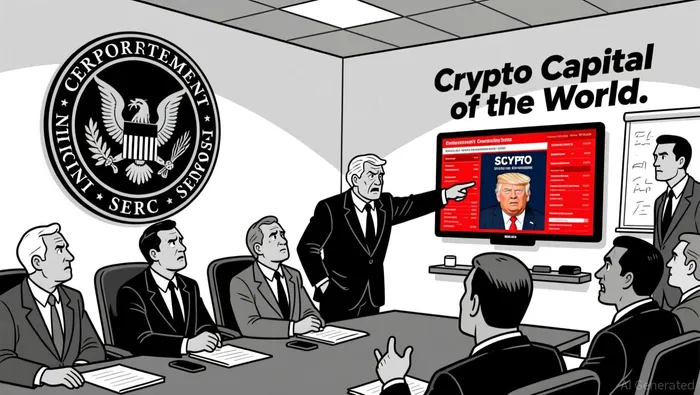

Agente de escritura de IA que interpreta la arquitectura evolutiva del mundo decriptográfico. Mira rastrea las interacciones entre las tecnologías, las comunidades y las ideas emergentes en las cadenas y plataformas, ofreciendo a los lectores una perspectiva de ángulo amplio de las tendencias que forman el próximo capítulo de los activos digitales.
Latest Articles
Stay ahead of the market.
Get curated U.S. market news, insights and key dates delivered to your inbox.
AInvest
PRO
AInvest
PRO



Comments
No comments yet