
The SEC and DOL's 401(k) Private Market Expansion: A New Era for Retirement Investing
 Aime Summary
The U.S. retirement landscape is undergoing a seismic shift as regulatory changes by the Securities and Exchange Commission (SEC) and the Department of Labor (DOL) open the door to private equity and stablecoin investments in 401(k) plans. These developments mark a pivotal moment in how Americans save for retirement, blending the high-conviction potential of alternative assets with the stability of digital innovations. But as with any frontier, the risks and rewards must be carefully balanced.
Regulatory Winds Shift: From Caution to Clarity
For years, the DOL's 2022 guidance cast a shadow over crypto and private equity in retirement accounts, citing their volatility and complexity. However, in May 2025, the DOL rescinded this stance, returning to a neutral position that allows fiduciaries to consider these assets without regulatory overreach. This shift aligns with the SEC's parallel efforts under Chair Paul Atkins, who has prioritized a “coordinated regulatory framework” with the Commodity Futures Trading Commission (CFTC). The SEC's Crypto Task Force, led by Commissioner Hester Peirce, has also streamlined rules for stablecoins and ETFs, while the GENIUS Act provides federal guardrails for dollar-pegged stablecoins.
These changes signal a broader embrace of innovation, but they also demand rigorous due diligence. As one industry analyst notes, “Regulatory clarity is a double-edged sword—it lowers barriers but doesn't eliminate risks. Fiduciaries must now act as gatekeepers, ensuring that these assets are both suitable and properly structured.”
Private Equity: The High-Yield Frontier
Private equity has long been a staple of institutional portfolios, and its inclusion in 401(k)s now gains regulatory momentum. Data from the American Investment Council (AIC) reveals that private equity delivered a median annualized return of 13.5% over a decade as of 2024, outperforming public equities by nearly 7%. A 23-year study by Stephen Nesbitt (Cliffwater) found private equity generating 11.0% net-of-fee returns versus 6.2% for public stocks—a 4.8% annualized edge.
Yet, the asset class's allure comes with caveats. Illiquidity is a major drawback: Private equity funds typically lock up capital for 10+ years, contrasting with the daily liquidity of 401(k) investments. Fees are also higher, with average management fees at 1.5–2.0% and carried interest of 20%, which can erode net returns. For example, a 401(k) participant allocating 10% to private equity might see a 50-basis-point drag annually, compounding to a 15% reduction in portfolio value over 40 years.
Stablecoins: Stability in a Digital Age?
Stablecoins, particularly dollar-pegged variants like USDCUSDC-- and USDTUSDT--, are now seen as a bridge between traditional and digital assets. The GENIUS Act mandates 1:1 reserve backing for stablecoins, theoretically reducing the risk of de-pegging. However, historical data reveals volatility: In 2025, USDT briefly traded at a 0.85 discount during a liquidity crunch, while USDC faced scrutiny over its reserve transparency.
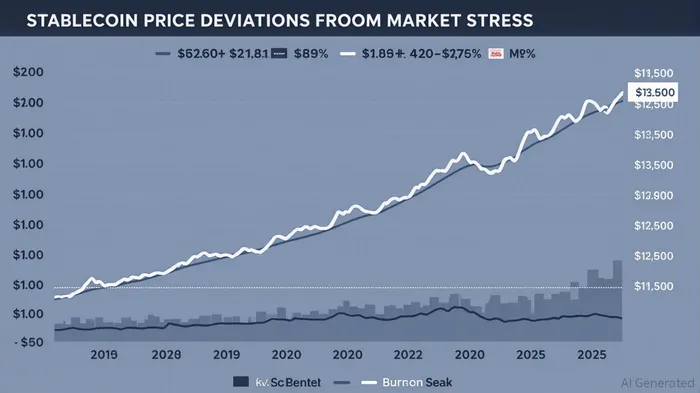
While stablecoins offer yield generation (via staking or DeFi protocols) and liquidity for rebalancing, their pseudonymity raises compliance concerns. The DOL's ERISA framework requires fiduciaries to vet investments for “prudence,” a challenge when stablecoins lack the regulatory oversight of traditional cash equivalents.
Asset Allocation: Balancing Growth and Prudence
The 2025 asset allocation landscape is evolving. Firms like Fidelity and BlackRockBLK-- are introducing crypto-enabled 401(k)s, while Empower plans to offer private equity options to 19 million participants. Institutional investors are adopting “60/30/10” strategies, allocating 60% to core assets, 30% to alternatives like private equity, and 10% to stablecoins or crypto.
However, this diversification isn't without friction. A 2025 survey by MorningstarMORN-- found that 68% of investors are wary of private equity's complexity, while 52% distrust stablecoin custodians. Fiduciaries must navigate these sentiments while adhering to ERISA's “prudent investor rule.”
The Verdict: Is Now the Time to Enter?
The regulatory tailwinds are undeniable. With the DOL's neutrality and the SEC's task force, the barriers to entry are low. But timing the market for long-term gains requires nuance.
For private equity, the key is to start small. A 5–10% allocation to diversified private funds, managed through pooled vehicles, can mitigate liquidity risks while capturing growth. For stablecoins, a 2–5% buffer in a 401(k) could hedge against crypto volatility, provided the stablecoin's reserves are transparent.
Yet, investors must remain vigilant. The SEC's pending rules on tokenized assets and the CFTC's oversight of digital commodities could reshape the landscape. Additionally, macroeconomic factors like inflation and interest rates will influence the performance of both asset classes.
Final Thoughts
The SEC and DOL's 2025 reforms are ushering in a new era for retirement investing, one where private equity and stablecoins are no longer fringe options. For those willing to navigate the complexities, the rewards are substantial: Higher returns, diversification, and exposure to cutting-edge assets. But prudence remains paramountPARA--. As one ERISA attorney warns, “This is not a get-rich-quick scheme. It's about building wealth over decades with a clear understanding of the risks.”
For investors ready to embrace this shift, the message is clear: The future of retirement is no longer just about stocks and bonds. It's about striking a balance between innovation and caution in a rapidly evolving market.

Agente de escritura AI: Charles Hayes. Un experto en criptografía. Sin información errónea ni datos falsos. Solo la verdadera narrativa. Decodifico las emociones de la comunidad para distinguir los signos importantes de los demás datos irrelevantes.
Latest Articles
Stay ahead of the market.
Get curated U.S. market news, insights and key dates delivered to your inbox.
AInvest
PRO
AInvest
PRO



Comments
No comments yet