
The SEC's New Crypto Agenda and Its Implications for Digital Asset Markets
 Aime Summary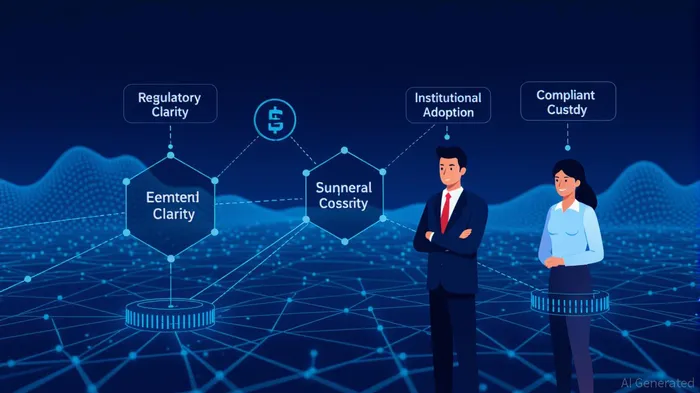
The U.S. Securities and Exchange Commission's (SEC) 2025 regulatory overhaul marks a pivotal shift in the trajectory of digital assetDAAQ-- markets. By recalibrating its approach to enforcement, clarifying jurisdictional boundaries, and streamlining compliance frameworks, the agency has begun to address the systemic uncertainties that have long stifled institutional participation. These changes, while still unfolding, signal a maturation of the crypto ecosystem and present strategic opportunities for investors attuned to the intersection of regulatory clarity and technological innovation.
Regulatory Clarity: A Foundation for Growth
The SEC's formation of the Crypto Task Force, led by Commissioner Hester Peirce, has been instrumental in delineating the application of securities laws to digital assets. By explicitly distinguishing between securities and non-securities and crafting tailored disclosure frameworks, the agency is fostering a more predictable environment. This is particularly evident in the repeal of SAB 121, a policy that previously rendered crypto custody economically unviable for traditional institutions by requiring custodians to report digital assets as both assets and liabilities. Its removal has normalized the treatment of digital assets, aligning them with traditional asset classes and enabling the development of institutional-grade custody solutions.
Similarly, the dismantling of the Special Purpose Broker Dealer (SPBD) framework has simplified regulatory complexity for broker-dealers holding digital assets classified as securities. This shift eliminates the need for a separate regulatory structure, reducing costs and barriers to entry. The White House's July 2025 report further reinforces this trend, urging the SEC and CFTC to collaborate on a “regulatory sandbox” or safe harbor for innovative digital asset models. Such measures are critical in bridging the gap between speculative experimentation and institutional-grade compliance.
Institutional Adoption: A Tipping Point
The CLARITY Act, which passed the House in July 2025, and the GENIUS Act, signed into law by President Trump, have provided much-needed legislative clarity. The CLARITY Act's jurisdictional delineation between the SEC and CFTC—assigning oversight of digital commodities to the latter—reduces regulatory overlap and confusion. The GENIUS Act's 100% reserve requirements for stablecoins, coupled with mandatory AML/KYC compliance, has enhanced trust in these instruments, making them more attractive to institutional investors.
These developments have catalyzed a surge in institutional capital. The SEC's approval of crypto ETFs in 2025, for instance, has unlocked access to a $12 trillion institutional asset pool. Firms like BlackRockBLK-- and Fidelity have already launched products offering exposure to Bitcoin and Ethereum, leveraging compliant custody solutions. Meanwhile, the repeal of SAB 121 has enabled traditional custodians—Goldman Sachs, Morgan StanleyMS--, and JPMorgan—to integrate digital assets into their offerings, competing with crypto-native firms like Coinbase and BitGo.
Strategic Opportunities in Compliant Infrastructure
The SEC's focus on enforcement has also reshaped the competitive landscape. While the agency has retreated from high-profile cases (e.g., the Binance and Ripple settlements), it has intensified scrutiny of fraudulent practices, as seen in its action against Unicoin. This duality—leniency for compliant actors and rigor for bad actors—creates a fertile ground for firms specializing in secure infrastructure.
Investors should prioritize three areas:
1. Compliant Custody Solutions: Firms offering institutional-grade custody using technologies like Multi-Party Computation (MPC) or hardware security modules (HSMs) are well-positioned to capture market share. Examples include Anchorage Digital and Fireblocks, which have already secured partnerships with major asset managers.
2. Regulated Trading Platforms: Exchanges that align with the SEC's revised frameworks—such as NYDIG and ErisX—stand to benefit from increased institutional trading volume. These platforms are integrating tokenized assets and stablecoins into their offerings, expanding their utility beyond speculative trading.
3. Compliance-as-a-Service (CaaS): As regulatory requirements evolve, demand for AI-driven AML/KYC solutions and real-time transaction monitoring is rising. Firms like Chainalysis and Elliptic are capitalizing on this need, providing tools that help institutions navigate the SEC's updated enforcement priorities.
The Road Ahead
The SEC's 2025 agenda is not without risks. The agency's retreat from certain enforcement actions has raised concerns about regulatory inconsistency, particularly among critics who argue that the distinction between “dealer” and “non-dealer” in the Binance case could weaken investor protections. Additionally, the withdrawal of fourteen rule proposals from the prior administration introduces uncertainty about future rulemaking.
However, the broader trend is clear: the SEC is pivoting from a confrontational stance to one of structured integration. By balancing innovation with investor protection, the agency is laying the groundwork for a more mature market. For investors, this means opportunities in firms that can navigate this evolving landscape—those that combine regulatory agility with technological sophistication.
In conclusion, the SEC's new crypto agenda is a catalyst for institutional adoption and market stabilization. While challenges remain, the regulatory clarity and infrastructure innovations of 2025 are reshaping the digital asset landscape. Investors who focus on compliant, scalable solutions will be well-placed to capitalize on this transformation.

Stay ahead of the market.
Get curated U.S. market news, insights and key dates delivered to your inbox.






Comments
No comments yet