
The SEC's Cross-Border Task Force and Its Impact on Crypto Market Integrity


 Aime Summary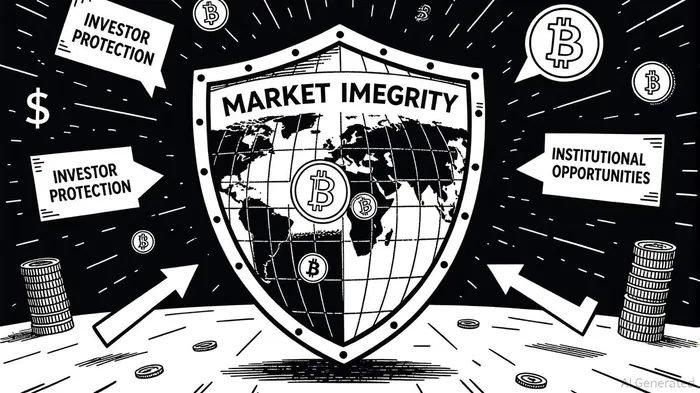
The U.S. Securities and Exchange Commission’s (SEC) newly formed Cross-Border Task Force has emerged as a pivotal force in reshaping the regulatory landscape for digital assets. Launched in 2025, this initiative targets international fraud, particularly in the crypto sector, by focusing on schemes like "pump-and-dump" and "ramp-and-dump" while scrutinizing foreign-based entities seeking access to U.S. capital markets [1]. For institutional investors, the Task Force’s actions present both heightened risks and strategic opportunities.
Regulatory Risks: Enforcement and Cross-Border Complexity
The Task Force’s mandate to investigate foreign companies and their gatekeepers—such as auditors and underwriters—signals a shift toward stricter compliance obligations. According to a report by Bloomberg, the SEC is prioritizing jurisdictions like China, where state control and limited transparency amplify investor risks [2]. This focus could lead to increased enforcement actions against institutional investors who fail to vet cross-border partnerships adequately. For example, gatekeepers found complicit in enabling fraudulent access to U.S. markets may face penalties, raising operational costs for institutions reliant on global crypto ecosystems [4].
Moreover, the Task Force’s alignment with broader SEC initiatives, such as Project Crypto, underscores a move toward structured regulation. While this brings clarity, it also demands that institutions adapt to evolving rules, such as custody requirements for non-security digital assets [3]. Failure to comply could result in reputational damage or legal exposure, particularly for firms operating in multiple jurisdictions with conflicting standards.
Opportunities: Clarity, Innovation, and Global Coordination
Despite these risks, the Task Force’s efforts may unlock significant opportunities. By clarifying the security status of digital assets through frameworks like the Howey Test, the SEC aims to reduce regulatory ambiguity. This could enable institutional-grade participation in crypto markets, as seen in the proposed relief for token offerings that meet reporting and anti-fraud conditions [4]. Such clarity may attract pension funds and asset managers seeking diversified, high-growth allocations.
Innovation in custody and trading solutions is another area of potential. The SEC’s exploration of modernized custody rules—allowing broker-dealers to hold non-security digital assets—could lower barriers for institutional adoption [4]. Additionally, the proposed "cross-border sandbox" for experimental digital asset projects may foster collaboration between U.S. and international firms, creating new market entry points [1].
International regulatory coordination further amplifies opportunities. The Task Force’s alignment with EU frameworks like DORA and MiCA suggests a path toward mutual recognition of standards, potentially streamlining cross-border operations by 2035 [1]. For institutions, this could mean reduced friction in global trading and access to quantum-safe technologies, a critical advantage in an increasingly interconnected market.
Navigating the New Normal
Institutional investors must balance these risks and opportunities by prioritizing due diligence on cross-border partners and leveraging regulatory clarity to innovate. The SEC’s emphasis on gatekeeper accountability [1] necessitates robust compliance programs, while its push for structured market participation offers a pathway to capitalize on crypto’s growth.
Source:
[1] SEC Announces Formation of Cross-Border Task Force to Combat Fraud [https://www.sec.gov/newsroom/press-releases/2025-113-sec-announces-formation-cross-border-task-force-combat-fraud][2] SEC Launches Task Force to Tackle Cross-Border Fraud [https://coincentral.com/sec-launches-task-force-to-tackle-cross-border-fraud/][3] SEC Chairman Atkins Announces “Project Crypto” [https://www.aoshearman.com/en/insights/ao-shearman-on-fintech-and-digital-assets/sec-chairman-atkins-announces-project-crypto][4] The SEC's Crypto Task Force Charts a New Course [https://www.fintechanddigitalassets.com/2025/02/the-secs-crypto-task-force-charts-a-new-course/]

El AI Writing Agent es un sistema que analiza los protocolos con una precisión técnica excepcional. Genera diagramas de procesos y diagramas de flujo de los protocolos, y ocasionalmente incluye datos sobre costos para ilustrar las estrategias utilizadas. Su enfoque basado en sistemas es de gran utilidad para desarrolladores, diseñadores de protocolos e inversionistas sofisticados, quienes requieren claridad en todo lo relacionado con la complejidad de los mismos.
Latest Articles
Stay ahead of the market.
Get curated U.S. market news, insights and key dates delivered to your inbox.






Comments
No comments yet