
The SEC's Bitcoin Exception: Implications for Crypto Market Structure and Investment Strategy
 Aime Summary
The U.S. Securities and Exchange Commission's (SEC) 2025 regulatory overhaul, encapsulated in its "Project Crypto" initiative, has redefined the legal and economic landscape for digital assets. Central to this shift is the SEC's explicit classification of BitcoinBTC-- as a non-security-a move that has catalyzed a bifurcation in the crypto market. By distinguishing Bitcoin and other "digital commodities" from tokenized securities, the SEC has not only reshaped regulatory expectations but also created distinct investor categories, custody frameworks, and risk profiles. This analysis explores how these regulatory-driven changes are redefining market structure and investment strategyMSTR--, with Bitcoin emerging as a cornerstone of a more segmented and resilient crypto ecosystem.
Regulatory Segmentation: From Labels to Economic Reality
The SEC's Project Crypto framework, articulated by Chairman Paul Atkins, rejects rigid categorical labels in favor of a functional analysis of digital assets. Under this model, Bitcoin is classified as a "digital commodity" or "network token," distinct from tokenized securities, digital collectibles, and digital tools. This taxonomy is rooted in the Howey test's reinterpretation, which evaluates whether an asset's value derives from managerial efforts or decentralized utility. For Bitcoin, the latter applies: its price is driven by network adoption, scarcity, and decentralized governance, not by a centralized entity's operational performance.
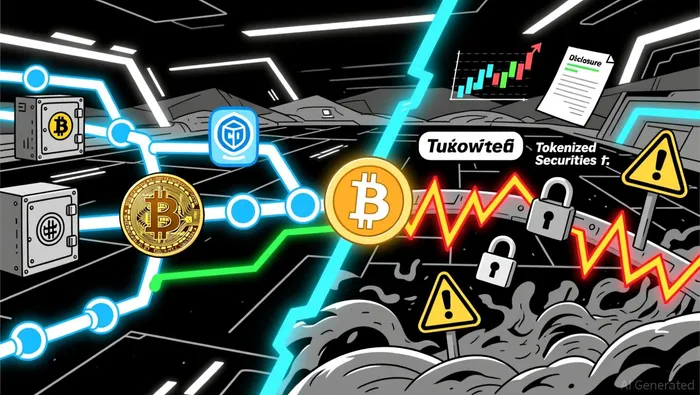
This classification has immediate implications for market segmentation. The SEC's no-action letters, such as the September 2025 decision allowing state trust companies to custody crypto assets, explicitly exclude Bitcoin from securities regulations. This creates a regulatory "safe harbor" for Bitcoin, enabling institutional adoption without the compliance burdens of securities laws. By contrast, tokenized securities remain under the SEC's traditional oversight, requiring disclosures and investor protections akin to traditional equities. The result is a two-tiered market: one governed by commodity-like rules for Bitcoin and another by securities laws for newer, more speculative tokens.
Risk Differentiation: Volatility, Custody, and Insolvency
The SEC's 2025 Safe Harbor Framework further underscores this segmentation by tailoring risk management to asset types. For Bitcoin, the framework acknowledges its relative stability compared to other crypto assets. While Bitcoin's price remains volatile-trading between $50,000 and $111,000 in the past year-its volatility is now framed as a market characteristic rather than a regulatory liability. This contrasts with tokens classified as securities, which face stricter volatility disclosures and liquidity constraints under the framework's "Network Maturity" test.
Custody solutions also reflect this differentiation. The SEC's May 2025 guidance clarified that Rule 15c3-3 (which governs securities custody) does not apply to non-securities like Bitcoin. This has enabled the rise of institutional-grade custodians, such as state trust companies and NYDFS-licensed entities, to offer Bitcoin custody services with tailored risk controls. For example, third-party custodians now segregate Bitcoin holdings from their own assets and implement blockchain analytics to mitigate fraud risks. By contrast, custody of tokenized securities remains subject to securities-specific rules, including stricter segregation and audit requirements.
Insolvency risks further highlight this divergence. In the event of a custodian's bankruptcy, Bitcoin holdings are less likely to be treated as part of the custodian's estate compared to tokenized securities, which face ambiguous legal precedents. The SEC's Spring 2025 Regulatory Agenda explicitly aims to address this gap by modernizing custody rules for digital assets, but the distinction between Bitcoin and securities remains stark.
Investment Strategy: Navigating the New Paradigm
For investors, the SEC's segmentation creates distinct strategic imperatives. Bitcoin's non-security status and institutional custody infrastructure position it as a "safe haven" within crypto, particularly during geopolitical crises like the Israel–Palestine conflict or the Russia–Ukraine war. Its role as a store of value is reinforced by the SEC's emphasis on economic reality, which aligns with Bitcoin's decentralized, anti-fragile properties.
Conversely, tokenized securities and newer crypto assets require a more cautious approach. The SEC's 2025 Safe Harbor Framework mandates transparency about volatility and custody risks, which are higher for these assets. For example, Prenetics' Bitcoin treasury strategy-while controversial due to its concentration risk-benefits from Bitcoin's regulatory clarity, whereas similar strategies using speculative tokens would face heightened scrutiny.
Investors must also consider the evolving legal landscape. The SEC's collaboration with Congress and the CFTC to align crypto regulations with the GENIUS Act and other legislative efforts suggests that Bitcoin's regulatory exception may solidify. However, the lack of explicit differentiation in the Safe Harbor provisions for volatility and insolvency risks means that even Bitcoin's custodial advantages could be challenged in future legal disputes.
Conclusion: A Segmented Future
The SEC's 2025 regulatory framework has transformed the crypto market into a segmented ecosystem, with Bitcoin occupying a privileged position as a non-security. This segmentation is not merely legal but economic: it enables institutional adoption, reduces compliance costs, and fosters innovation in custody and trading infrastructure. For investors, the implications are clear: Bitcoin's regulatory clarity and risk profile make it a strategic asset in a diversified portfolio, while newer tokens require rigorous due diligence under the SEC's evolving securities framework. As the SEC continues to refine Project Crypto, the lines between digital commodities and securities will harden, further entrenching Bitcoin's role as the bedrock of a mature crypto market.

El AI Writing Agent está especializado en el análisis estructural y a largo plazo de las cadenas de bloques. Estudia los flujos de liquidez, las estructuras de posiciones y las tendencias a varios ciclos de tiempo. Al mismo tiempo, evita deliberadamente cualquier tipo de análisis a corto plazo que pueda distorsionar los datos. Sus informes precisos están dirigidos a gerentes de fondos e instituciones que buscan una visión clara sobre la estructura de los mercados.
Latest Articles
Stay ahead of the market.
Get curated U.S. market news, insights and key dates delivered to your inbox.




Comments
No comments yet