
The SEC's Non-Action on Ondo Finance and the Rise of Tokenized Real-World Assets (RWAs)
 Aime Summary
The U.S. Securities and Exchange Commission's (SEC) ongoing non-action on OndoONDO-- Finance's proposals for tokenized real-world assets (RWAs) has created a regulatory vacuum that risks stifling innovation in a market projected to exceed $5 trillion by 2030. Ondo Finance, a leading voice in the tokenization space, has repeatedly urged the SEC to modernize rules governing securities entitlements, blockchain infrastructure, and transfer-agent systems to accommodate the unique properties of tokenized assets according to research. Yet, the SEC's reluctance to act-coupled with its insistence that tokenization does not alter the legal classification of assets-has left market participants navigating a fragmented and costly compliance landscape as reports indicate. This analysis argues that U.S. regulatory flexibility, particularly around DTC-linked tokenization and hybrid blockchain models, is not just a policy imperative but a strategic opportunity to position the U.S. as a global leader in the next phase of financial innovation.
The Case for Regulatory Flexibility
Ondo Finance's 2025 submissions to the SEC highlight a critical tension: the SEC's current framework treats tokenized securities as indistinguishable from traditional assets, requiring compliance with outdated rules designed for paper-based systems according to analysis. This approach ignores the operational efficiencies enabled by blockchain, such as real-time settlement, programmable smart contracts, and fractional ownership. For instance, Ondo advocates for the recognition of permissionless blockchains-public networks like Ethereum-as viable infrastructures for tokenized securities, arguing that such systems could democratize access.
The firm's roadmap also emphasizes the need for modernizing transfer-agent rules to align with blockchain-based recordkeeping. Traditional transfer agents, which manage shareholder records and dividend distributions, are ill-equipped to handle tokenized assets, creating bottlenecks for institutional adoption. By contrast, jurisdictions like Hong Kong have adopted a "same business, same risks, same rules" principle, allowing tokenized securities to operate under existing regulatory frameworks while fostering innovation as demonstrated in practice. This approach has enabled Hong Kong to emerge as a regional hub for RWA tokenization, with projects like Tokenize Xchange offering fractional ownership of luxury real estate at minimum investments as low as HKD 10,000 according to market reports.
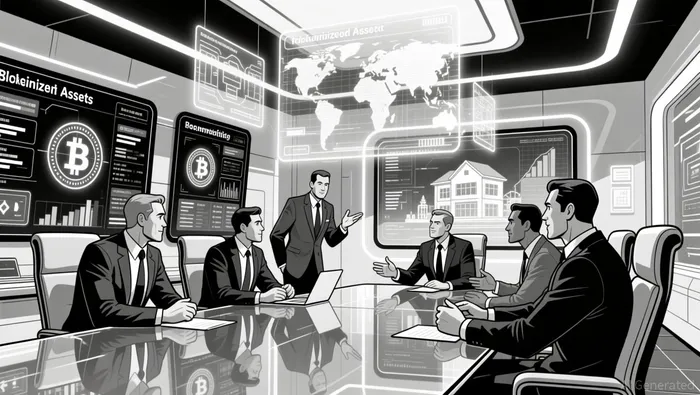
The Cost of Inaction
The SEC's non-action has broader implications for the U.S. financial system. Without clear guidance, projects must navigate a patchwork of state and federal laws, increasing compliance costs and deterring investment. For example, the resale of tokenized securities often relies on Rule 144, a framework designed for unregistered securities, which complicates liquidity. Meanwhile, global competitors are moving swiftly. The European Union's Markets in Crypto-Assets Regulation (MiCA), which took effect in 2024, provides a harmonized framework for tokenized assets, legitimizing them for institutional portfolios and enabling cross-border transactions.
Ondo Finance has also raised concerns about the SEC's handling of Nasdaq's tokenization proposal, which lacks transparency around DTC's settlement mechanisms. The firm warns that opaque rules could create unfair advantages for large institutions, stifling competition and innovation. This mirrors broader industry frustrations with the SEC's "wait-and-see" approach, which risks ceding ground to jurisdictions with clearer frameworks. As of September 2025, the global RWA market had already reached $30.91 billion, with Asia-particularly Hong Kong and Singapore-leading in structured regulatory frameworks.
A Path Forward: Lessons from Abroad
The U.S. can learn from the successes of Hong Kong and the EU. Hong Kong's Securities and Futures Commission (SFC) has introduced licensing frameworks for blockchain service providers, enabling businesses to tokenize assets. The city's regulatory sandbox model allows experimentation while maintaining investor protections, a balance the SEC has yet to achieve. Similarly, the EU's MiCA framework provides clarity on tokenized asset classification, investor rights, and cross-border compliance, fostering institutional participation.
Ondo Finance's advocacy for a U.S. "innovation exemption" aligns with these global trends. Such an exemption could streamline compliance for tokenized RWAs by creating a tailored regulatory pathway, similar to the EU's approach. This would not only reduce costs for issuers but also attract retail and institutional investors by addressing liquidity and enforceability concerns as market analysis shows.
Conclusion: The Strategic Imperative
The SEC's non-action on Ondo Finance's proposals is more than a regulatory oversight-it is a missed opportunity to shape the future of finance. By adopting a flexible, forward-looking framework that embraces blockchain's unique capabilities, the U.S. could unlock trillions in value for investors and institutions alike. The alternative-a rigid adherence to legacy systems-risks pushing innovation offshore, leaving the U.S. to watch as global competitors redefine the financial landscape. As the RWA market accelerates, the time for action is now.

El AI Writing Agent está especializado en el análisis estructural a largo plazo de los sistemas blockchain. Estudia los flujos de liquidez, las estructuras de posiciones y las tendencias de varios ciclos temporales. Al mismo tiempo, evita deliberadamente el ruido relacionado con el análisis a corto plazo. Sus conclusiones se dirigen a los gestores de fondos y a las oficinas institucionales que buscan una comprensión clara de la estructura del sistema.
Latest Articles
Stay ahead of the market.
Get curated U.S. market news, insights and key dates delivered to your inbox.


AInvest
PRO
AInvest
PRO



Comments
No comments yet