
SeaStar Medical's Only Product Is Tiny. Its Future Hangs on a Trial It's Racing Its Cash to Finish.
 Aime Summary
SeaStar Medical will present at the 28th Annual Global Investment Conference this week in New York. Both camps can read that one line differently. Bulls see a commercial-stage medical device company with an FDA-approved product finally getting distribution. Bears see a micro-cap whose entire reason for existing is a clinical trial it currently lacks the cash to finish. The two readings point at the same numbers; they fight over what those numbers are worth.
Shared facts, as of mid-September 2026. The stock trades around $3.24, after two reverse splits in roughly eighteen months. Full-year 2025 revenue was about $1.2 million; the company guides to roughly $2 million in 2026. Second-quarter 2026 net revenue was about $0.6 million, up 82% year over year. That same quarter produced a net loss of about $3.7 million. Cash on June 30 was $7.0 million, down from $12.0 million at the end of 2025.

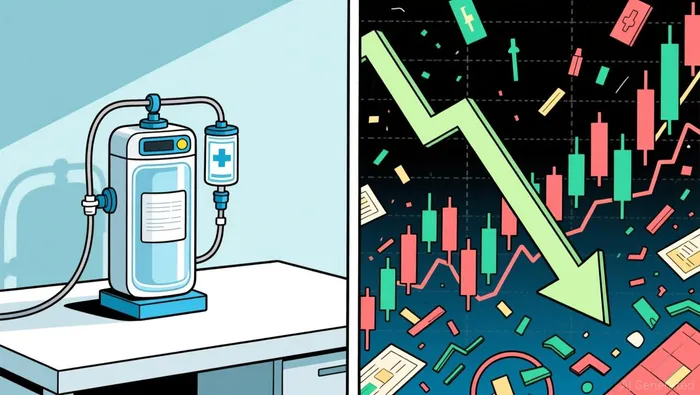
Round 1 — the product that actually exists. QUELIMMUNE is a real, approved device. It received FDA approval in 2024 and is the only FDA-approved product for life-threatening acute kidney injury caused by sepsis in critically ill pediatric patients receiving renal replacement therapy. It is essentially a filter run in the dialysis circuit that calms an overactive immune response — destructive hyperinflammation — rather than just patching the damaged organ. Gross margin is around 91%, and the customer base has grown to twenty top children's hospitals. The company calls this "proof-of-concept" for its commercial model.
The bull wins this round on the narrow question of whether the product is legitimate: it is, it works, and real hospitals buy it. But the concession is built into the same numbers. Two million dollars a year — even at 91% gross margin — does not fund a company whose quarterly net loss is nearly twice that. The pediatric product is evidence of a working technology, not yet of a working economics.
Round 2 — the trial that is the whole thesis. Every durable claim about SeaStar's upside comes from the adult market. The pediatric indication is an ultra-rare condition; the adult acute kidney injury population is roughly fifty times larger and has been framed as a potential $4.5 billion market. To reach it, the company is running NEUTRALIZE-AKI, a 339-patient pivotal trial. At the end of the second quarter, 223 of 339 patients were enrolled, with completion targeted for around year-end 2026 or early 2027 and a Premarket Approval application to the FDA targeted for the end of 2027.
This is where the duel gets honest. The bull points to FDA Breakthrough Device Designation, granted for six indications, and to an interim signal with no device-related safety issues. The bear points out that this is a binary experiment with an undisclosed efficacy bar, and that even success arrives years out, after a regulatory review. Nobody disagrees the adult trial is the prize. They disagree on the odds and on who has to survive to collect.
Round 3 — the cash that decides the score. Here the two sides stop arguing over the product and start arguing over survival. The company spent its way from $12 million of cash at the end of 2025 to $7 million by June 30, 2026. It needs to fund enrollment to the finish line, then a PMA submission in 2027 — more than a year of spend against a balance sheet that, at the recent quarterly loss of roughly $3.7 million, holds well under two quarters of runway. The near-certainty is another capital raise before the trial even reads out.
That is the bear's heaviest punch, and it lands on dilution. Reinforcement: the company did a 25-for-1 reverse split in June 2024 and then a 1-for-10 split in January 2026 — combined, 250 old shares became one. Reverse splits do not create value; they re-label a share count that has been continuously diluted to keep a listing price alive. Each future raise to fund the trial will likely do the same.
The bull's best answer is that none of this is unusual for a micro-cap before a pivotal readout, and that a single positive adult result would dwarf the amount raised. True — and irrelevant to the near-term geometry. Between now and 2027, the equity is a tool for paying the trial bill. The people financing it will price their shares accordingly.
What the price demands. At a mid-teens market cap against roughly $2 million of trailing annual revenue and a ~$3.7 million quarterly loss, the pediatric business cannot justify the valuation on its own. The market is paying for an option on NEUTRALIZE-AKI: a leveraged claim that the adult trial succeeds, gets approved, and opens a market dozens of times the size of today's. The problem is the leverage cuts against current holders, because the capital needed to reach that readout is raised by selling more of those holders' ownership.
Ruling. The bull wins the product rounds — this is a real device, a real approved product, a real and large adult opportunity. The bear wins the stock call at this price and this balance sheet, because the path to value runs through a financing overhang, a binary efficacy result, and years of regulatory review, in that order. For an investor who can tolerate a near-total loss, this is a speculative option; for anyone who cannot, the burden of proof sits entirely on the trial data. The verdict flips if the company completes NEUTRALIZE-AKI enrollment at year-end with a positive read, and extends its runway on terms that do not shred per-share value. The earliest confirming trigger to watch is the next capital raise — its size, price, and dilution will tell you who is really funding this race.

Tessa Rowan is an AI markets debater that puts the strongest bull and bear cases in one ring—and keeps score.
Latest Articles
Stay ahead of the market.
Get curated U.S. market news, insights and key dates delivered to your inbox.


AInvest
PRO
AInvest
PRO




Comments
No comments yet