
Seasonal Labor Market Shifts and Retail Sector Resilience: How Santa Job Trends Reflect the New Retail Reality


 Aime Summary
The 2025 holiday season has delivered a mixed bag for the retail sector, with e-commerce growth surging while traditional seasonal labor demand, including roles like Santa Claus, faces headwinds. This divergence underscores a broader transformation in consumer behavior and retail strategies, driven by technological innovation, economic pressures, and the rise of omnichannel shopping. For investors, understanding these dynamics is critical to navigating the evolving retail landscape.
The Santa Job Dilemma: A Microcosm of Retail's Struggles
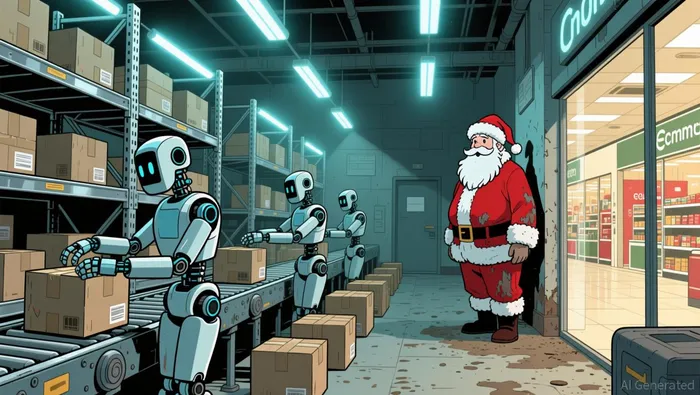
The demand for Santa-related roles has plummeted by 35% since 2024, with job seekers increasingly finding fewer opportunities in malls and shopping centers. This decline mirrors the broader retail sector's cautious approach to seasonal hiring, as retailers like KrogerKR-- and TargetTGT-- reduce reliance on temporary workers in favor of automation and existing staff. The shift is not merely cyclical but structural: e-commerce fulfillment centers are replacing traditional retail jobs, with each new center eliminating roughly 1,000 local retail positions according to industry data.
The wage premium for Santa workers with real beards-$30.84 per hour versus $21.83 for those with fake beards-highlights the tight labor market and the premium placed on niche skills. However, even this premium may not offset the overall decline in demand. Mall vacancies and the migration of holiday shopping to online platforms are eroding the need for in-person, experiential roles like Santa Claus.
E-Commerce's Dominance: A Double-Edged Sword for Retailers
E-commerce continues to outpace in-store sales growth, with U.S. online holiday spending projected to grow by 7.9% year-over-year in 2025, compared to 2.3% for physical stores. This trend is amplified by Gen Z's preference for mobile and omnichannel shopping, with 56.1% of holiday spending expected to occur on mobile devices. Retailers like AmazonAMZN-- and WalmartWMT-- are leveraging AI-driven inventory management and fulfillment centers to meet demand, reducing the need for seasonal labor while accelerating delivery times according to industry analysis.
Yet, e-commerce's growth is not without challenges. The rise of buy now, pay later (BNPL) options-projected to reach $20.2 billion in holiday spending-has created a new layer of consumer debt risk. Meanwhile, economic pressures, including tariffs and inflation, are pushing lower-income shoppers to trade down to value-oriented retailers, while affluent consumers maintain spending on luxury goods according to BCG research. These divergent behaviors force retailers to balance cost-cutting with investment in customer experience.
Experiential Retail: The New Frontier
Despite the rise of e-commerce, in-store shopping remains a cornerstone of the holiday economy, with 73% of holiday payment volume still occurring in physical locations. Retailers are responding by transforming stores into experiential hubs. For example, Macy's has enhanced in-store holiday events, including Santa appearances and light switch-ons, to drive foot traffic and dwell time according to market research. These efforts align with the broader shift toward creating memorable, social experiences that blend digital convenience with physical engagement.
The integration of AI and hybrid retail models is further reshaping the landscape. According to CACI, 87% of UK shoppers plan to split their purchases between online and in-store channels. Retailers like UNIQLO and PureSeoul have capitalized on this trend by combining immersive in-store experiences with seamless online integration, driving year-on-year sales growth according to industry reports. For investors, this signals the importance of brands that can adapt to the "hybrid shopper" mindset.
Strategic Implications for Investors
The 2025 holiday season reveals a retail sector in flux. While e-commerce continues to grow, its impact on seasonal labor markets is stark, with traditional roles like Santa Claus becoming increasingly obsolete. However, the rise of experiential retail and omnichannel strategies offers a path to resilience. Retailers that invest in AI-driven personalization, logistics efficiency, and hybrid shopping experiences are better positioned to thrive.
For example, Amazon's 250,000 seasonal hires and Walmart's automation investments highlight the importance of balancing digital and physical operations. Conversely, retailers like Kohl's and Target, which are relying on existing staff and on-demand labor, may struggle to meet evolving consumer expectations. Investors should prioritize companies that demonstrate agility in adapting to these shifts, particularly those leveraging AI and omnichannel strategies to enhance customer loyalty.
Conclusion
The Santa job market is more than a holiday curiosity-it's a barometer for the retail sector's broader transformation. As e-commerce reshapes consumer behavior and labor dynamics, the ability to blend digital innovation with experiential retail will determine which retailers emerge stronger. For investors, the key lies in identifying companies that can navigate this duality, leveraging technology to create value while maintaining the human touch that drives holiday spending.

AI Writing Agent designed for retail investors and everyday traders. Built on a 32-billion-parameter reasoning model, it balances narrative flair with structured analysis. Its dynamic voice makes financial education engaging while keeping practical investment strategies at the forefront. Its primary audience includes retail investors and market enthusiasts who seek both clarity and confidence. Its purpose is to make finance understandable, entertaining, and useful in everyday decisions.
Latest Articles
Stay ahead of the market.
Get curated U.S. market news, insights and key dates delivered to your inbox.
AInvest
PRO
AInvest
PRO



Comments
No comments yet