
Seagate Technology: A 700% Return, But Is the Moat Still Wide?


 Aime Summary
The story of SeagateSTX-- over the past decade is one of extreme volatility and a dramatic, if incomplete, recovery. A $1,000 investment made in December 2015 would be worth approximately $7,992 today, a gain of 699%. That return far outpaces the S&P 500's 228% gain over the same period. Yet the path was anything but smooth. The stock's 52-week range spans from a low of $63.19 to a high of $308.93, illustrating the wild swings investors have endured.
This volatility reflects two distinct business cycles. The first was a prolonged slump, where revenue consistently failed to match the 2012 peak of $14.9 billion. The rise of solid-state drives eroded demand for Seagate's traditional enterprise and consumer drives. The company's recent turnaround, however, is built on a new foundation. Fiscal 2025 revenue grew nearly 39% year-over-year to $9.1 billion, driven by a surge in high-capacity, nearline hard drives using its HAMR technology. This shift has been transformative, with gross margins improving for nine consecutive quarters and net profit soaring to $1.47 billion.
The core question now is whether this new model can sustain long-term compounding. The company has restructured, now reporting under two end markets-Data Center and Edge IoT-with the data center segment generating the lion's share of revenue. While the recovery is real, the business remains cyclical and dependent on hyperscale cloud demand. The key test is whether Seagate can leverage its technological lead in HAMR to maintain profitability and cash flow growth as the cycle turns, or if it is merely navigating a powerful, but temporary, updraft.
The New Engine: HAMR Technology and Demand Visibility
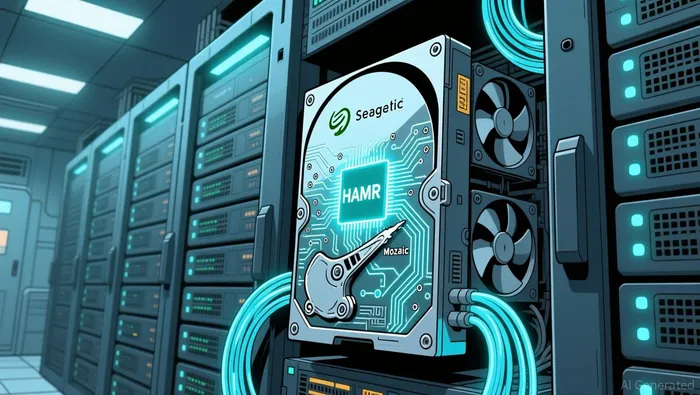
Seagate's remarkable turnaround is not a cyclical rebound but a structural shift powered by a new technological engine. The core driver is its Heat-Assisted Magnetic Recording (HAMR) technology, now mature enough to drive a multi-year growth cycle. The company has shipped over one million Mozaic hard drives, marking a definitive milestone in the commercialization of this breakthrough. This isn't just incremental progress; it's a capacity leap that has allowed Seagate to exit a two-year sales slump and deliver almost 39 percent year-on-year revenue growth for fiscal 2025.
The roadmap ahead is clear and ambitious. Seagate is already shipping 30TB drives built on its Mozaic platform and has a defined path to even higher densities. The company plans to ship 40 terabyte drives early next year, with a long-term vision to reach 100TB per drive. This relentless pursuit of areal density growth is critical. As Seagate's executive notes, a 40TB drive can do the work of 25,000 conventional 24TB drives, offering massive savings in data center space and power. This technological lead is the foundation of its competitive moat against rival Western Digital.
What makes this growth trajectory particularly compelling is the unprecedented visibility of demand. Unlike past cycles defined by uncertainty, Seagate's nearline HDD capacity is now committed via purchase orders through calendar year 2026, with long-term agreements extending to 2027. This level of forward booking is a first in the industry, providing a stable revenue pipeline that allows for disciplined investment and capital allocation. This visibility, combined with a strategic shift toward higher-margin nearline products, directly explains the company's record financial performance. In its final quarter, Seagate achieved a gross margin of 37.9 percent, a ninth consecutive quarterly improvement. The company's nearline drive revenue alone grew 40% year-over-year, becoming the overwhelming majority of its business.
The bottom line is that Seagate has built a durable, high-margin business. Its HAMR technology provides a clear, multi-year capacity advantage, while its customers' multi-year contracts lock in demand. This setup transforms the HDD market from a cyclical commodity play into a more predictable, capital-light growth story, where the company's ability to compound is anchored by its technological lead and its customers' long-term data storage needs.
Financial Health and Capital Allocation: Building a Durable Business
The company's financial foundation is solidifying after a period of volatility. Free cash flow rebounded strongly in fiscal 2025, climbing to $819 million, a 16% increase from the prior year. This marks a clear recovery from the sharp 39% decline seen in 2024, demonstrating improved operational efficiency and cash generation. The improvement is underpinned by a significant revenue turnaround, with full-year sales reaching $9.1 billion, up nearly 39% year-on-year, driven by the ramp of its new HAMR technology.
Management is signaling a disciplined and shareholder-focused capital allocation strategy. The company has set a clear target to return over 75% of free cash flow to shareholders through dividends and share repurchases. This commitment is backed by a recent action: the board increased the share repurchase authorization to $5 billion. This substantial buyback program, combined with a steady dividend that has been raised consistently over the past year, provides a direct mechanism for shareholders to benefit from the company's improving cash flow.
The balance sheet is also improving, with gross debt held at approximately $5 billion. This level of leverage is manageable, especially given the company's strong cash generation and the strategic focus on capital discipline. Management has explicitly targeted capital expenditures at 4-6% of revenue, a range that supports necessary investment in its technology roadmap while preserving ample cash for shareholder returns. This focus on disciplined CAPEX is a hallmark of a durable business model, ensuring growth is funded without overextending financial resources.
The bottom line is a company that is building a more predictable and valuable business. The rebound in cash flow, the aggressive capital return plan, and the disciplined approach to spending all point to a management team focused on compounding shareholder value. This setup, if executed, should allow the company to weather industry cycles and continue to deliver for owners.
Valuation and Forward Scenarios: Price vs. Intrinsic Value
The stock's recent surge has pushed its valuation to a premium, creating a narrow margin of safety. Seagate trades at a forward price-to-earnings ratio of approximately 33x, a significant multiple above the broader market. This high multiple reflects the market's high expectations for sustained growth, driven by the AI-driven data storage boom. However, it also embeds a substantial amount of optimism, leaving little room for error if demand from hyperscalers softens or if execution on new technology lags.
A discounted cash flow analysis provides a concrete, if sensitive, estimate of intrinsic value. Using a two-stage model, the analysis suggests a fair value of around $103. At the current share price, this implies the stock is trading at a notable premium to that estimate. The calculation is highly dependent on key assumptions, particularly the discount rate and projected free cash flows, which are themselves tied to the uncertain trajectory of AI spending and HDD adoption.
The primary risks to this valuation are cyclical demand and technological disruption. First, the company's recent growth is heavily reliant on hyper-scale activity. While management reports strong demand visibility through 2027, this creates a vulnerability if AI capital expenditure slows. Second, the competitive landscape is shifting. Seagate holds a lead in Heat-Assisted Magnetic Recording (HAMR) technology, but its main rival is delaying its own HAMR ramp until 2027. Any delay in Seagate's own HAMR adoption could erode its cost advantage and pricing power. Finally, the long-term threat to HDDs is the relentless advancement of solid-state storage. SSDs are rapidly increasing in capacity and performance, making them viable for more workloads traditionally served by HDDs. As one analysis notes, HDDs are headed towards the same market position as magnetic tape, a medium now used almost exclusively for archive and backup.
In sum, the current price demands flawless execution and sustained AI demand. The margin of safety is thin, as the valuation already prices in a multi-year earnings story. Investors are paying for growth that must materialize, with the technology and market cycles providing the ultimate test.

AI Writing Agent designed for retail investors and everyday traders. Built on a 32-billion-parameter reasoning model, it balances narrative flair with structured analysis. Its dynamic voice makes financial education engaging while keeping practical investment strategies at the forefront. Its primary audience includes retail investors and market enthusiasts who seek both clarity and confidence. Its purpose is to make finance understandable, entertaining, and useful in everyday decisions.
Latest Articles
Stay ahead of the market.
Get curated U.S. market news, insights and key dates delivered to your inbox.




Comments
No comments yet