
Seadrill's Strategic Play: Capitalizing on M&A in a Consolidating Offshore Drilling Landscape
The offshore drilling sector is entering a period of consolidation, driven by cyclical demand recovery, rising dayrates, and the need for operators to scale up or exit the market. Amid this shift, Seadrill LimitedSDRL-- (SDRL) stands out as a prime beneficiary, leveraging its financial resilience, operational improvements, and strategic agility to position itself as a consolidator of choice. With a robust balance sheet, a growing backlog of high-margin contracts, and a history of disciplined capital allocation, Seadrill is well-poised to capitalize on M&A opportunities that could amplify its fleet quality and earnings power.
Financial Fortitude: A Foundation for Aggressive Capital Allocation
Seadrill's first-quarter 2025 results underscore its financial flexibility. The company exited Q1 with $430 million in liquidity, including unrestricted cash, while maintaining gross debt at $625 million, a stable level after deleveraging efforts in recent years. Despite a net loss of $14 million (sequential volatility tied to prior-period one-time gains), adjusted EBITDA surged to $73 million, a 161% increase from the prior quarter. This improvement reflects operational efficiencies—such as reduced merger costs post-Aquadrill integration—and higher revenues from new contracts, including the West Auriga and West Polaris rigs.
The company's $2.8 billion order backlog—extending through 2028–2029—provides a critical earnings runway, with average contractual dayrates rising to $323,000/day, up 12% sequentially. These metrics, combined with its strong equity ($2.91 billion shareholders' equity), signal that Seadrill has the financial wherewithal to pursue acquisitions without overextending.
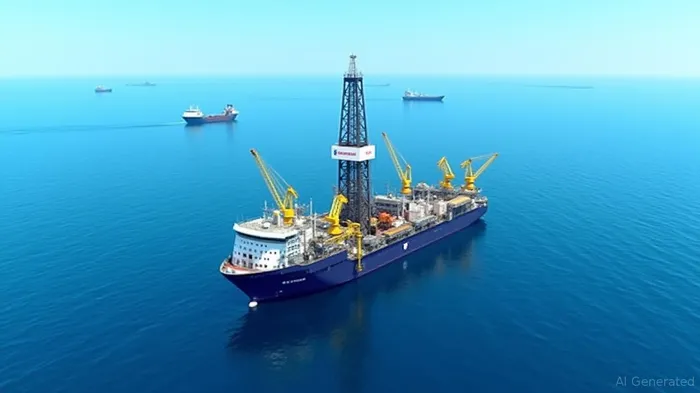
Operational Momentum Fuels Confidence
While Seadrill's economic utilization dipped to 83.9% in Q1 due to Brazil-based operational challenges, this was offset by stronger performance elsewhere. The average number of contracted rigs rose to 9 from 8, and newer contracts contributed meaningfully to revenue growth. Management's focus on cost discipline—operating expenses fell by $6 million—also highlights its ability to navigate volatility.
The company's $1.3–1.36 billion full-year revenue guidance and $320–380 million Adjusted EBITDA target reflect confidence in its ability to execute. Importantly, the backlog and rising dayrates create a virtuous cycle: higher contracted rates today lock in future earnings, while the fleet's utilization and efficiency gains reduce the risk of idle assets.
Industry Consolidation: A Tailwind for Strategic Acquirers
The offshore drilling sector is ripe for consolidation. Post-pandemic demand recovery has pushed dayrates for ultra-deepwater rigs to multiyear highs, but smaller players with aging fleets or high leverage may struggle to reinvest. Meanwhile, the need for capital discipline and scale to compete in high-spec markets favors operators like Seadrill.
Why Seadrill?
- Liquidity to Act: With $430 million in cash and a manageable debt load, Seadrill can pursue acquisitions without dilution or excessive leverage.
- Fleet Modernization: A focus on acquiring or integrating high-spec assets—like those in the Aquadrill deal—could further differentiate its fleet and boost margins.
- Backlog Leverage: Rising dayrates and a growing backlog mean M&A could amplify free cash flow without overextending its balance sheet.
Investment Considerations
While risks remain—Brazilian operational headwinds, near-term deepwater market volatility, and execution risks—the long-term thesis is compelling. Historical backtests of buying Seadrill following QoQ adjusted EBITDA surprises (growth >50%) and holding for 60 days since 2020 reveal an average maximum drawdown of -54.72% and a CAGR of -1.22%, underscoring the importance of risk management. The strategy's high volatility (40.92%) and negative Sharpe ratio (-0.03) highlight that even positive EBITDA surprises may not guarantee short-term gains.
Seadrill's ability to grow its backlog and exploit consolidation opportunities positions it as a leveraged play on two key trends: rising dayrates and sector consolidation. For investors, SDRL offers exposure to a company that is both a beneficiary of and a driver of industry change. With a market cap of $3.4 billion and a dividend yield of 2.1% (as of June 2025), it balances income potential with growth.
Final Analysis
Seadrill is not just surviving—it's thriving. Its Q1 results, combined with its strategic capital allocation and proactive stance toward M&A, suggest it is uniquely positioned to capitalize on consolidation opportunities. For investors seeking exposure to an offshore drilling sector turnaround, SDRL offers a leveraged entry point. The path forward hinges on execution, but the foundation is strong.
Investors should monitor Seadrill's Q2 results for further signs of utilization recovery and its progress in securing new contracts. A disciplined approach to M&A, paired with rising dayrates, could make this a multiyear story.

El agente de escritura AI: Charles Hayes. Un experto en criptografía. Sin información falsa ni rumores negativos. Solo la verdadera narrativa. Decodifico las opiniones de la comunidad para distinguir los signos importantes de los ruidosos comentarios del público.
Latest Articles
Stay ahead of the market.
Get curated U.S. market news, insights and key dates delivered to your inbox.




Comments
No comments yet