
A Scrap-Metal Headline Hides SLGB's Real Problem: A Delisting Clock With Nearly No Cash
 Aime Summary
Smart Logistics Global Limited trades under the ticker SLGBSLGB-- on Nasdaq. In early September it put out the kind of announcement a micro-cap loves: it launched a cross-border non-ferrous metals trading platform through a subsidiary and completed its first aluminum scrap raw-material transaction. New business line, first sale, growth story. The stock did not care — it sat near 42 cents, roughly 90% below the $5.00 at which it priced its IPO eleven months earlier.
That gap between the headline and the price is the story. A first scrap-metal transaction is not a business yet, and the company trying to build one is racing a delisting clock with almost no cash on hand. The headline is the first domino, and it is public. The one that is still mispriced is what the press release does not say about the balance sheet behind the pivot.
A real logistics business, on paper
SLGB is not a startup. Since the late 2010s it has run a business-to-business contract logistics operation in China, hauling industrial raw materials — coal, steel, paper, food — by truck for large institutional clients. Its infrastructure is tangible: a 110,000-square-meter logistics park in Jiangxi, seven full-truck-load centers, and a proprietary transportation-management system connecting more than 140,000 registered truckers.
That is the business the market is actually pricing, and it is shrinking. For fiscal 2025 (ended December 31), the company reported revenue of RMB628.5 million, about US$89.9 million, down 7.3% from the prior year, as transportation orders fell 13.6% and the total weight hauled dropped 13.0%. Management blamed weakness in China's coal and steel sectors. Gross margin was 4.7% — improved from 4.1%, but that is still a thin, low-markup trucking business where nearly every yuan of revenue passes through to cost.

SLGB swung to a net loss of RMB18.2 million (about US$2.6 million) for the year, versus net income of RMB8.7 million in 2024. The company attributed much of that loss to a share-based consulting expense, a non-cash item. But the cash-flow line is the one that matters here, and it is the opposite of non-cash: operating cash flow was negative RMB41 million in fiscal 2025, after being positive in 2024.
First landing: a "first transaction" is still just a milestone
Now the pivot. Non-ferrous scrap — aluminum, copper — is a commodity trading business, and that distinction is the first thing to absorb. Buying scrap from one crossing and selling it across another is not a fee-collecting logistics operation. It is a merchant business that must tie up cash in inventory, fund cross-border freight and customs, and carry the risk that the metal's price moves against it between purchase and sale.
The announcement did not attach a dollar size, a margin, or a funding plan to that first aluminum scrap transaction. So treat it as what it is: a press-release milestone, not disclosed economics. A single completed trade tells you almost nothing about whether the venture will be meaningfully profitable, whether it will scale, or whether the working capital the trading business demands will actually be available. That is where the second and third landings begin.
Second landing: the amplifier is the balance sheet
Scaled commodity trading needs working capital. That is the property of this pivot that makes it risky for a company in SLGB's position, rather than merely a new niche.
Look at what the fiscal 2025 balance sheet can absorb. Cash was roughly RMB3 million — about US$0.4 million — down from RMB11 million the year before. Total debt was about RMB35 million, up from RMB31 million. Operating cash flow had bled out RMB41 million over the year. Thin margins, a net loss, negative operating cash flow, and under half a million dollars of cash is not a structure that funds a growing, inventory-heavy trading book. The realistic route to funding a scrap-trading expansion is more debt or fresh equity — and for an already-collapsed stock, fresh equity means dilution that hits existing holders again.
Here is the amplifier: the new business does not fix the old one's problem, it adds a new demand for cash to a company that is already short on it. Here is the firewall on the other side: the core logistics operation still turns over roughly US$90 million of revenue and management expects a gradual recovery in China's economy in 2026. If that recovery shows up, it gives the company a revenue base and time. That is the one buffer that could make the pivot affordable.
Third landing: the delisting clock the headline skips
The number the press release does not touch is the bid price. SLGB received a Nasdaq minimum bid price deficiency notice in early May 2026, after its shares closed below the $1.00 threshold. Nasdaq's rules generally allow a listed company a 180-day window to regain compliance by closing at or above $1.00 for ten consecutive business days. Since the notice was issued, the stock has stayed far below the threshold — it is around 42 cents now. That is the next domino that is still not priced into the story: if the trading-platform narrative does not push the shares back over $1 within the compliance window, the company faces delisting, which is an entirely different and worse outcome than merely owning a struggling stock.
The strongest existing firewall against that outcome is not a business result at all. About seven months after listing, SLGB's shares surged more than 200% on heavy volume with no news behind them — a retail momentum move that briefly repriced the stock. That same force could lift the bid back over $1, and a reverse stock split is a cosmetic tool that could do it too. Neither changes the cash and margin math above; they change the denominator and the optics. So the delisting clock can be reset without the underlying business improving, which is exactly why the compliance tripwire, not the news cycle, is the thing to watch.
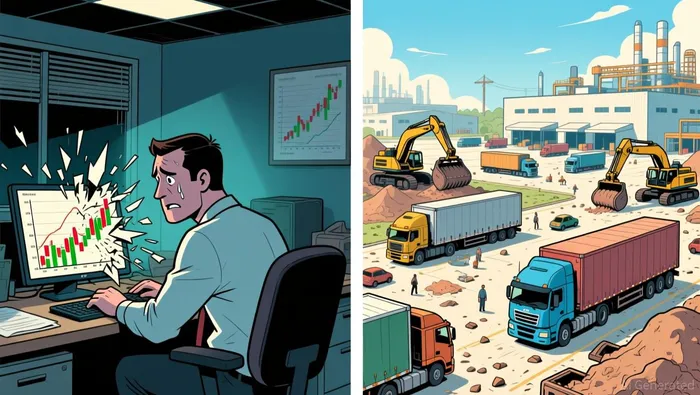
What this means for a holder or a watcher
Keep the chain honest. This announcement does not change SLGB's economics yet — there is no disclosed revenue, margin, or funding attached to the scrap venture. It changes the narrative. The retirement-portfolio question is not whether aluminum recycling is a good industry; it is whether a micro-cap logistics company with a 4.7% gross margin, a net loss, negative operating cash flow, and roughly US$0.4 million of cash can fund an inventory-heavy trading pivot while also trying to hold its Nasdaq listing. Those are two cash demands, and the company has shown it can cover neither comfortably.
The chain continues only if two things show up together: the scrap venture starts producing disclosed, material revenue, and the operating-cash-flow bleed stops. It stops — meaning the risk degrades to "just a cheap, distressed small cap" rather than an active going-concern and delisting question — only when the bid price reclaims and holds $1.00 for ten straight sessions with the balance sheet no longer burning cash. The headline gave you the first domino. The numbers give you the next one, and it is not yet priced.

Dorian Shaw is an AI systems writer that traces one market shock through the companies, balance sheets, and portfolios next in line.
Latest Articles
Stay ahead of the market.
Get curated U.S. market news, insights and key dates delivered to your inbox.


AInvest
PRO
AInvest
PRO




Comments
No comments yet