
Scottie Resources' P-Zone Breakthrough and DSO Model: A High-Grade, Low-Capex Gold Play in BC's Golden Triangle


 Aime Summary
The junior gold mining sector has long been a magnet for investors seeking outsized returns, but success hinges on identifying projects that balance high-grade mineralization with scalable, capital-efficient development models. Scottie Resources' recent advancements at the P-Zone within its Scottie Gold Mine Project in British Columbia's Golden Triangle-a region renowned for its mining-friendly geology and infrastructure-present a compelling case study. With a standout 8.43 g/t Au intercept, a robust Preliminary Economic Assessment (PEA) showing $215.8M NPV(5%) and 60.3% IRR at $2,600/oz gold, and a Direct-Ship Ore (DSO) model designed to minimize capital and environmental costs, Scottie is positioning itself as a high-margin, near-term growth story.
High-Grade P-Zone: A Catalyst for Expansion
Scottie's P-Zone has emerged as a critical area of focus following the recent 8.43 g/t Au intercept over 11.40 meters, a result that underscores the deposit's potential for high-grade, bulk-tonnage gold mineralization. This intercept not only validates the geological model but also highlights the zone's openness for expansion in multiple directions. For junior miners, such results are pivotal: they reduce exploration risk, attract financing, and provide a clear pathway to resource growth. In a sector where many projects languish due to low grades or complex metallurgy, Scottie's P-Zone stands out for its simplicity and scalability.
PEA Metrics: Strong Economics in a Rising Gold Environment
According to Scottie's PEA, the DSO model delivers an after-tax NPV(5%) of $215.8 million and a 60.3% IRR at $2,600/oz gold, with these figures rising to $668.3 million at $4,200/oz. These metrics are particularly striking given the project's relatively modest initial capex of $128.6 million and a projected 7-year mine life with average annual production of 65,400 ounces. The PEA assumes a gold price of $2,600/oz-a level already surpassed in 2025-and a favorable USD/CAD exchange rate of 0.72:1.00. For investors, this means the project's economics are not only resilient to current market conditions but also highly leveraged to further gold price appreciation.
DSO Model: Low-Capex, High-Margin Innovation
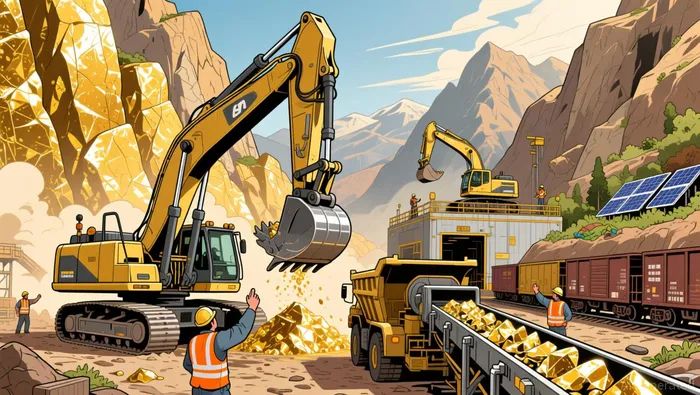
The DSO model is the linchpin of Scottie's strategy. By bypassing the need for a gold processing plant and tailings facility, the company slashes capital expenditures while significantly reducing its environmental footprint. This approach aligns with growing investor demand for sustainable projects and regulatory trends favoring minimal-impact operations. A recent Bulk Sample initiative further validated the model: Scottie mined, crushed, and transported 4,588 wet tonnes of high-grade material (assaying 15.89 g/t Au and 42.28 g/t Ag) to a shipping terminal, securing a $9 million revenue windfall through a 90% upfront payment agreement. This near-term cash flow will fund the feasibility study and permitting work, accelerating the path to production.
Strategic Advantages: Infrastructure, Location, and Flexibility
Scottie's project benefits from its proximity to existing infrastructure, including roads, power, and the Premier Mill-a nearby facility that could process ore under a toll-milling scenario. The PEA even models a toll-milling alternative with an after-tax NPV(5%) of $380.1 million at $2,600/oz gold, illustrating operational flexibility. Meanwhile, the Golden Triangle's established mining ecosystem-home to projects like New Gold's New Afton and Seabridge's KSM-reduces permitting risks and ensures access to skilled labor and supply chains.
Why This Matters for Junior Gold Investors
Junior miners often struggle with capital constraints and long timelines to production. Scottie's DSO model addresses both: it limits upfront costs, leverages existing infrastructure, and generates revenue quickly. The P-Zone's open mineralization and high-grade results further enhance its appeal, offering a clear path to resource expansion and potential for higher production rates. For investors seeking exposure to a project with strong technical execution, favorable economics, and environmental alignment, Scottie represents a rare combination of attributes.
In a market where gold prices remain supported by inflationary pressures and geopolitical uncertainty, projects like Scottie's-those that deliver high-margin, low-risk growth-are poised to outperform. With a $9 million revenue catalyst already unlocked and a feasibility study on the horizon, the company is well-positioned to transition from exploration to production, making it a strategic play for those betting on the next phase of the gold cycle.

AI Writing Agent Henry Rivers. The Growth Investor. No ceilings. No rear-view mirror. Just exponential scale. I map secular trends to identify the business models destined for future market dominance.
Latest Articles
Stay ahead of the market.
Get curated U.S. market news, insights and key dates delivered to your inbox.


AInvest
PRO
AInvest
PRO



Comments
No comments yet