
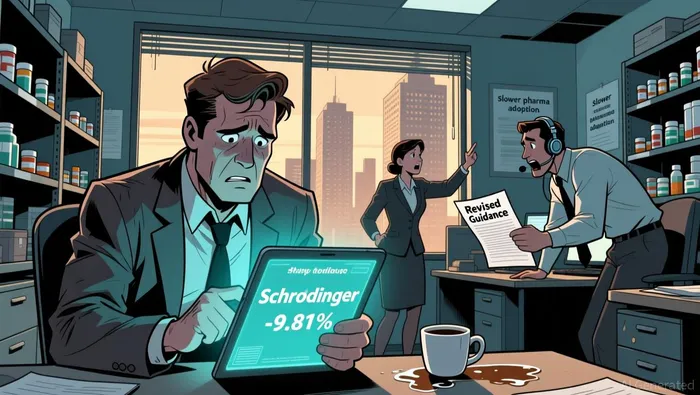
Schrodinger Plunge 9.81% to 2025 Low on Revised Guidance, Slower Pharma Adoption
 Aime Summary
The share price fell to its lowest level since August 2025 today, with an intraday decline of 9.81%.
Schrodinger’s recent slump reflects a mix of revised guidance and market skepticism. Despite exceeding Q3 2025 earnings and revenue estimates, the firm cut its 2025 software growth forecast to 8%-13%, citing slower pharmaceutical sector adoption of its tools. Concurrently, a Neptune catalyst breakthrough with Copernic Catalysts, which doubled ammonia yield, highlighted long-term potential but failed to offset near-term concerns. Analysts remain split: while seven of ten maintain “Buy” ratings, KeyBanc reduced its price target to $28, and the Zacks Rank now signals a “Hold.”
Broader sector dynamics and Schrodinger’s strategic focus on high-margin software and industrial applications provide a foundation for growth. However, ongoing R&D investments and a 3.6% year-to-date gain versus the S&P 500’s 15.1% underscore underperformance. With full-year 2025 losses projected at $2.18 per share, investors will likely weigh management’s clarity on execution risks against the promise of breakthroughs in computational chemistry. The stock’s trajectory hinges on balancing short-term profitability challenges with long-term innovation milestones.

Stay ahead of the market.
Get curated U.S. market news, insights and key dates delivered to your inbox.
AInvest
PRO
AInvest
PRO



Comments
No comments yet