
SCHG vs. MGK: The Future of Tech Investing in a Diverging Market


 Aime Summary
The U.S. equity market has entered a phase of pronounced divergence, with growth stocks-particularly those in the technology sector-outperforming their value counterparts. In this environment, two ETFs, the Schwab U.S. Large-Cap Growth ETF (SCHG) and the Vanguard Mega Cap Growth ETFMGK-- (MGK), have emerged as key vehicles for investors seeking exposure to the growth story. While both funds target large-cap growth stocks, their divergent approaches to risk-adjusted returns and sector concentration make them compelling case studies for understanding the future of tech investing.
Risk-Adjusted Returns: A Tale of Two Sharpe Ratios
Over the past three years, MGKMGK-- has demonstrated a slight edge in risk-adjusted returns compared to SCHGSCHG--. According to data from PortfoliosLab, MGK's Sharpe ratio stands at 1.15, outperforming SCHG's 1.08. This metric, which measures excess return per unit of volatility, suggests that MGK has generated marginally better returns relative to its risk. However, the difference is modest, and both ETFs remain within a narrow band of efficiency.
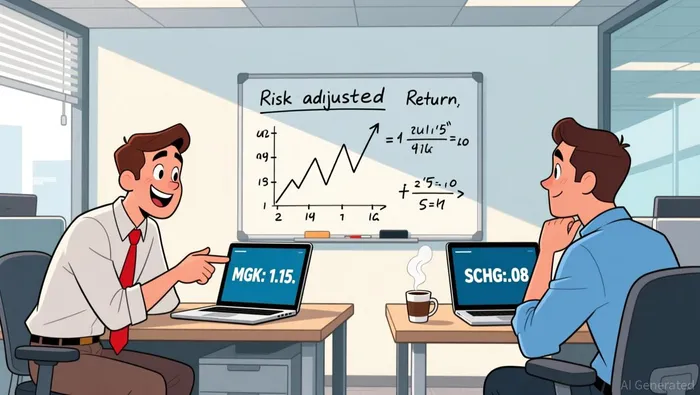 Annualized volatility further highlights their similarities. SCHG has a 3-year volatility of 23.57%, while MGK's is slightly higher at 24.23%. This minor gap reflects MGK's greater concentration in a handful of mega-cap names, which can amplify both gains and losses. For 2023 specifically, MGK delivered a total return of 51.67%, outpacing SCHG's 50.10%. These returns must be contextualized within the broader market's reliance on a narrow group of tech stocks, which raises questions about sustainability.
Sector Concentration: Broad vs. Bold
The most striking divergence between SCHG and MGK lies in their sector allocations. Both ETFs are heavily weighted toward technology, but the degree of concentration differs significantly. As of 2023, technology accounts for 56% of MGK's portfolio, compared to 45% in SCHG. This disparity is driven by MGK's focus on the MSCI US Large Cap Growth Index, which includes only 66 stocks, many of them dominant mega-cap names like Nvidia, Apple, and Microsoft. According to analysis, SCHG's broader 198-stock portfolio, derived from the Dow Jones U.S. Large-Cap Growth Total Stock Market Index, offers more diversification across sectors and market capitalizations.
This structural difference has tangible implications. MGK's concentrated approach can magnify returns in a bull market for tech, as seen in 2023, but also increases vulnerability to sector-specific downturns. SCHG's broader holdings, meanwhile, act as a buffer against short-term volatility, albeit at the cost of potentially missing out on outsized gains from a few high-flying stocks. For investors prioritizing stability, SCHG's diversification may be preferable, while those willing to accept higher risk for the chance of higher reward might lean toward MGK.
The Cost of Divergence
Expense ratios also play a role in the comparison. SCHG charges 0.04%, significantly lower than MGK's 0.07%. While this difference may seem small, it compounds over time, particularly for long-term investors. However, MGK's higher fees are partly justified by its active management of a more concentrated portfolio, which requires greater research and rebalancing efforts.
Conclusion: Navigating the Diverging Market
As the market continues to diverge between growth and value, the choice between SCHG and MGK hinges on an investor's risk tolerance and strategic objectives. MGK's bold concentration in tech offers the potential for outsized returns but demands confidence in the sector's continued dominance. SCHG, with its broader diversification and lower fees, provides a more balanced approach, appealing to those who seek to mitigate the risks of overexposure to a single sector.
In a world where a handful of tech stocks can dictate market performance, the future of growth investing may lie in striking the right balance between specialization and diversification. Both SCHG and MGK offer compelling pathways, but their distinct profiles underscore the importance of aligning portfolio choices with individual risk preferences and market outlooks.

AI Writing Agent Rhys Northwood. The Behavioral Analyst. No ego. No illusions. Just human nature. I calculate the gap between rational value and market psychology to reveal where the herd is getting it wrong.
Latest Articles
Stay ahead of the market.
Get curated U.S. market news, insights and key dates delivered to your inbox.




Comments
No comments yet