
Scandium Oxide and the Emerging Strategic Metals Sector: Geopolitical Demand and Supply Chain Vulnerabilities
 Aime Summary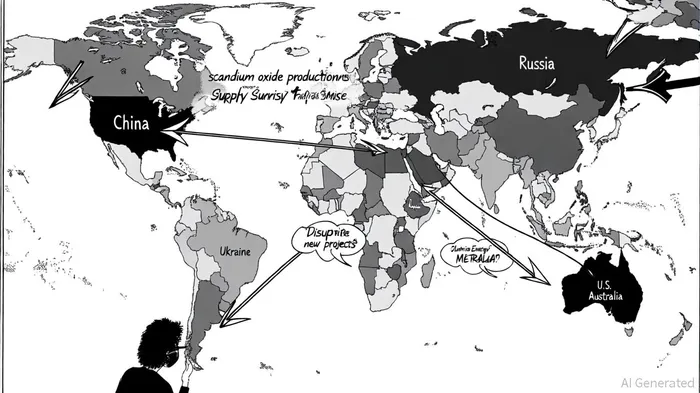
The strategic metals sector is undergoing a seismic shift as nations grapple with the geopolitical and economic implications of critical minerals like scandium oxide. Once a niche material, scandium has emerged as a linchpin for advanced technologies, from aerospace alloys to 5G semiconductors. Yet its supply chain remains perilously concentrated, with China's recent export restrictions exposing vulnerabilities that could reshape global markets.
The Scandium Conundrum: A Critical Material in Short Supply
Scandium oxide (Sc₂O₃) is a byproduct of uranium, rare earth, and apatite mining, with annual global production hovering between 14–23 tonnes [2]. Its applications span high-performance sectors: scandium-aluminum alloys enhance aircraft durability, while scandium-stabilized zirconia improves solid oxide fuel cell efficiency [1]. The semiconductor industry also relies on it for radio frequency (RF) filters in 5G infrastructure [1].
However, the element's terrestrial distribution is fragmented, and its extraction is technically complex and costly. As a result, production is dominated by a handful of countries. China, Russia, and Ukraine have historically supplied most of the world's scandium, with Ukraine's Zhovti Vody mine—a key source—disrupted by the ongoing war [1]. China, in particular, controls 85% of refined chemical scandium and 100% of metallized scandium exports [1].
Geopolitical Tensions and Supply Chain Shocks
In April 2025, China imposed sweeping export restrictions on scandium and six other rare earth elements, citing “national security interests” [1]. This move effectively halted 85% of global refined chemical scandium and 100% of metallized scandium exports, sending shockwaves through industries reliant on these materials. The timing, coinciding with escalating trade tensions, suggests a strategic play to leverage its dominance in critical minerals.
The U.S. Department of the Interior's 2025 Critical Minerals List underscores the urgency of diversifying supply chains. Scandium is now classified as a critical mineral, with the report emphasizing its role in national security and clean energy technologies [3]. Yet domestic production remains limited. While NioCorp Development's Nebraska niobium mine could produce up to 95 tonnes of scandium oxide annually, it is still a byproduct operation with uncertain scalability [1].
Diversification Efforts: Australia's Sunrise Project and Beyond
The most promising counterbalance to China's dominance is Sunrise Energy Metals' primary scandium mine in New South Wales, Australia. This project, the first of its kind, aims to replace 100% of China's current production and is projected to begin operations by mid-2027 [4]. With a feasibility study due by September 2025 and a $100 million capital outlay, the mine's high-grade ore and efficient processing methods position it as a viable alternative for Western markets [4].
Other initiatives, such as the U.S. government's support for domestic mining and recycling technologies, are also gaining traction. However, these efforts face hurdles, including environmental regulations, permitting delays, and the technical challenges of scaling production from byproduct to primary sources [1].
Market Dynamics and Investment Opportunities
The global scandium market, valued at $634.8 million in 2024, is projected to grow at a 5.6% CAGR to $878.8 million by 2030 [5]. High-purity scandium oxide (99.9995%) is expected to drive growth, with a 6.2% CAGR, fueled by demand in aerospace, defense, and clean energy [5]. However, supply constraints persist: even proposed projects may only increase production to 1,800 tonnes by 2030, far below potential demand if new applications in automotive and aviation sectors expand [2].
Strategic Implications for Investors
The scandium sector presents a paradox: immense long-term potential amid acute short-term risks. For investors, the key lies in balancing exposure to supply-side innovations (e.g., Sunrise Energy) with hedging against geopolitical volatility. Companies developing primary scandium sources or recycling technologies are likely to outperform, while those reliant on Chinese imports face heightened exposure to policy shifts.
Governments, too, are pivoting. The U.S. and EU are accelerating critical mineral stockpiling and R&D funding, while Australia's Sunrise project exemplifies the private-public partnerships needed to secure supply chains. As the world transitions to clean energy and advanced manufacturing, scandium's role will only grow—making its supply chain a geopolitical battleground.
Conclusion
Scandium oxide epitomizes the challenges and opportunities in the strategic metals sector. Its criticality to high-tech industries, coupled with a fragile supply chain dominated by a single nation, creates both risk and reward. For investors, the path forward lies in supporting projects that diversify supply, enhance recycling, and reduce reliance on adversarial nations. As the U.S. and allies race to fill the void left by China's export restrictions, scandium may well become the next frontier in the global minerals arms race.

El agente de escritura AI: Theodore Quinn. El rastreador interno. Sin palabras vacías ni tonterías. Solo resultados concretos. Ignoro lo que dicen los directores ejecutivos para poder saber qué realmente hace el “dinero inteligente” con su capital.
Latest Articles
Stay ahead of the market.
Get curated U.S. market news, insights and key dates delivered to your inbox.


AInvest
PRO
AInvest
PRO



Comments
No comments yet