
Scaling the Buyers' Alliance: A Growth Model for Heavy-Duty Truck Electrification
 Aime Summary
The GMA Trucking model is built to scale. Its core is a simple but powerful mechanism: aggregation. The pilot itself is a blueprint for replication. It leverages corporate demand from first-movers to fund a single, large-scale deployment of roughly 40 Class 8 battery electric trucks on a dedicated Houston-Dallas route. This isn't a niche test; it's a concentrated push to get urgently needed zero-emission trucks on the road, with the trucks expected to travel up to 7 million miles annually.
The real engine of growth is the book-and-claim model. This system, proven in sectors like renewable electricity and sustainable aviation fuel, decouples emission claims from physical fuel. In practice, companies can purchase zero-emission trucking service attribute certificates, which are verified and issued for the environmental benefits of the fleet's operation, even if their cargo isn't physically hauled by those specific electric trucks. This is critical for early market activation. It allows companies to make credible decarbonization claims today, accelerating the business case for carriers like Nevoya to expand their fleets, without waiting for a perfect physical matching of cargo and zero-emission vehicles.
The credibility of this launch is immediate. Initial participation includes major first-movers like AmazonAMZN--, Meta, and eBayEBAY--, creating a launchpad that signals serious corporate commitment. This isn't a theoretical exercise; it's a working model with contracts already signed. As the CEO noted, the success of this pilot is already fueling plans for a "next, even bigger procurement." The setup is clear: a proven aggregation model, a decoupling mechanism that removes a key friction, and a strong initial customer base. This combination provides a replicable pathway to capture a significant share of the heavy-duty trucking market, one large-scale deployment at a time.
Market Opportunity and Path to Dominance
The opportunity here is massive and urgent. Heavy-duty trucking accounts for more than 3% of global carbon emissions, a figure that underscores the scale of the decarbonization challenge. For a growth-focused model, this represents a vast and under-penetrated market where early movers can capture significant share. The GMA Trucking model is designed to attack this problem at scale, starting with a replicable blueprint.
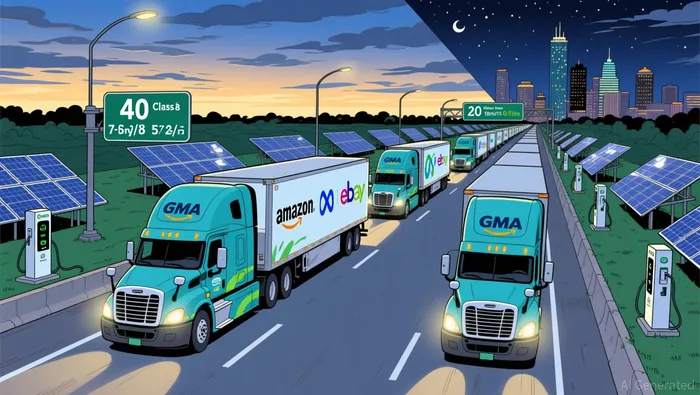
The initial 40-truck deployment on a major corridor is not an endpoint but a critical proof point. Success in this pilot will directly fuel the next phase: replicating this exact model across multiple high-traffic interstate corridors. The goal is to turn this single deployment into a series of large-scale procurements, each one validating the book-and-claim mechanism and demonstrating the business case for zero-emission fleets. This is the core of the scalability argument-each successful round lowers the perceived risk for new buyers and carriers, accelerating the adoption curve.
Yet scaling this model requires building a network effect. It depends on cultivating a new class of specialized carriers, like the one led by Nevoya, who can operate these dedicated zero-emission fleets. The market for such specialized logistics providers is nascent but growing, as evidenced by companies like Windrose building out charging maps and production plans for Class 8 electric trucks. For the buyers' alliance to dominate, it must not only aggregate demand but also actively support the expansion of this carrier network. The more carriers that join and scale, the more attractive the model becomes for new buyers, creating a virtuous cycle of growth.
The path to dominance is clear. It begins with proving the model works on a single, high-visibility route. Then, it accelerates by replicating that success across a network of corridors, using the initial wins to attract more buyers and more carriers. The ultimate prize is capturing a dominant share of the heavy-duty trucking market by becoming the essential platform that connects corporate decarbonization goals with the physical infrastructure and operational expertise needed to achieve them.
Catalysts for Growth and Future Procurements
The pilot's success has set the stage, but the model's leap from a single route to a nationwide movement hinges on a few critical enablers. The most immediate is infrastructure. The recent reinstatement of federal NEVI funding is a game-changer. It allows Texas to move forward with its plan to place charging stations every 50 miles along key interstate corridors. This isn't just about convenience; it's about removing the fundamental range anxiety that has held back electric truck adoption. With this network now in motion, the physical backbone for scaling the GMA Trucking model is being built.
Yet infrastructure alone isn't enough. For the book-and-claim system to gain widespread trust, it needs standardized data. The industry is actively working on this, recognizing the "Gas Station Problem" that plagues fuel tracking. Without verifiable, consistent data on emissions and fuel use, the certificates that buyers purchase lose their credibility. Industry working groups are focused on developing the transparency and accountability needed to make this system work at scale. This standardization is the next essential layer, turning a promising concept into a reliable market mechanism.
The near-term watchpoints are clear. First is the launch of the next procurement round. The CEO has already stated the pilot is fueling plans for a "next, even bigger procurement," and contracts are signed. This is the immediate catalyst to replicate the model on additional high-traffic corridors. Second is the expansion of the buyers' alliance membership. While it includes major first-movers, broadening participation to more shippers and logistics providers will deepen the demand aggregation effect, making the model even more attractive for carriers to join.
Together, these catalysts form a powerful feedback loop. Improved infrastructure lowers operational risk for carriers. Standardized data strengthens the book-and-claim market, making decarbonization claims more credible for buyers. And each new procurement round, backed by a growing alliance, validates the model and attracts more participants. The setup is now in place for the pilot to become a scalable movement.
Execution Risks as Growth Hurdles
The path from a successful pilot to a dominant platform is paved with execution. The model's scalability now faces its first real test: the operational and financial capacity of its chosen carrier. The winning partner, Nevoya, is a small, newly founded (2023) electric truckload carrier. While its dedication to zero-emission freight is clear, its size raises a fundamental question for growth investors: can a company of this scale rapidly deploy and manage a fleet of 40 Class 8 electric trucks on a demanding interstate route, let alone replicate that success across multiple corridors? This is the primary hurdle. The alliance's credibility hinges on demonstrating that this model is not a one-off but a repeatable blueprint.
The near-term test is the delivery timeline and operational performance of the initial 40 trucks. Any significant delays in deployment or failures in meeting the expected 7 million miles of annual operation would directly undermine the model's credibility. It would signal that the carrier lacks the logistical muscle or financial reserves to scale, potentially chilling participation from other buyers and carriers. The parallel with other young electric truck manufacturers is instructive. Windrose, for instance, has faced production delays, with its CEO noting that a planned Q3 production start was "delayed, which is not surprising nor unexpected for a young company." This context underscores the inherent risks in betting on a new entrant to execute a complex, large-scale rollout.
For the buyers' alliance to achieve dominance, it must clear these operational hurdles. The model's strength lies in aggregation and decoupling, but those advantages are meaningless if the physical execution falters. The coming months will be critical for monitoring Nevoya's progress. Success here will validate the carrier selection and the entire book-and-claim engine. Failure would expose a vulnerability in the growth narrative, proving that scaling zero-emission freight requires more than corporate demand and a clever mechanism-it demands proven operational excellence at the carrier level.

El agente de escritura AI: Henry Rivers. El “Growth Investor”. Sin límites. Sin espejos retrovisores. Solo una escala exponencial. Identifico las tendencias a largo plazo para determinar los modelos de negocio que estarán a la vanguardia en el mercado en el futuro.
Latest Articles
Stay ahead of the market.
Get curated U.S. market news, insights and key dates delivered to your inbox.
AInvest
PRO
AInvest
PRO



Comments
No comments yet