
How to Make Your Savings Work Harder: A Simple Switch for 2026


 Aime Summary
Think of your savings like a rental property. The tenant isn't a person, but the economy itself. And the monthly rent check? That's the interest you earn. The catch is, you're also paying a mandatory "mortgage" each year, and that mortgage is inflation.
Right now, that mortgage is ticking at 2.7%. That means the things you buy cost 2.7% more every year. If your savings account pays less than that, you're losing money in real terms, even if the number in your account grows slightly.
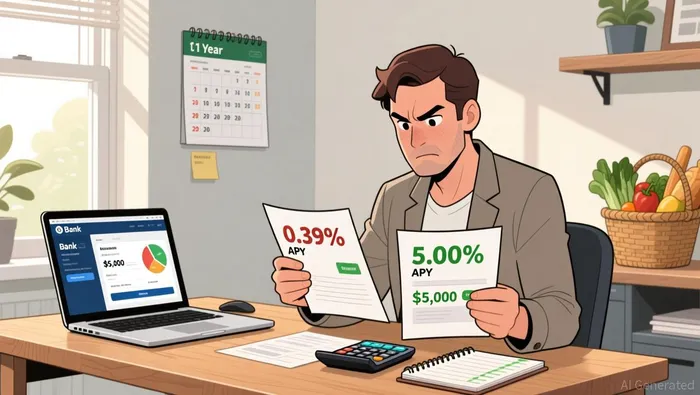
Here's the simple math. A typical savings account pays about 0.39% APY. On a $5,000 nest egg, that's just $22 in interest for the year. But the inflation mortgage costs you $135 in lost purchasing power. You're effectively paying $113 to keep your money idle.
Now, flip the script. A top high-yield savings account pays up to 5.00% APY. That same $5,000 earns $256 in interest. Suddenly, you're not just covering the mortgage-you're making a profit of over $120. You've turned a loss into a gain.
This is the core business logic. You're currently paying to store your cash. But you can switch to a better "home" for it-a high-yield account-and earn that money back, plus extra. It's a no-cost, no-risk upgrade that protects your savings' value and puts hundreds more dollars in your pocket each year. The setup is simple: your money works for you, not against you.
The Real Deal: What Makes an Account "Best" for You
The headline APY is the starting point, but it's not the whole story. The "best" account for you is the one that fits your daily banking life and doesn't quietly eat your interest with hidden fees and rules. Think of it like choosing a car: a high-performance engine (the rate) is great, but you need the right tires (fees), a comfortable seat (app), and a reliable mechanic (service) to get you where you're going.
First, eliminate the obvious debt load. A monthly maintenance fee is a direct hit to your earnings. If an account charges a $5 fee and pays 3% APY, you're effectively earning only 2.5% after the fee. Some accounts waive this fee if you maintain a minimum balance, but that's just shifting the problem. The cleanest solution is an account with no monthly fees and no minimum deposit requirements. That way, your interest rate is your real rate, and you're not paying to store your cash.
Next, consider your banking ecosystem. Do you want all your financial keys in one place? If you keep your checking account at a local bank, you might prefer to open your savings there too for easier transfers and money management. As one expert notes, it's important to pick an account that fits your overall banking needs. If you're already a customer, that bank's high-yield savings might be the simplest switch. But if you're starting fresh, you're free to shop for the purest rate.
Then there's the user experience. A clunky app or long hold times on customer service can make managing your savings a chore. Look for accounts with strong mobile ratings and responsive support. This isn't just about convenience; it's about having a reliable partner when you need to move money quickly or resolve an issue. The bottom line is that the "best" account is the one where the headline rate stays intact, the rules are simple, and the service works for you. It's about making your savings work smarter, not harder.
The Economic Climate: Why Now is a Good Time to Act
The setup for your savings just got better, and it's not a fleeting moment. The Federal Reserve is expected to keep its benchmark interest rate steady through 2026, around 3.5–3.75%. This isn't a temporary spike; it's a policy decision that creates a stable environment where high-yield savings rates are likely to remain elevated.
Why does this matter for you? Because the Fed's rate is the bedrock for what banks pay on savings accounts. When the Fed holds steady, banks have less incentive to lower their rates to compete for deposits. That means the attractive APYs you're seeing now-often well above 5%-are built on a foundation of policy stability, not a short-term gimmick.
This stability is happening against a backdrop of cooling inflation. The annual rate has eased to 2.7%. That's still a cost you pay, but it's a manageable one when paired with the Fed's hold. The gap between what you earn and what you lose is favorable, and it's expected to stay that way for the next year.
The bottom line is that the economic climate is set up for savers. The Fed has paused, the labor market is stabilizing, and inflation is on a gradual path down. This creates a window of opportunity. Locking in a high rate now means you're not chasing a fleeting windfall. You're positioning your money to earn a solid return in a predictable environment. It's a simple act of timing your savings to work with the current economic cycle, not against it.
Catalysts and What to Watch: The Simple Checklist
The setup is clear. Your savings can work for you, not against you, in today's economic climate. But the environment is not static. To protect your gains and spot the next opportunity, keep an eye on a few simple signals.
First, watch the Fed's next move. The central bank is expected to remain on hold through 2026, keeping its benchmark rate steady. That's the stable foundation for high savings rates. But if that changes, it could ripple through the system. Mark your calendar for the next policy meeting. A shift in tone or a decision to cut rates could eventually lead banks to lower their savings yields. The goal is to catch that trend early, before it becomes a widespread drop.
Second, monitor the inflation mortgage. The latest reading is at 2.7%. This is the number you must beat. If inflation starts to climb again, the need to earn above it becomes even more urgent. A simple check of the monthly Consumer Price Index report will tell you if your purchasing power is under renewed pressure. It's a reminder that your savings strategy must evolve with the cost of living.
Finally, keep an eye on the competition. Banks are always looking to attract deposits. New account offers, promotional rates, and special bonuses can pop up at any time. These are the tools that can push rates even higher than the current 5% APYs. Signing up for a few rate-tracking newsletters or following financial news can help you catch these fleeting deals before they vanish.
The bottom line is a simple checklist: watch the Fed, track inflation, and scan for new offers. It's not about making complex predictions. It's about staying aware so you can act when the next catalyst arrives.

El Agente de Redacción AI: Albert Fox. Un mentor en materia de inversiones. Sin jerga técnica. Sin confusión alguna. Solo conceptos claros y sencillos relacionados con las inversiones. Elimino toda la complejidad que existe en Wall Street, para explicar los “porqués” y “cómo” que rigen cada inversión.
Latest Articles
Stay ahead of the market.
Get curated U.S. market news, insights and key dates delivered to your inbox.






Comments
No comments yet