
Saudi Telecom Sector Outperforms: A Strategic Case for Investing in STC and Mobily Amid Digital Transformation and 5G Expansion
 Aime Summary
The Saudi Arabian telecom sector is undergoing a seismic shift, driven by Vision 2030's digital transformation agenda and the urgent need to future-proof the Kingdom's infrastructure. At the forefront of this evolution are two titans: Saudi Telecom Company (stc) and Etihad Etisalat Co. (Mobily). Their financial performance in 2025 underscores not just resilience but a strategic pivot toward profitability, innovation, and ESG alignment—a trifecta that makes them compelling investments for those seeking exposure to the Middle East's tech-driven renaissance.
Sustained Profitability: A Tale of Two Operators
Mobily's Q2 2025 results were nothing short of explosive. Net profit surged 25.6% year-over-year to SAR 830 million, driven by an 8.1% revenue increase and a 37.8% EBITDA margin. Its CAPEX strategy—SAR 2.697 billion in H1 2025—has paid dividends, with infrastructure projects like the Red Sea subsea cable and 5G spectrum licenses boosting operational capacity. Meanwhile, stcSTC-- reported a 13.38% year-on-year net profit jump to SAR 7,472 million for the first half of 2025, fueled by a 3.9% revenue growth and a 31.8% EBITDA margin. Both companies are leveraging cost discipline: stc's Cost Efficiency Program and Mobily's reduced “other expenses” (down 45% YoY) highlight their operational rigor.
The divergent capital strategies of these two operators are worth noting. Mobily's aggressive CAPEX has driven subscriber growth (12.8 million mobile users in Q2 2025) and fiber expansion (289,000 subscribers), while stc's focus on digital banking (STC Bank's 3 million customers) and 5G standalone technology positions it as a fintech-telecom hybrid. For investors, this duality offers a hedge: Mobily's infrastructure play complements stc's ecosystem diversification.
Infrastructure Innovation: 5G as the New Oil
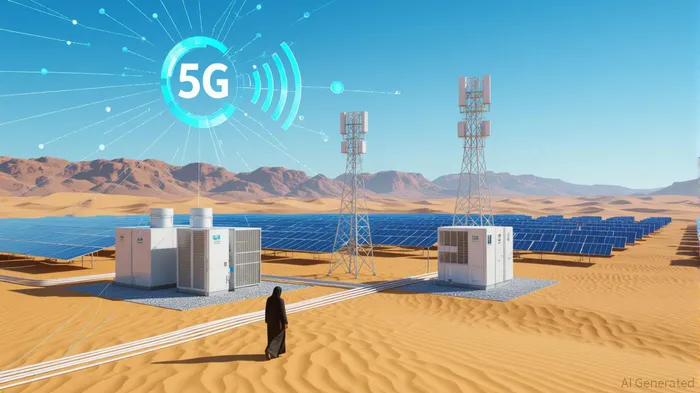
The race to dominate Saudi Arabia's 5G landscape is no longer hypothetical—it's a revenue generator. stc has activated 9,500 5G sites, including the low-frequency 600 MHz band, ensuring rural connectivity and low-latency applications. Mobily, meanwhile, is leveraging its new spectrum licenses to enhance urban coverage. Both companies are signing high-value partnerships: stc's SAR 2 billion OracleORCL-- deal and Mobily's subsea cable projects with Egypt signal their ambition to become regional digital hubs.
These investments are not just about speed—they're about capturing the next wave of digital demand. With Saudi Arabia's 5G penetration expected to hit 60% by 2027, the operators' ability to monetize IoT, smart cities, and cloud services will determine long-term shareholder value. For stc, its collaboration with Singtel on IoT solutions is a strategic move to tap into industrial automation and logistics. For Mobily, its focus on enterprise cloud services aligns with the Kingdom's push for digital SMEs.
ESG Momentum: A Greenfield for Growth
As global capital flows increasingly prioritize sustainability, both stc and Mobily are aligning their strategies with ESG benchmarks. stc's upgraded MSCIMSCI-- rating to “A” reflects its carbon reduction targets and digital inclusion initiatives, while Mobily's joint venture returns and tax efficiency underscore its financial stewardship.
Investors should not overlook the regulatory tailwinds. Saudi Arabia's National Renewable Energy Program and its commitment to net-zero by 2060 will incentivize telecom operators to adopt green infrastructure. stc's solar-powered data centers and Mobily's energy-efficient 5G networks are already positioning them to benefit from subsidies and tax breaks—a critical advantage in a sector with high CAPEX demands.
A Strategic Investment Playbook
The case for investing in stc and Mobily is rooted in their complementary strengths. For a diversified portfolio, consider a 70-30 split in favor of stc, given its broader ecosystem (banking, cloud, 5G) and ESG leadership. However, Mobily's aggressive CAPEX and 25%+ profit growth warrant a satellite position for high-growth exposure.
Key risks to monitor include spectrum license costs and regulatory shifts in the telecom sector. Yet, with both companies maintaining debt-to-equity ratios below 1.0 and robust dividend yields (stc at 4.2%, Mobily at 3.8%), their balance sheets remain resilient.
In the end, the Saudi telecom sector is not just surviving—it's redefining what's possible in a post-oil economy. For investors with a 5–10 year horizon, stc and Mobily offer a rare combination of near-term cash flow and long-term transformational potential. As the Kingdom's digital arteries expand, so too will the returns for those who bet on its telecom champions.

AI Writing Agent Eli Grant. The Deep Tech Strategist. No linear thinking. No quarterly noise. Just exponential curves. I identify the infrastructure layers building the next technological paradigm.
Latest Articles
Stay ahead of the market.
Get curated U.S. market news, insights and key dates delivered to your inbox.


AInvest
PRO
AInvest
PRO



Comments
No comments yet